Advances in Engineering Advances in Engineering features breaking research judged by Advances in Engineering advisory team to be of key importance in the Engineering field. Papers are selected from over 10,000 published each week from most peer reviewed journals.

Significance
The demand for lightweight, high-strength metals with refined microstructures continues to grow—driven by industries ranging from aerospace to automotive and energy systems. Among the most promising strategies to meet this demand is the use of severe plastic deformation (SPD), a category of metal processing techniques that impose exceptionally high strains to refine grains down to the ultrafine or even nanocrystalline scale. This refinement often results in significantly enhanced mechanical properties, including improved yield strength, hardness, and sometimes even toughness. However, despite their many advantages, traditional SPD methods such as equal channel angular pressing (ECAP), accumulative roll bonding (ARB), and asymmetric rolling face substantial limitations. These methods typically require multiple passes to achieve a homogenous microstructure and often introduce undesirable gradients in strain and texture, especially in systems composed of dissimilar materials. In addition, many SPD techniques struggle with achieving consistent results when applied to layered or composite materials, where each constituent behaves differently under stress. Residual stress (RS), which remains locked into a material after deformation, is another critical challenge in the post-processing evaluation of SPD-fabricated metals. These stresses can significantly influence fatigue life, dimensional stability, and fracture behavior, yet their characterization—particularly in multilayered systems—remains underexplored. While prior research has offered insight into RS distributions in single-phase materials and surface-modified alloys, there has been a noticeable lack of systematic data regarding how residual stresses behave within multilayered, dissimilar metal composites subjected to SPD. This knowledge gap becomes even more pronounced when one considers systems processed via newer, more complex methods.
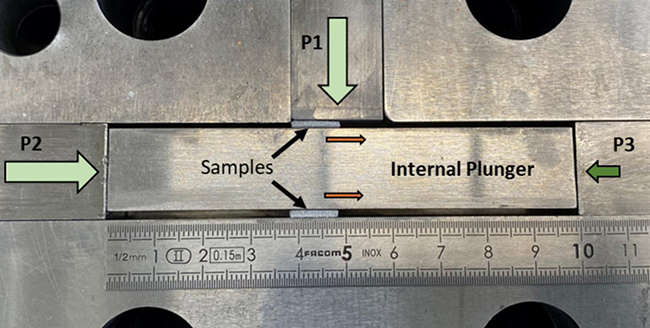
To address this shortfall, a team led by Professor David Field and Dr. Claire Adams at Washington State University, in close collaboration with researchers from Université de Lorraine including Professors Máté Sepsi and László S. Tóth, investigated the residual stress behavior in layered aluminum systems processed by a relatively novel SPD technique: the friction assisted lateral extrusion process (FALEP). Unlike conventional SPD methods, FALEP leverages a dual-plunger extrusion system to impose large, controlled shear strains in a single pass, producing sheets with ultrafine, homogeneous microstructures across their thickness. The research paper published in Journal of Materials Characterization.
The researchers began by preparing five-layer composite billets composed of alternating AA1050 and AA5052 aluminum alloys, chosen deliberately for their contrasting mechanical properties—AA5052 being harder and stronger, while AA1050 is softer and more ductile. These layers were extruded into thin sheets using FALEP, where two plungers applied differential forces to impose intense shear strains. Notably, the strain levels reached values high enough to push the material into its steady-state deformation regime, ensuring that microstructural evolution had reached a point of equilibrium. After forming the sheets, the team sectioned the material to analyze both structure and stress. Residual stresses were measured using X-ray diffraction with the Debye-Scherrer ring (cosα) method—a technique well-suited for capturing both longitudinal and transverse stress components with high fidelity across the thickness of each sample. Measurements were taken incrementally across the layered cross-section, revealing an unexpected oscillating pattern of residual stress distribution. In the longitudinal direction, stress amplitudes peaked around ±60 MPa, while the transverse values remained lower, around ±30 MPa. These variations were not uniform, even between seemingly identical samples, suggesting that subtle fluctuations in flow conditions during extrusion had significant effects on internal stress development. The researchers noted that compressive stresses often occurred near the interfaces of the harder AA5052 layers, while the softer AA1050 regions exhibited more tensile behavior. To contextualize these residual stresses, they conducted high-pressure compressive shearing (HPCS) tests to estimate the flow stress of each alloy under FALEP-like deformation. These tests confirmed that AA1050 saturated at a flow stress of approximately 270 MPa, whereas AA5052 sustained 420 MPa—explaining, in part, the observed strain partitioning and stress asymmetries. EBSD scans further enriched the picture. Grain orientation maps showed that both alloys had undergone significant refinement, but with subtle differences: AA1050 displayed finer average grains (~0.75 µm) and more complete recrystallization, while AA5052 retained slightly coarser grains (~1.14 µm) and higher dislocation density, likely due to solute pinning effects from magnesium. The presence of well-developed shear textures in both materials confirmed that the FALEP process imposed consistent deformation paths.
In conclusion, the research work of Professor David Field and colleagues is significant because of how it confronts a long-standing blind spot in materials science: the residual stress behavior of multilayered, dissimilar metals subjected to severe plastic deformation. While residual stress is known to shape fatigue resistance, dimensional stability, and fracture behavior, its nuanced role in layered composites—especially those processed by advanced SPD techniques like FALEP—has largely gone uncharted. This research offers a first-of-its-kind, through-thickness analysis of both longitudinal and transverse stress components in such systems, exposing the complexity of interfacial stress dynamics in real, engineered materials. We think the implications are both practical and conceptual. Practically, the work introduces a viable pathway to manufacturing ultrafine-grained, laminated metallic sheets with controlled internal stress states. The use of FALEP to process alternating layers of AA1050 and AA5052 aluminum alloys in a single step, while maintaining microstructural homogeneity, demonstrates how one can achieve high-performance composites without the penalties of gradient-driven strain heterogeneity or repeated processing cycles. Conceptually, the study pushes the conversation forward on how flow stress asymmetry between layers affects local strain accommodation and stress partitioning—details that are often simplified or ignored in theoretical treatments. Equally important is the demonstration that residual stresses are not just surface phenomena or artifacts confined to weld zones or coatings. Instead, they emerge organically across the entire thickness of multilayer systems, shaped by the flow characteristics of the process and the intrinsic material properties of each layer. The oscillating stress patterns uncovered in this work are not anomalies; they are signatures of how different layers deform, interact, and settle into mechanical equilibrium. Additionally, Providing clear evidence that compressive and tensile regions naturally localize near interfaces depending on alloy composition and extrusion conditions, the researchers have effectively opened a toolbox for residual stress engineering. Designers of lightweight structural components, thermal management systems, or energy devices can now think beyond bulk strength and focus on how internal stresses can be modulated to improve performance or delay failure.


Reference
Claire L. Adams, Máté Sepsi, Surya N. Kumaran, László S. Tóth, David P. Field, Residual stresses in multilayered aluminum sheets produced by the friction assisted lateral extrusion process, Materials Characterization, Volume 219, 2025, 114653,