Advances in Engineering Advances in Engineering features breaking research judged by Advances in Engineering advisory team to be of key importance in the Engineering field. Papers are selected from over 10,000 published each week from most peer reviewed journals.

Significance Statement
The degree to which masonry vaults are susceptible to seismic hazard is quite high as demonstrated by the collapse of many masonry churches in the recent past. This can be attributed to the fact that the masonry vaults lack sufficient capacity to redistribute the seismic load between the masonry piers of the building. As a result, the preservation of historic vaults has devolved to the application of advanced materials and new technologies on the ancient structures. As anticipated, the assessment of their effects has assumed key relevance. Presently, from an analytical viewpoint, plastic analysis techniques are now popularly used to determine the ultimate load-carrying capacities of masonry arch as opposed to convectional retrofitting techniques such as external reinforcement with steel plates, surface concrete coating and welded mesh, which have proven to be impractical, time consuming and add a considerable mass to the masonry structure. This paper aspires to improve on a novel technology of retrofitting of masonry vaults by means of wrapping carbon fiber reinforced polymers around a high resistance mortar core cast and molded in situ.
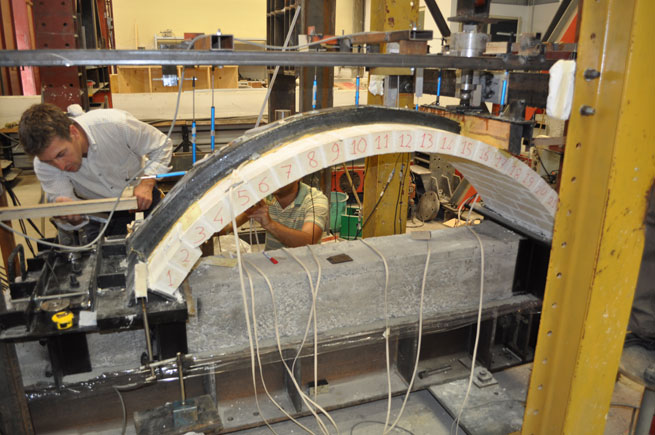
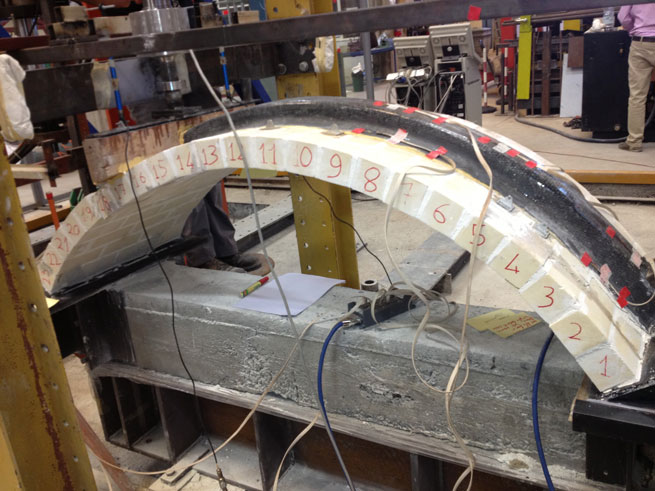
Laura Anania and Giuseppe D’Agata from the Department of Civil Engineering and Architecture at University of Catania in Italy investigated the limit analysis of vaulted masonry structures strengthened using new technique applying carbon fiber reinforced polymers. The two researchers aimed at discussing the efficiency of analytical models validated by means of empirical investigations carried out on masonry arches reinforced with the innovative technology based on the use of carbon fiber reinforced polymer strips, with a special configuration called the ‘‘Ω-wrap”. Their research work is now published in the journal, Construction and Building Materials.
At first, several assumptions were postulated in order to legitimize the proposed limit analysis formulation. Secondly, the team set up a scaled model of the barrel vault which was retrofitted with Ω-wrap reinforcement. The researchers then derived the ultimate strength using the theoretical prediction from the undertaken experiments. They then developed the novel incremental step-by-step lower bound limit analysis approach while taking into consideration the shear failure mechanism at each mortar joint. Eventually, shear strength was assessed by the Mohr-Coulomb friction law for the mortar joint and by other nonlinear Italian Code relations for carbon fiber reinforced polymers Ω -Wrap reinforcement.
The authors of this paper observed that the proposed formulations results were in excellent agreement with the available original tentative data, derived from tests carried out by the authors on calcareous voussoirs masonry barrel vaults, exclusively in terms of pick load and final collapse mechanism reached at the first cycle of loading. More so, they observed that the limit load and mechanism provided by each intermediate step of this heuristic procedure seem to capture the evolution of the damage in the structure, reinterpreted in terms of sequence of different limit kinematic mechanisms.
As illustrated, an approximate technique for approaching the lower bound limit analysis of masonry arch reinforced by carbon fiber reinforced polymers has been developed. Anania and D’Agata have highlighted that the proposed formulations are in good agreement with the available original experimental data derived from tests established by the same researchers. Moreover, the proposed analytical procedure has been seen to be able to highlight all the capabilities of the new strengthening technique. Lastly, the described configuration has an added advantage in that it allows the resulting carbon fiber reinforced polymer reinforced ribbed vault to assume the necessary strength, membranal and flexural rigidity, so as to ensure the aforementioned seismic action redistribution capability and to avoid local collapse of the vault.

Reference
Laura Anania, Giuseppe D’Agata. Limit analysis of vaulted structures strengthened by an innovative technology in applying CFRP. Construction and Building Materials volume 145 (2017) page 336–346
Go To Construction and Building Materials