Advances in Engineering Advances in Engineering features breaking research judged by Advances in Engineering advisory team to be of key importance in the Engineering field. Papers are selected from over 10,000 published each week from most peer reviewed journals.

Supersonic combustion occupies a uniquely demanding corner of reactive flow physics, where shock dynamics, rapid thermochemical transients, and tightly coupled energy–chemistry interactions coexist on spatial and temporal scales that strain even modern computational resources. Applications such as scramjet combustors and rotating detonation engines exemplify this challenge: they rely on sustained combustion in highly compressible environments while demanding predictive fidelity sufficient to guide engineering design. In this context, the accurate representation of chemical kinetics becomes a dominant cost driver, often rendering simulations with detailed chemistry impractical for realistic geometries or long integration times. Tabulated chemistry models, particularly flamelet and flamelet/progress variable formulations, emerged as an elegant response to this limitation. By projecting the complex evolution of multi-species chemistry onto a low-dimensional manifold, these approaches dramatically reduce computational expense while retaining the essential structure of turbulent flames. Their success in low-Mach and moderately compressible regimes is well established, and over the past decade they have been extended to increasingly aggressive flow conditions. However, such extensions raise a fundamental question that has remained insufficiently examined: whether modeling assumptions inherited from flame-dominated regimes remain valid once shock-induced combustion and detonation dynamics become dominant. Unlike low-Mach flows, compressible reacting systems must explicitly solve the energy equation and satisfy an equation of state that links temperature, density, and pressure. In these regimes, temperature is no longer a passive output of chemistry but a dynamically active variable that governs reaction rates, shock strength, and wave propagation speed. Many tabulated chemistry strategies therefore introduce approximations to reconcile transported energy with tabulated thermochemical quantities, often assuming frozen composition or simplified temperature–energy relationships. While such approximations may be benign for weakly compressible flames, their validity under the extreme thermodynamic excursions of detonations is far from guaranteed. To this end, new research paper published in Proceedings of the Combustion Institute and led by Professor Alexandra Baumgart from the Department of Mechanical and Civil Engineering at California Institute of Technology together with Professor Matthew Yao from University of New Brunswick, and Dr. Guillaume Blanquart (currently at Lawrence Livermore National Laboratory), the researchers developed a rigorous a priori assessment framework for compressible flamelet/progress variable models in supersonic and detonative combustion. By systematically comparing flamelet-based tabulations against exact detonation solutions, they identified specific thermodynamic and chemical assumptions that fail under shock-driven conditions. The work establishes clear limits of validity for existing models and motivates regime-consistent tabulation strategies that reproduce flames and detonations without approximation.
The research team examined how compressible tabulated chemistry models close the governing equations of reacting flow and how their approximations interact with detonation physics. The authors focus on tri-variate tabulations involving the progress variable, temperature, and density, reflecting common practice in recent supersonic combustion studies. Canonical one-dimensional configurations serve as the foundation for analysis, allowing direct comparison between flamelet-based representations and exact detonation solutions. The authors selected a premixed hydrogen–oxygen–argon system as a representative test case. Steady premixed flamelets are computed under prescribed unburnt conditions, while corresponding Zel’dovich–von Neumann–Döring detonation solutions are generated across a range of driving conditions. These datasets provide a controlled environment in which thermodynamic relationships and chemical source terms can be interrogated without the confounding influence of turbulence or geometry. By mapping both flames and detonations into progress-variable space, the authors expose how different combustion regimes populate distinct regions of thermochemical state space. They found that many tabulated chemistry models assume frozen composition when evaluating the equation of state, effectively treating molecular weight as a function of the progress variable alone. Analysis of conditional statistics from detonation data reveals that this approximation introduces only minor errors, even under strong compressibility. This result suggests that, for molecular weight, low-dimensional tabulation remains robust. The situation changes dramatically when examining the relationship between temperature and internal energy. Several widely used approaches rely on linearized or weakly nonlinear approximations derived from flamelet reference states. When these expressions are applied to detonation data, large discrepancies emerge, particularly near regions of peak reaction rate. Errors in temperature reconstruction on the order of hundreds of kelvin are observed, directly undermining the ability of the model to satisfy shock jump conditions. These thermodynamic inconsistencies propagate into macroscopic predictions, including detonation wave speed. The modeling of the progress variable source term further amplifies these issues. Analytical corrections intended to account for density and temperature effects improve upon uncorrected flamelet source terms but remain highly sensitive to fitting procedure and reference state selection. Even under optimal fitting, notable deviations from exact detonation source terms persist. In contrast, tabulations generated directly from detonation solutions reproduce both thermodynamic structure and chemical source terms without approximation.
In conclusion, the new work of Professor Alexandra Baumgart and colleagues demonstrate that flamelet-based tabulation, even when augmented with compressibility corrections, struggles to capture the internal structure of detonations. The core limitation lies not in the concept of tabulation itself, but in the choice of flamelets as the baseline manifold for regimes governed by shock-driven chemistry. This study makes a decisive contribution to the modeling of high-speed reacting flows by shifting the discussion from model development to model validity. Its central significance lies in demonstrating that the breakdown of flamelet/progress variable methods in detonation regimes is not incidental or implementation-specific, but structural. By tracing modeling errors back to fundamental thermodynamic assumptions, the work clarifies why seemingly reasonable extensions of flamelet models can yield misleading results when applied outside their original domain. For the combustion modeling community, this analysis provides a much-needed diagnostic framework. Rather than treating discrepancies in detonation simulations as calibration issues, the study shows that errors in temperature–energy coupling and source-term representation are intrinsic consequences of flamelet-based reference states. This insight helps explain prior reports of underpredicted wave speeds and altered detonation dynamics, grounding them in first-principles reasoning rather than numerical artifact.
The implications for practical applications are substantial. Rotating detonation engines and advanced scramjet concepts frequently operate in regimes where deflagration and detonation coexist or transition dynamically. The present work indicates that a single flamelet-based tabulation cannot be expected to span these regimes reliably. Instead, it suggests that regime-aware or hybrid tabulation strategies are required—approaches that respect the distinct thermochemical manifolds of flames and detonations rather than forcing one to approximate the other. More broadly, the paper reinforces an important modeling philosophy: reduced-order chemistry is only as good as the physical assumptions that underpin it. Computational efficiency cannot be pursued independently of thermodynamic consistency, particularly in compressible flows where energy coupling governs global behavior. By emphasizing a priori analysis over a posteriori validation, the study sets a rigorous standard for evaluating future tabulated chemistry models. Finally, this work opens clear avenues for future research. The demonstrated separation between flamelet and detonation manifolds suggests the feasibility of mixed tabulation frameworks that reproduce each regime exactly within its own domain. Developing such unified yet physically faithful models represents a critical step toward predictive simulation of next-generation propulsion systems. In this sense, the study does more than critique existing methods—it provides a roadmap for their evolution.
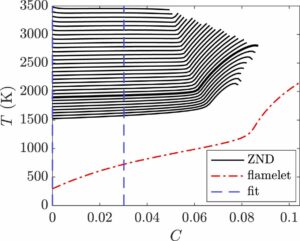
Image credit: Proceedings of the Combustion Institute, Volume 41, 2025, 105798,


Reference
Alexandra Baumgart, Matthew X. Yao, Guillaume Blanquart, Assessment of flamelet/progress variable methods for supersonic combustion, Proceedings of the Combustion Institute, Volume 41, 2025, 105798,