Advances in Engineering Advances in Engineering features breaking research judged by Advances in Engineering advisory team to be of key importance in the Engineering field. Papers are selected from over 10,000 published each week from most peer reviewed journals.

Significance
Hydrogels consist of polymer networks swollen with solvent. Their mechanical response can be altered substantially by changing the length of the polymer chains, the density of entanglements between them, and the properties of the surrounding liquid. Long, highly entangled chains are especially interesting because they can produce networks that combine high stiffness with considerable resistance to fracture while retaining nearly complete elastic recovery.
A widely used description of fracture in polymer networks is the Lake–Thomas model. It considers the elastic energy stored in polymer strands ahead of a crack and relates fracture toughness to the length of those strands. The underlying picture is essentially quasi-static: deformation proceeds slowly enough for stress to become distributed along each load-bearing chain before it breaks. Under those conditions, increasing strand length can increase the energy required for fracture.
Fast fracture creates a different physical situation. Near a crack tip, deformation is highly concentrated and can occur far more rapidly than the externally imposed loading would suggest. Stress must propagate along polymer chains, but movement of those chains is resisted by friction from the solvent and by constraints associated with entanglements. If the crack-tip deformation develops faster than the chains can relax, the assumption of approximately uniform loading along a strand no longer applies.
This creates a central question for highly elastic polymer networks. A material may appear extremely tough when loaded gradually, yet its resistance to a rapidly advancing crack may be controlled by a much more localized process. Understanding that difference requires separating the elastic response of the bulk material from the rate-dependent processes operating in the small region surrounding a crack tip. Yang and colleagues addressed this problem using single-network polyacrylamide hydrogels whose chain length, entanglement density, loading rate, and solvent viscosity could be systematically varied.
In a recent research paper published in the Proceedings of the National Academy of Sciences Dr. Hang Yang, Dr. Shuming Kang, Dr. Yujing Du, Professor David Weitz, and Professor Joost Vlassak from John A. Paulson School of Engineering and Applied Sciences at Harvard University the researchers established a strand-scale shear-lag description of dynamic fracture in highly entangled polymer networks. The model connects crack-tip fracture energy to the competition between stress transmission along polymer chains and viscous resistance to chain motion. They introduced a Weissenberg-like parameter that combines deformation rate, chain length, network length scale, and viscosity, allowing fracture data obtained under different conditions to be described within a common scaling picture. At slow deformation the model approaches the Lake–Thomas limit, whereas faster deformation produces localized strain, reduced dynamic toughness, and conditions associated with crack branching.
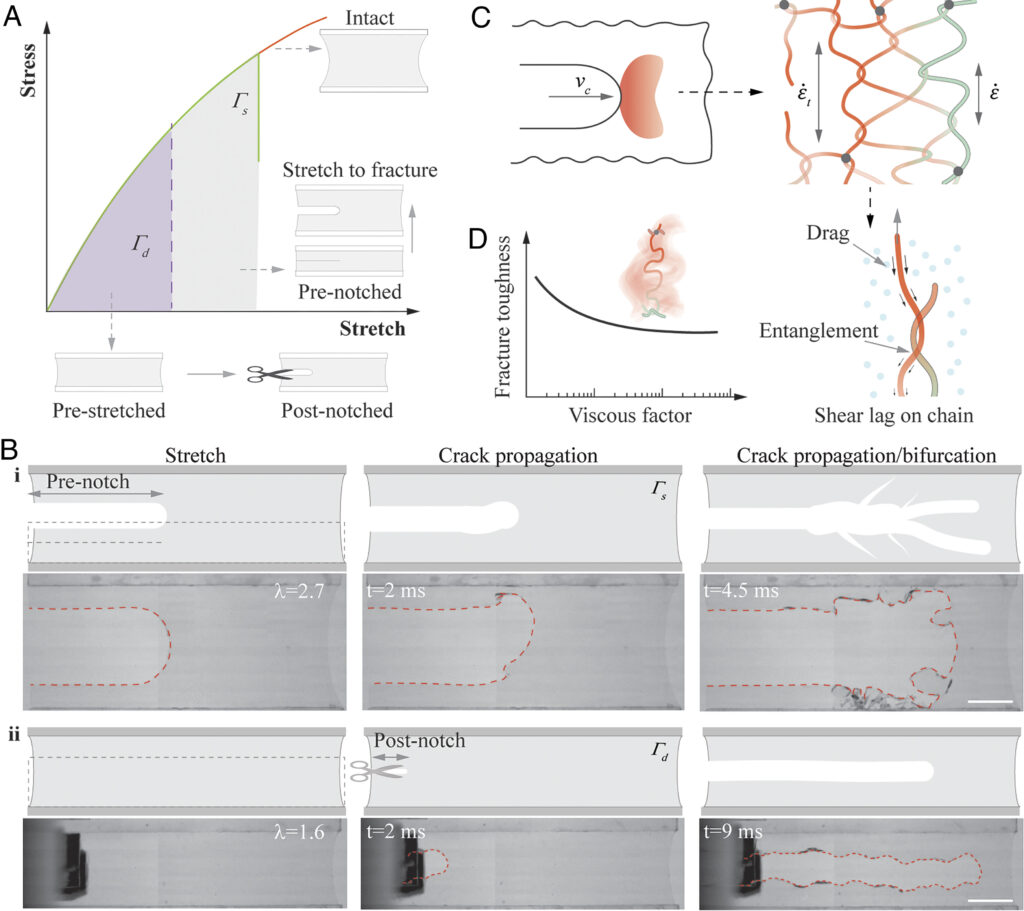
The authors studied changing when the crack was introduced and found when a hydrogel was notched before stretching, the existing crack experienced gradually increasing deformation as the sample was loaded. Long-chain, highly entangled gels could reach an apparent fracture toughness of roughly 1,300 J/m² before the crack propagated. Once propagation began, however, the crack accelerated rapidly and developed extensive branching.
A very different response occurred when an intact sample was first stretched and a notch was introduced afterward. Crack growth began at a substantially lower energy release rate. For long-chain gels, this dynamic fracture toughness was only about 230–260 J/m². Despite the large difference in the energy required to initiate propagation under the two protocols, rapidly moving cracks could approach the material’s shear-wave speed, measured at about 6.6 m/s in one of the highly entangled networks.
The distinction arose from the time available for relaxation near the crack tip. With a pre-existing notch, gradual loading allows some redistribution of stress along the chains before fracture starts. Introducing a notch into an already stretched specimen instead produces an abrupt crack-tip deformation. The local strain rate rises so quickly that relaxation becomes severely restricted. The material can consequently enter dynamic fracture at an energy well below the toughness inferred from slower loading.
Chain length strongly influenced this behavior. Long-chain networks displayed pronounced rate dependence and extensive crack bifurcation. Short-chain gels had much lower toughness, but their fracture response changed relatively little with loading rate and cracks propagated more smoothly. Increasing entanglement density also altered the crack dynamics: more densely entangled networks became stiffer and were increasingly susceptible to bifurcation and branching.
Changing the solvent provided another way to probe the mechanism without changing the polymer network itself. The researchers exchanged water for water–glycerol mixtures covering roughly three orders of magnitude in viscosity. The bulk tensile behavior remained nearly unchanged and highly elastic, yet fracture changed substantially. At a fixed loading rate, increasing viscosity reduced the apparent toughness of long-chain gels from about 1,340 J/m² in water to about 390 J/m² in pure glycerol. Branching also became progressively weaker and eventually disappeared. When the glycerol-swollen gels were loaded much more slowly, their toughness increased again, consistent with additional time for local relaxation.
The team developed a shear-lag model in which a polymer strand transfers tensile stress along its length while viscous resistance opposes chain motion. Short strands can approach a uniformly strained state, but long strands subjected to rapid deformation develop strongly localized strain. A Weissenberg-like dimensionless number was then introduced to compare the time scale of chain deformation with the time required for relaxation. It incorporates strain rate, chain length, network length scale, and viscous resistance. Experimental measurements obtained by changing loading rate, chain length, entanglement, and solvent viscosity followed the same general dependence on this parameter.
The important physical distinction is between fracture controlled by the total elastic energy available in a polymer strand and fracture controlled by how rapidly that energy can be redistributed near a moving crack. For highly entangled gels, the two pictures approach one another when deformation is sufficiently slow. Under faster conditions, viscous resistance prevents stress from spreading efficiently along long chains. Deformation becomes concentrated near the crack tip, reducing the effective region over which energy can be dissipated before a strand fails. This explains an initially counterintuitive result: making polymer strands very long can produce high quasi-static toughness without guaranteeing equally high resistance to dynamic fracture. At sufficiently large values of the Weissenberg-like parameter, the calculated fracture energy departs from the Lake–Thomas behavior and approaches a lower limiting value. Further increases in chain length no longer provide the increase in dynamic toughness that would be expected from a purely quasi-static description.
Crack branching can also be interpreted through this dissipation-limited picture. When the available energy exceeds what a single advancing crack can dissipate locally, the crack can divide, distributing energy among several fronts. The branching is therefore connected to the changing capacity of the crack-tip region to accommodate energy rather than simply to the amount of elastic energy stored in the sample.
The new model also brings several experimental variables into one physical description. Loading rate, solvent viscosity, polymer-chain length, and network structure appear different at the macroscopic level, yet each changes the balance between deformation and local relaxation. This provides a way to interpret why a hydrogel that behaves as an almost perfectly elastic material in ordinary mechanical testing can exhibit strongly rate-dependent fracture.
For the design and evaluation of soft materials exposed to rapid or cyclic deformation, the findings make the distinction between quasi-static and dynamic fracture toughness especially consequential. Resistance measured during slow loading need not describe the energy required for a crack to propagate once local deformation becomes too rapid for polymer chains to relax.


Reference
Yang H, Kang S, Du Y, Weitz DA, Vlassak JJ. Dynamic fracture and catastrophic crack branching in highly entangled hydrogels. Proc Natl Acad Sci U S A. 2026;123(38):e2603322123. doi: 10.1073/pnas.2603322123.