Advances in Engineering Advances in Engineering features breaking research judged by Advances in Engineering advisory team to be of key importance in the Engineering field. Papers are selected from over 10,000 published each week from most peer reviewed journals.

Significance Statement
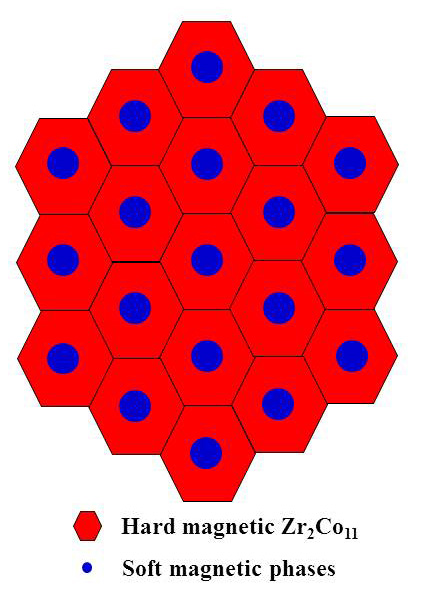
Supply constraint and rising price of rare earth (RE) elements hinder the development of permanent-magnet (PM) motors and generators with a clear performance and cost advantage [1]. In order to solve this issue, it is necessary to search for RE-free PM compounds with good intrinsic properties and develop high-performance PM. Potential candidates include rhombohedral Zr2Co11, orthorhombic HfCo7 and Hf2Co11, NiAs-type MnBi, L10 MnAl, tetragonal Mn2Ga, and DO22 Mn3Ga. Recent results in research and development of RE-free PM materials from David J Sellmyer and Kai-ming Ho’s groups show that rhombohedral Zr2Co11-based material is a promising candidate for the application of RE-free PM due to its large maximum energy product, high Curie temperature, and low price [2-4]. However, relatively low coercivity is unfavorable for further improvement of energy product of Zr2Co11-based nanocomposite materials whose schematic microstructure is shown in Fig.1. In this work, we have found a way to enhance the coercivity of Zr2Co11-based nanomaterials. The origin of coercivity enhancement was analyzed.
The role of Ti and Si additions in the magnetic hardening of rapidly-quenched Zr2Co11-based nanomaterials has been investigated. Nanocrystalline Zr17-xTixCo83 and Zr18Co82-ySiy are mainly composed of the hard magnetic rhombohedral Zr2Co11 phase and a small amount of soft magnetic orthorhombic Zr2Co11, hcp Co and cubic Zr6Co23 phases. Ti addition decreases the mean grain size of the soft magnetic phases, and thus increases coercivity and energy product from 1.6 kOe and 1.9 MGOe for x = 0 to 2.6 kOe and 3.9 MGOe for x = 2, respectively. Si addition enhances the measured magnetocrystalline anisotropy of the hard magnetic phase which increases the coercivity but slightly decreases the magnetization. This work shows that Ti has a positive effect on energy product through refinement of structure. Further improvement of magnetic properties for rapidly-quenched Zr2Co11-based ribbons may be obtained by grain alignment.
[1] M.J. Kramer, R.W. McCallum, I.A. Anderson, and S. Constantinides, JOM 64, 752(2012). [2] X. Zhao, M. C. Nguyen, W. Y. Zhang, C. Z. Wang, M. J. Kramer, D. J. Sellmyer, X. Z. Li, F. Zhang, L. Q. Ke, V. P. Antropov, and K. M. Ho, Phys. Rev. Lett. 112, 045502(2014). [3] B. Balasubramanian, B. Das, R. Skomski, W.Y. Zhang, and D.J. Sellmyer, Advanc. Mater. 25, 6090(2013). [4] W.Y. Zhang, X.Z. Li, S. Valloppilly, R. Skomski, J.E. Shield, D.J. Sellmyer, J. Phys.: Appl. Phys. 46, 135004(2013).
Figure 1 Schematic of Zr2Co11-based nanocomposite material
Journal of Alloys and Compounds, Volume 587, 25 February 2014, Pages 578–581.
W.Y. Zhang (a, b), S. Valloppilly (b), X.Z. Li (b), Y. Liu (a), b, S. Michalski (a,b), T.A. George (a,b), R. Skomski (a,b), D.J. Sellmyer (a, b)
a Department of Physics and Astronomy, University of Nebraska, Lincoln, NE 68588, USA.
b Nebraska Center for Materials and Nanoscience, University of Nebraska, Lincoln, NE 68588, USA.
Abstract
The role of Ti and Si additions in the magnetic hardening of rapidly-quenched Zr2Co11-based nanomaterials has been investigated. Nanocrystalline Zr17−xTixCo83 and Zr18Co82−ySiy are mainly composed of rhombohedral Zr2Co11 and a small amount of orthorhombic Zr2Co11, hcp Co and cubic Zr6Co23. Ti addition decreases the mean grain size of the magnetic phases, and thus increases coercivity and energy product from 1.6 kOe and 1.9 MGOe for x = 0 to 2.6 kOe and 3.9 MGOe for x = 2, respectively. Si addition enhances the anisotropy field of the hard phase which increases the coercivity but slightly decreases the magnetization. This work shows that Ti has a positive effect on energy product through refinement of structure.