Advances in Engineering Advances in Engineering features breaking research judged by Advances in Engineering advisory team to be of key importance in the Engineering field. Papers are selected from over 10,000 published each week from most peer reviewed journals.

Significance Statement
For a thermal facility to operate at its peak performance, it must be economically and environmentally optimized, and all processes that contribute to its functioning must be considered carefully. Best practices for equipment selection, proper implementation of optimized control systems and optimal maintenance must be observed. In case an anomaly appears in the system’s operation, or in a system’s component thus reducing its performance, the reference operation is ruined by increasing fuel consumption that has a direct impact on the operating cost.
Besides energy and efficiency analyses, exergy analysis as well as unit exergy consumption should be taken into account because exergy is a thermodynamic property that determines real energy availability. Exergy takes into account the amount of energy that can be transformed into other energy types, therefore, accounting for both quality and quantity of energy. It is a thermodynamic property to which cost can be allocated. Thermoeconomic is an analysis that combines both thermodynamic as well as economic analyses by applying the aspect of cost to exergy. The cost can be represented through exergoeconomic cost and exergy cost.
In a recent paper published in Energy and Buildings Ana Picallo-Perez and colleagues at the University of the Basque Country in Spain developed a thermoeconomic diagnosis approach that can be used to detect and analyze the anomalies that cause low system efficiency as well as increased fuel consumption in dynamic conditions. Their study was motived by the fact that thermoeconomic diagnosis methods are difficult to implement in a building energy supply system due to the interdependence of system components, the continuously changing states of the energy supply systems and the continued control intervention.
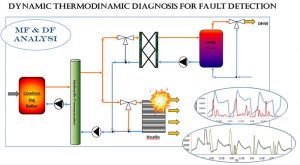
The case study entailed the heating as well as DHW system of a 16 household multifamily flat. The energy supply system consisted a condensing boiler operating at high temperature to obtain 28kW power with a manufacturer efficiency of 97% (17% exergy efficiency). The authors represented the heating demand through heat dissipation of the radiator system. DHW was given by a DHW tank and a three-way valve that ensured hot water at a constant temperature.
The researchers deliberately introduced a fault on the radiator system by reducing its energy performance by 10%. The control system intervention needed filtration through free condition obtainment. They considered two outputs in the setup; the heating and DHW demand. Heating was defined by the power demanded so that free and reference conditions yielded same heating output. DHW was defined by the amount of water flow demanded at a particular temperature.
One major outcome of the study was the quantification of the effects of the introduced anomaly in terms of malfunctions and dysfunctions. These were stated in both monetary and exergy units. The diagnosis approach took care of the effects of the control system, therefore, filtering the induced malfunctions that cause it. Thus, the authors introduced an innovative method for filtering the induced malfunctions that are initiated by the regulation system. Nevertheless, besides those, other induced malfunctions should be filtered in order to isolate the intrinsic malfunctions, such as fuel quality, ambient conditions or the ones carried by the nonlinear efficiency curves. In this study, the researchers derived the free conditions by simulation.
In the study, the authors concluded that heating as well as DWH demands were the system’s final products and while they kept heating constant, DHW decreased. They proposed two indexes for assessing the impact of malfunction cost of each component with regards to fuel impact computed in the diagnosis.





Reference
Ana Picallo-Perez, José Ma Sala-Lizarraga, Eider Iribar-Solabarrieta, Moises Odriozola-Maritorena, Luis Portillo-Valdés. Application of the malfunction thermoeconomic diagnosis to a dynamic heating and DHW facility for fault detection. Energy and Buildings, volume 135 (2017), pages 385–397.
Go To Energy and Buildings