Advances in Engineering Advances in Engineering features breaking research judged by Advances in Engineering advisory team to be of key importance in the Engineering field. Papers are selected from over 10,000 published each week from most peer reviewed journals.

Significance
It has been identified that the motion and growth of equiaxed crystals dictate crucial micro-structural features, particularly in larger castings such as heavy ingots. In an attempt to establish the origin of equiaxed crystals, many researchers tend to discuss the heterogeneous nucleation and fragmentation of dendrite arms from columnar regions. A good number of alloys are known to solidify by forming an outer equiaxed zone, which is then followed by a columnar zone, and finally an extended inner equiaxed zone.
The grains outer of the equiaxed zone develop in contact with the mold through heterogeneous nucleation, while with the columnar dendritic zone by growth competition from the outer equiaxed one. However, in the interior of the casting, equiaxed crystals develop by heterogeneous nucleation or by fragmentation of dendrites from the columnar region.
Unfortunately, the two mechanisms present the same uncertainty. For example, the origin of the heterogeneous site that is responsible for reducing the energy site necessary for nucleation remains unknown, particularly for non-inoculated alloys. On the other hand, the criteria for the occurrence of fragmentation of dendrite arms is hardly implemented owing to complicated overall interdendritic flow referenced to natural or forced convection or deformation of the dendrite skeleton.
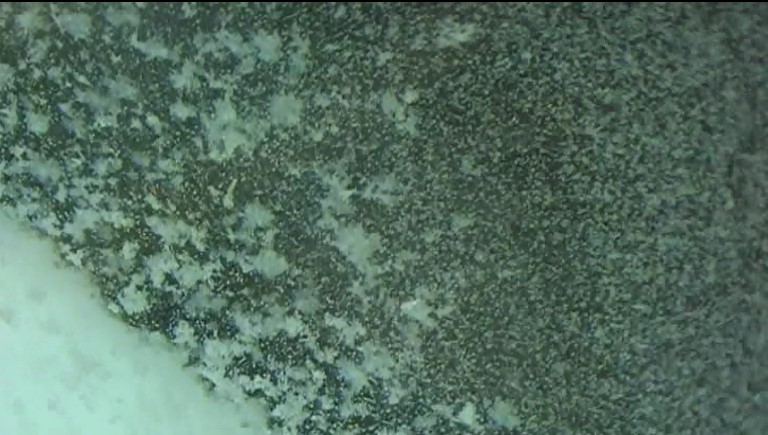
Researchers led by Professor Andreas Ludwig from Montanuniversitaet Leoben in Austria, reported their results which indicated that relatively large areas of vertical columnar zones, particularly at the upper part of the casting mold could slide down and develop crystal avalanches. They observed that these avalanches were composed of thousands of dendritic fragments from where equiaxed crystals develop. This could be viewed as a substantial fragmentation and therefore massive formation of equiaxed crystals. Their research work is published in Metallurgical and Materials Transactions A.
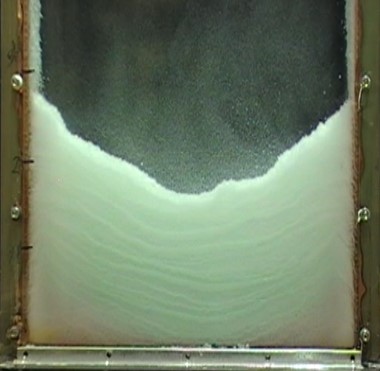
The authors used a large container filled with ammonium chloride-water solution. The lateral walls of the container were made of brass, the bottom plate was made of aluminum, while the back and front walls were made of polymethylmethacrylat plates. They started the experiment with an alloy at a temperature of 325K and then cooled down to 279K through the side walls. The interdendritic eutectic in the ammonium-water system forms at 253K, therefore, even with the minimal cooling temperature, some interdendritic melt in the mushy zone remained liquid.
Portions sliding down from the vertically growing columnar zones, particularly from the upper part of the containment, led to the appearing of avalanches of dendritic fragments. These fragments behaved like equiaxed crystals. These phenomena could have significantly contributed to the formation of the inner equiaxed zone in castings. The authors discussed the solutal melting of columnar dendrite stem, triggered by solutal buoyancy flow, as the probable origin of the sliding down of columnar arrays.
For this reason, these avalanches are likely to appear for particular steels, Pb-Sn, Cu-Al, and Ni-Al-alloys where rising interdendritic solute buoyancy flow is known to exist. With the hot topping that is generally applied during ingot casting, large columnar portions in the upper part of the casting could slide down as the low temperature gradient led to long columnar dendrites and inward turning vortices.
The described phenomenon led to the formation of V-segregation in steel ingots. The results of their study indicate that solutal melting is necessary for the dynamics of solidification process.




Reference
A. Ludwig, M. Stefan-Kharicha, A. Kharicha, and M. WU. Massive Formation of Equiaxed Crystals by Avalanches of Mushy Zone Segments. Metallurgical and Materials Transactions A, volume 48A, 2017—2927.
Go To Metallurgical and Materials Transactions A