Advances in Engineering Advances in Engineering features breaking research judged by Advances in Engineering advisory team to be of key importance in the Engineering field. Papers are selected from over 10,000 published each week from most peer reviewed journals.

Significance Statement
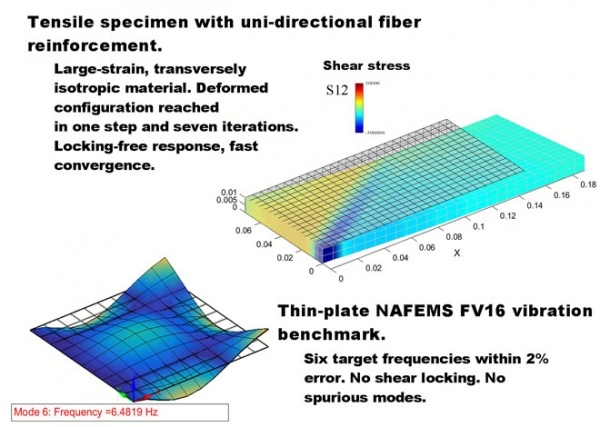
The presented mean-strain hexahedral finite element is robust and accurate under a variety of practically important conditions (almost incompressible deformation, thin and thick solid- and shell -like parts, vibration and buckling, and contact problems). The element does not require any additional user input. It is applicable for isotropic and anisotropic materials under arbitrarily large strains. The element is superior to competing formulations available in commercial finite element software packages.

Journal Reference
Numerical Methods in Engineering, Volume 103, Issue 9, 31 August 2015 , Pages 650–670.
Petr Krysl
University of California, San Diego, San Diego, CA, USA
Abstract
A method for stabilizing the mean-strain hexahedron for applications to anisotropic elasticity was described by Krysl (2015). The technique relied on a sampling of the stabilization energy using the mean-strain quadrature and the full Gaussian integration rule. This combination was shown to guarantee consistency and stability. The stabilization energy was expressed in terms of input parameters of the real material, and the value of the stabilization parameter was fixed in a quasi-optimal manner by linking the stabilization to the bending behavior of the hexahedral element (Krysl, submitted). Here, the formulation is extended to large-strain hyperelasticity (as an example, the formulation allows for inelastic behavior to be modeled). The stabilization energy is expressed through a stored-energy function, and contact with input parameters in the small-strain regime is made. As for small-strain elasticity, the stabilization parameter is determined to optimize bending performance. The accuracy and convergence characteristics of the present formulations for both solid and thin-walled structures (shells) compare favorably with the capabilities of mean-strain and other high-performance hexahedral elements described in the open literature and also with a number of successful shell elements. Copyright © 2015 John Wiley & Sons, Ltd.
Numerical Methods in Engineering