Advances in Engineering Advances in Engineering features breaking research judged by Advances in Engineering advisory team to be of key importance in the Engineering field. Papers are selected from over 10,000 published each week from most peer reviewed journals.

Significance Statement
This study was first presented in 22nd International Symposium on Plasma Chemistry (Antwerp, Belgium, 2015), and summarized in a journal paper of its special issue in Plasma Chemistry and Plasma Processing.
Journal Reference
Plasma Chemistry and Plasma Processing, , Volume 36, Issue 1, pp 281-294.
Osamu Sakai1,2,Yu Hiraoka2,Naoya Kihara2,Ella Blanquet1,2,Keiichiro Urabe2,3,Masanobu Tanaka4
[expand title=”Show Affiliations”]
1. Department of Electronic Systems Engineering, The University of Shiga Prefecture, 2500 Hassakacho, Hikone, Shiga, 522-8533, Japan
2. Department of Electronic Science and Engineering, Kyoto University, Kyoto-daigaku Katsura Nishikyo-ku, Kyoto, 615-8510, Japan
3. Department of Advanced Materials Science, School of Frontier Sciences, University of Tokyo, 5-1-5 Kashiwanoha, Kashiwa, Chiba, 277-8561, Japan
4. Department of Electronic Chemistry, Interdisciplinary Graduate School of Science and Engineering, Tokyo Institute of Technology, 4259 Nagatsuta-cho, Midori-Ku, Yokohama, Kanagawa, 226-8502, Japan [/expand]
Abstract
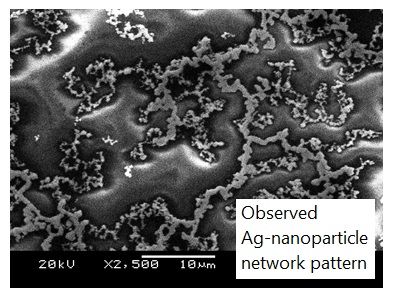
Microdischarge-induced reaction processes working at atmospheric pressure create fractal-like network structure of metal nano-particles which shows variable electric and optical properties. Due to their smallness, microdischarges or microplasmas can be installed in a gas-tubing system, and they enable us to create a compact chemical reduction reactor which includes decomposers of molecules, gas flows, and aqueous solutions with metallic ions at atmospheric pressure. Ammonia (NH3) gas is successfully decomposed in this reactor, and its products which include mainly hydrazine (N2H4) and flow in the downstream induce reduction reactions for AgNO3 solution. Various parameters in the reactor trigger formation of functional patterns of silver nano-particles like partially transparent layers whose conductivity is variable. Optical properties of this equivalent films show some absorption spectra coming from structure resonances, which can be an optical metamaterials in this self-assembly process.