Advances in Engineering Advances in Engineering features breaking research judged by Advances in Engineering advisory team to be of key importance in the Engineering field. Papers are selected from over 10,000 published each week from most peer reviewed journals.

The lithium-metal battery is a potential candidate for high-energy storage, however, the challenge of uncontrolled dendrite growth remains unresolved. Researchers have often approached this problem by concentrating on the anode or electrolyte, with the hope that surface coatings, engineered SEI layers, or novel electrolyte formulations would soften the intrinsic instability at the Li–electrolyte interface. These interventions help, but they inevitably depend on chemistry-specific optimization, which fragments progress across battery platforms. Moreover, the separator stands out as an oddly neglected component. Although every commercial lithium battery contains one, its role has long been treated as passive which prevents direct contact between electrodes. The difficulty, however, is that separators are structurally far more complex than early models assumed. Industrial membranes have heterogeneous pore networks, variable tortuosity, multi-layer constructions, and frequently include nanoparticle-based surface coatings. These features introduce additional phases into what was traditionally modeled as a simple electrode–electrolyte two-phase system. In practice, this complexity has made it extremely hard to understand how the microstructure of a separator actually shapes Li-ion transport. Without such clarity, using the separator as a lever for governing dendrite morphology has remained more of an intuition than a quantitative design strategy. To this end new research paper published in Advanced Energy Materials and conducted by Dr. Yajie Li, Yiping Wang, Bin Chen, Dr. Yuxiao Lin, Dr. Maxim Avdeev, and led by Professor Siqi Shi from the Shanghai University in collaboration with Dr. Geng Zhang from King Abdullah University of Science and Technology, the researchers developed a high-fidelity multi-phase phase-field simulation framework that incorporates realistic separator microstructures and surface-coating nanoparticles into the evolution of Li-ion transport. Their approach links porosity, tortuosity, inner-pore roughness, and coating uniformity directly to dendrite height and space-utilization metrics. The model demonstrates that uniformity of coating nanoparticles dominates dendrite regulation, often outweighing matrix uniformity. This framework offers quantitative, manufacturable design rules for separators that proactively suppress dendrites from the earliest stages of electrodeposition.
The research team reconstructed phase-field model capable of simulating lithium electrodeposition inside separators with realistic geometries. Because the separator adds one or two additional phases to the electrochemical environment, they replaced the traditional two-phase formalism with a multi-phase representation, assigning dedicated phase-field variables to the separator matrix and, when present, the nanoparticle coating layer. This allowed Li-ion diffusion and local conductivity to evolve dynamically with the surrounding microstructure—an essential capability, given that ionic pathways in commercial separators shift as pores become constricted or elongated.
The authors validated their system and found when they simulated electrodeposition in a bare electrolyte, dendrites grew in patterns essentially identical to those described in earlier work by Hong and Chen, establishing that the baseline physics was reliable. When a uniform separator was added, the model naturally reproduced the experimentally observed slowing of dendrite amplification near the separator surface. The presence of coating nanoparticles produced another realistic outcome: regions around the nanoparticles accumulated slightly higher Li-ion concentrations, creating “local reservoirs” that helped soften concentration gradients and reduce dendrite acceleration. Afterward, the model became a test bed for a wide sweep of separator properties. Introducing randomly blocked pores produced pronounced heterogeneity in Li-ion transport, which in turn triggered faster side-branch formation. The authors changed the overall porosity across a range from 20% to 80% and found that too little porosity slowed ion transport excessively, while too much porosity accelerated dendrite nucleation. A moderate window around 40–50% offered optimal behavior.
Furthermore, the team found that inner-pore roughness is an important factor and when the roughness index increased to roughly 1.5–2.7, concave micro-regions formed gentle ionic reservoirs that moderated local polarization, leading to substantially shorter and more compact deposits. Past that window, the effect reversed as overly tortuous paths hindered uniform flux. Moreover, they found that layered separators produced another stabilizing effect. Simulations showed that multi-layer constructions created interlayer electrolyte retention zones that equalized vertical concentration gradients. With each added layer, the Li-ion flux distribution beneath the separator became more homogeneous, and the resulting dendrite morphology grew progressively smoother. Finally, the team turned to uniformity. They decoupled the effects of separator-matrix uniformity from coating-particle uniformity. The result was unexpectedly clear: non-uniform coatings—even when applied to a perfectly uniform matrix—rapidly disrupted Li-ion transport and encouraged dendrite initiation. In contrast, highly uniform coatings maintained smooth deposition even on non-uniform matrices. Quantitatively, the coating uniformity dominated the dendrite metrics, making it the primary determinant of achievable suppression.
In conclusion, Professor Siqi Shi and colleagues demonstrated successfully that separator microstructure can actively shape Li-ion distribution before the first nucleation event, and placed the separator on equal footing with the anode and electrolyte as a designable component. This shift matters because separator engineering is far more transferable across chemistries than SEI manipulation or electrolyte tuning. A manufacturing line producing polyolefin separators can incorporate adjustments to porosity, roughness, or coated-particle dispersion without redesigning the anode or compromising cell chemistry. That alone makes the approach broadly applicable. We believe the implications of coating-particle uniformity are especially noteworthy and prior work has often focused on identifying the right coating material (ceramic particles, nanorods, polymer binders) without fully considering how uniformly that material is dispersed. The simulations here reveal that small clusters or agglomerates break ionic symmetry strongly enough to overwhelm the effects of even a perfectly uniform separator matrix. In practical terms, this means that quality control during slurry mixing and deposition may be as important as the choice of coating material itself. Battery fabricators, who already struggle with nanoscale uniformity in other contexts, may find that dendrite suppression hinges not on expensive new chemistry but on meticulous control of coating dispersion.
Additionally, the new work of Yajie Li et al. also provides numerical thresholds that designers can actually use where porosity in the 40–50% range, inner-pore roughness between 1.5 and 2.7, and multi-layer architectures emerge as quantifiable targets that sit within the realm of commercial feasibility. These values come not from heuristic reasoning but from simulations that couple concentration fields, electric potential, and evolving phase boundaries across multi-phase systems. Beyond immediate engineering recommendations, the new model itself is extensible. Because it incorporates porous media, surface coatings, and evolving concentration–potential coupling, it can be adapted to composite solid electrolytes or hybrid anodes. Many instabilities in solid-state batteries originate from similar gradients and microstructural mismatches, and the same phase-field logic could illuminate those processes as well. By refining how multi-phase interactions are quantified, Li and colleagues provide a blueprint for modeling electrochemical growth in environments where interfaces and transport pathways coexist at multiple scales. Ultimately, the significance lies in showing that dendrite suppression need not wait until dendrites appear. It can begin at the separator, in the first milliseconds of deposition, guided by rational microstructural design rather than after-the-fact mitigation. This reframing could help lithium-metal systems progress toward safer operation at practical current densities which is an important and longstanding.
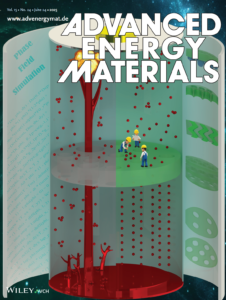
This paper is selected for the inside backcover of Advanced Energy Materials. Vol. 15, No. 24, June 24, 2025.
In recent years, Siqi Shi, Yajie Li and co-authors have developed four phase-field simulation software (2022SR0147340, 2022SR0147443, 2025SR0357319, 2025SR0357310). They incorporated the dependent relationships among key factors (diffusion coefficient, exchange current density, electrolyte concentration, temperature, and applied voltage) into the phase-field model to capture their synergistic effects on electrodeposition (Chin. Chem. Lett., 2023, 34, 107993, 22 citations). They established a mechanism diagram correlating the activation–energy ratio, uniform initial temperature, and maximum dendrite height, which unifies the seemingly contradictory simulation results (Energ. Mater. Adv., 2023, 4, 0053, 26 citations). They investigated the influences of separator pore size, tilt angle, porosity, tortuosity, layer number, closed pores, internal pore roughness, pore uniformity on lithium dendrite growth (Chin. Chem. Lett., 2022, 33: 3287, 69 citations; Acta Phys.-Chim. Sin. 2024, 40, 14 citations; Adv. Energy Mater. 2025, 15, 2500503, 8 citations). Additionally, they prepared multilayer battery separators with controllable microstructures via multilayer coextrusion (Electrochim. Acta, 2018, 264: 140-149, 92 citations; J. Power Sources, 2018, 384: 408-416, 63 citations; Polymer, 2022, 253: 125027, 11 citations).



Reference
Yajie Li &Yiping Wang &Bin Chen & Yuxiao Lin & Geng Zhang &Max Avdeev & Siqi Shi. (2025). Proactive Lithium Dendrite Regulation Enabled by Manipulating Separator Microstructure Using High‐Fidelity Phase‐Field Simulation. Advanced Energy Materials. 15. 10.1002/aenm.202500503.