Advances in Engineering Advances in Engineering features breaking research judged by Advances in Engineering advisory team to be of key importance in the Engineering field. Papers are selected from over 10,000 published each week from most peer reviewed journals.

Significance
Cement-based concrete is the dominant building and construction material globally. However, due to various infrastructural and components failures that have resulted in destruction and loss of life, infrastructural durability and sustainability matrices have been developed to investigate the integrity of the infrastructures. Therefore, understanding of the microstructure of the cementitious materials especially those used in complex and severe environmental conditions will be of great significance in evaluating the behavior of cement matrix that may affect the material’s performance and durability.
In a recent research work, the impact factors of cement pastes such as moisture, temperature, and water to cement ratio on the microstructures have been investigated. In particular, the influence of curing temperature on cement hydration reaction has been reported. However, the influence of other factors such as atmospheric pressures on cement matrix remains a research area despite the increasing application of cement materials in severe environments such as low altitude regions.
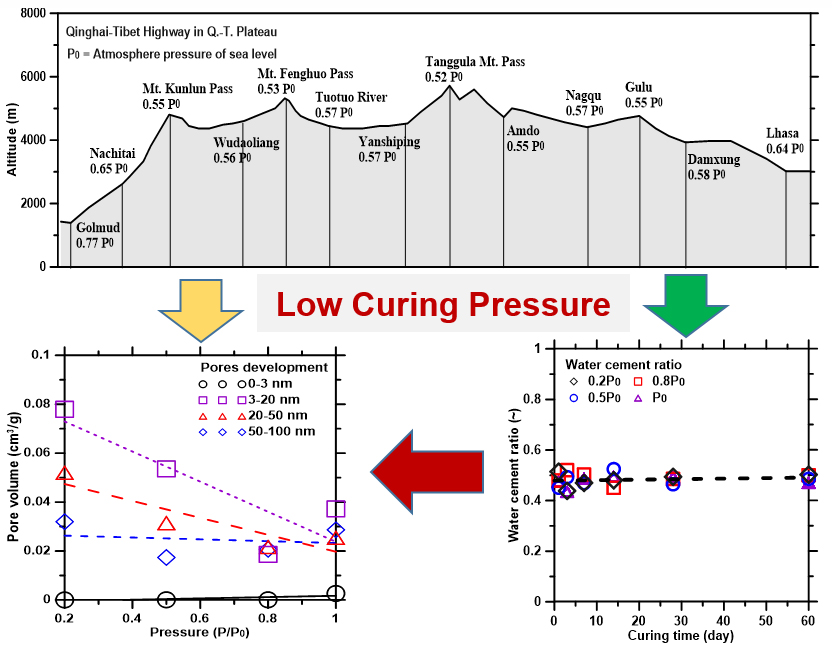
Since the pressure effects on concretes have increasingly become an important aspect of infrastructure design, understanding the relationship between the atmospheric pressure distribution and the altitude is of great importance. For instance, the effects of lower atmospheric pressures on the air voids and air contents of concretes have been revealed. Unfortunately, the effects of low curing pressures on the cement-based composites are not fully explored. Therefore, to understand the behavior of cement-based composites and evaluate their potential engineering performances, proper understanding of the microstructure of Portland cement matrix especially those applied in extreme environmental conditions is highly necessary.
To this note, Chang’an University researchers: Dr. Zhuangzhuang Liu, Aimin Sha, Xuhao Wang, Baowen Lou, and Peidong Du looked carefully on the cement hydration behavior under lower curing pressures and standard atmospheric pressures. Specifically, the microstructure characterization during the hydration of Portland cement was investigated using various techniques: X-ray diffraction, thermogravimetric analysis, differential thermal analysis, and nitrogen adsorption techniques. Fundamentally, the authors determined the hydration degree, hydrate evolution, and pore size distribution during the microstructure development. Eventually, a thermodynamic model of cement hydration was developed to calculate the products under low curing pressures. The work is currently published in the journal, Construction and Building Materials.
The authors observed diminishing effects on the degree of hydration due to lower curing pressures. A decrease in the curing pressure resulted in a corresponding decrease in the portlandite, ettringite and calcium silicate hydrate phases. Also, nitrogen absorption evaluation revealed cumulative volumes in both mesopores and micropores but with marginal effects on the latter. Furthermore, the degree of hydration, water to cement ratio and the moisture evaporation effects were noted to be the main factors influencing the microstructures of cement paste.
In summary, the Zhuangzhuang Liu and his colleagues are the first to investigate the microstructure development and hydration behavior of Portland cement under low curing pressures. The study thus supplements the existing knowledge on the factors such as lower atmospheric pressure affecting the durability and performance of concrete-based infrastructures, especially in high altitude areas.

Reference
Liu, Z., Lou, B., Sha, A., Du, P., & Wang, X. (2019). Microstructure characterization of Portland cement pastes influenced by lower curing pressures. Construction and Building Materials, 227, 116636.
Go To Construction and Building Materials