 Advances in Engineering Advances in Engineering features breaking research judged by Advances in Engineering advisory team to be of key importance in the Engineering field. Papers are selected from over 10,000 published each week from most peer reviewed journals.

Significance
Hairline fractures in an airplane wing, a bridge support, or a pipeline often start small enough to evade standard inspections. Left unchecked, those microscopic flaws can lead to catastrophic failures. Detecting them early usually means wiring up structures with bulky sensors that struggle to fit onto curved or tight surfaces. Antenna-based sensors can detect this damage through changes in electromagnetic signals, but conventional designs are often too large or insufficiently flexible for small components and surfaces with complex shapes.
Microstrip patch antenna sensors consist of a conductive patch separated from a metallic ground plate by a dielectric layer. When a crack develops in the metal beneath the patch, it changes the antenna’s electromagnetic response and shifts its resonant frequency. Measuring this shift makes it possible to monitor changes in crack length wirelessly.
Making these sensors smaller without compromising their performance can be difficult. One approach involves introducing slots into the conductive patch to extend the electrical current path without increasing its physical dimensions. However, producing these features accurately becomes more difficult as the antenna becomes smaller. An alternative is to improve the dielectric material. Higher relative permittivity, which describes how strongly a material responds to an electric field, can support a smaller antenna operating at the same frequency. The difficulty is that materials with high permittivity often have greater dielectric loss, causing more electromagnetic energy to dissipate.
Polyvinylidene fluoride (PVDF) is an attractive material for flexible dielectric films because of its mechanical strength, chemical stability, and electrical properties. Its dielectric response depends partly on its crystalline structure, especially the polar β-phase, which contributes strongly to polarization. Adding ceramic particles can increase permittivity, but these particles may cluster together and create defects at their interfaces with the polymer. Such defects can increase electrical losses and reduce the benefits of adding the ceramic material.
To address this problem, Professor Caifeng Chen, Postgraduate Chenglong Bi, Postgraduate Tianle Sheng, Postgraduate Yu Hou and Professor Andong Wang from Jiangsu University investigated composite films containing PVDF, barium titanate (BT) particles, and boron nitride nanotubes (BNNTs). Their research, published in Composites Science and Technology, examined how these materials influence dielectric properties and how those changes affect antenna size and crack detection sensitivity.
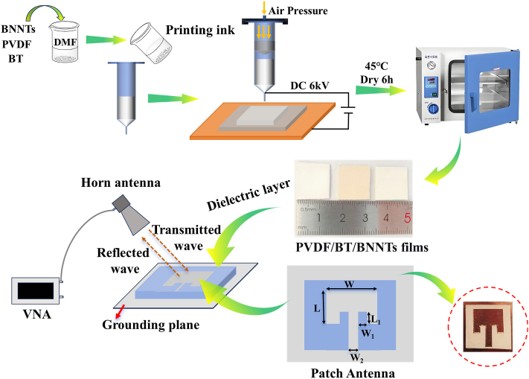
The researchers prepared PVDF composite films containing a fixed amount of BT and varying concentrations of BNNTs. They used a printing process in which compressed air pushed the mixture through a fine nozzle, and an applied electric field helped stabilize and stretch the material as it was deposited in thin layers.
The combined stretching and electric field encouraged the formation of the polar β-phase, in which the molecular chains adopt an arrangement that strengthens their response to an electric field. X-ray diffraction and infrared spectroscopy confirmed that the printed films contained a high proportion of this phase.
The nanotubes also influenced how barium titanate particles were distributed within the polymer. When the authors conducted microscopic analysis, they showed that BT particles tended to cluster together in films without BNNTs, creating regions where small voids and cracks could develop. On the other hand, adding nanotubes helped separate these clusters and distribute the particles more evenly, possibly because the BNNTs formed an interconnected network within the polymer.
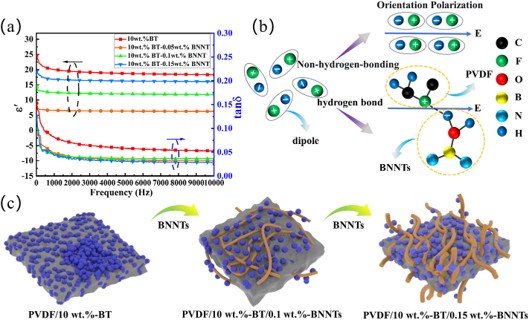
Hydrogen bonding involving water molecules adsorbed on the nanotube surfaces may also have helped organize PVDF molecular chains and promote β-phase formation. However, the β-phase content did not increase continuously with BNNT concentration. It reached its highest level at an intermediate concentration before declining slightly at higher loadings, possibly because nanotube aggregation restricted the movement of polymer chains.
The dielectric measurements showed that adding a small amount of BNNTs initially reduced permittivity. The nanotubes separated closely packed BT particles and weakened the interfacial polarization associated with their proximity. As the nanotube concentration increased, however, permittivity began to recover.
The increase in permittivity may be linked to interactions between the polymer, ceramic particles, and nanotubes. These interactions can help electrical charges accumulate at the material interfaces, strengthening polarization. Hydrogen bonding may also help neighboring PVDF chains respond together to an electric field. The composite with the highest permittivity did not have the greatest β-phase content, showing that other polarization mechanisms also played a role.
The nanotubes were effective in reducing dielectric loss and their insulating structure and interactions with the surrounding polymer restricted the movement of electrical charges, reducing leakage and energy dissipation. The composite containing 10 wt% BT and 0.15 wt% BNNTs achieved a relative permittivity of 16.89 and a dielectric loss of 0.042 at 1 kHz. Although its permittivity was lower than that of the BT-filled film without nanotubes, it offered a better balance between permittivity and dielectric loss.
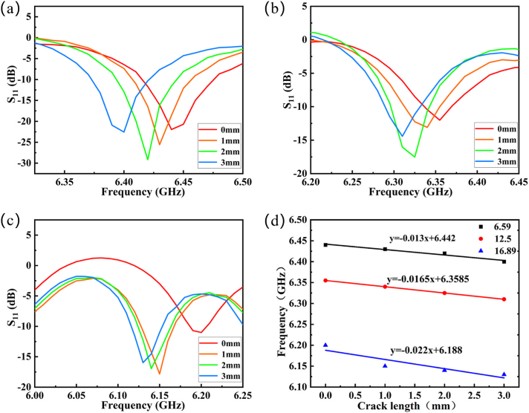
The Jiangsu University team then used these composite films as dielectric layers in microstrip patch antenna sensors. The resulting sensor measures roughly 8 by 6 millimeters—smaller than a fingernail—cutting its footprint by 62% compared to standard polymer versions. To evaluate crack detection, the researchers placed the sensors over metallic ground plates containing cracks of different lengths. A separate horn antenna transmitted and received electromagnetic signals, enabling wireless measurements of the sensors’ responses. They found that as crack length increased, the resonant frequency decreased. The sensors also became more sensitive as the permittivity of their dielectric layers increased. Crack detection sensitivity rose from 13 MHz/mm for the lowest-permittivity composite to 22 MHz/mm for the highest-permittivity composite.
Electromagnetic simulations helped explain this improvement. Materials with higher permittivity concentrated more of the electric field beneath the conductive patch, increasing its interaction with the damaged metal surface. This stronger interaction caused larger shifts in resonant frequency as crack length increased, making the sensor more sensitive to structural damage.
The new findings show that engineers can shrink wireless crack sensors by tuning the dielectric material itself, rather than carving complex patterns into the metal patch. This approach avoids the difficulty of etching tiny, high-precision slots as antennas scale down. The study also showed why selecting the right amounts of nanotubes matters because it affects how PVDF crystallizes and how electrical charges build up at the interfaces between materials. Both factors influence permittivity, but keeping dielectric loss low is just as important for antenna performance. The sensors successfully detected cracks in metal plates under laboratory conditions. Further testing on curved surfaces and under changing temperatures and vibrations would help determine how well they perform in practical applications.


Reference
Caifeng Chen, Chenglong Bi, Tianle Sheng, Yu Hou, Andong Wang, Synergistic enhancement of dielectric properties in PVDF/BT/BNNTs composites for miniaturized antenna sensors with improved crack detection sensitivity, Composites Science and Technology, Volume 283, 2026, 111726, DOI: 10.1016/j.compscitech.2026.111726.