Advances in Engineering Advances in Engineering features breaking research judged by Advances in Engineering advisory team to be of key importance in the Engineering field. Papers are selected from over 10,000 published each week from most peer reviewed journals.

Significance
Microgrids are local, small-scale energy systems that can generate, distribute, and operate electricity independently or in collaboration with the main electrical grid. They are designed to provide reliable and resilient power supply to critical facilities such as hospitals, emergency services, and military installations. However, microgrids have their own limitations, including low inertia, voltage-frequency dependence, and the need for effective control systems to deal with uncertainty and nonlinearity. Canadian scientists: Dr. Xun Gong and Professor Xiaozhe Wang from McGill University have recently published a study in the Journal Applied Energy that addresses these challenges by introducing a new data-driven approach to secondary voltage and frequency control in microgrids (as shown in Fig. 1).
Microgrid control is typically divided into primary control at the individual Distributed Energy Resources (DERs) level and secondary/tertiary control at the system-wide level. Primary control, often based on droop characteristics, helps maintain local stability within DERs. However, it does not completely eliminate frequency and voltage deviations at the system level. The authors focused on the secondary control which is becoming essential to restore stable voltage and frequency at the system level. Traditionally, secondary control in microgrids has been approached through model-based control methods, which rely heavily on accurate physical models. These models can be challenging to maintain due to the dynamic nature of microgrid topologies and the uncertainty introduced by renewable energy sources and load. While these methods can enhance system stability, they are not always practical due to the need for precise physical models.
To overcome the limitations of model-based control, researchers previously explored model-free control methods, including Proportional and Integral (PI) control and averaging/consensus-based secondary droop control. These methods offer advantages but may lack adaptiveness and robustness to uncertainty. Additionally, they may lead to overshoot, sensitivity to controller gains, and sluggish responses to disturbances. Machine learning-based methods, such as artificial neural networks and reinforcement learning, have also been proposed for secondary voltage and frequency control in microgrids. While these methods can provide effective control, they often lack physical interpretability and may struggle to represent the system’s dynamics accurately in diverse operating conditions. Gathering sufficient offline training data to support these methods can be a significant challenge as well.
In response to these challenges, Dr. Gong and Professor Wang proposed a novel data-driven secondary voltage and frequency control method for microgrids (Fig. 2), considering DERs with both grid-forming and grid-following capabilities. The key innovation lies in the application of Koopman operator theory to convert the nonlinear dynamics of a microgrid into a linear system. This conversion enables the use of well-established linear control techniques.
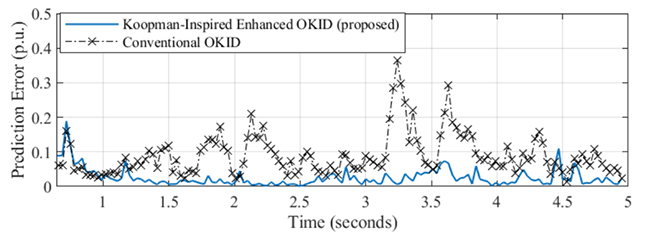
The Koopman operator-inspired enhanced Observer Kalman-filter IDentification (OKID) algorithm is at the core of this approach. It allows for the accurate and adaptive identification of the microgrid’s dynamics, even in the presence of nonlinearity and uncertainty during large disturbances. The OKID algorithm, tailored for Koopman-based identification, optimally identifies the linearized dynamical system, making it a powerful tool for control. As shown in Fig. 3, the prediction error with the tailored OKID is smaller than conventional OKID in the case study of the paper.
In a statement to Advances in Engineering, Professor Xiaozhe Wang, the lead and corresponding author said, “the benefits of this novel data-driven approach are multifold: the Koopman-inspired OKID method accurately models the microgrid’s dynamics, ensuring reliable control even under nonlinearity and uncertainty introduced by disturbances. Moreover, unlike some machine learning-based methods, the proposed approach requires no offline training data, making it suitable for dynamic microgrid environments with changing topologies and operating conditions. Furthermore, the microgrid system controlled using the new method is guaranteed to be Bounded-Input-Bounded-Output (BIBO) stable. Additionally, the method provides conditions under which the system is asymptotically stable. Indeed, the new approach has demonstrated robustness to measurement noise and time delays in numerical studies, further affirming its applicability in practical scenarios”.
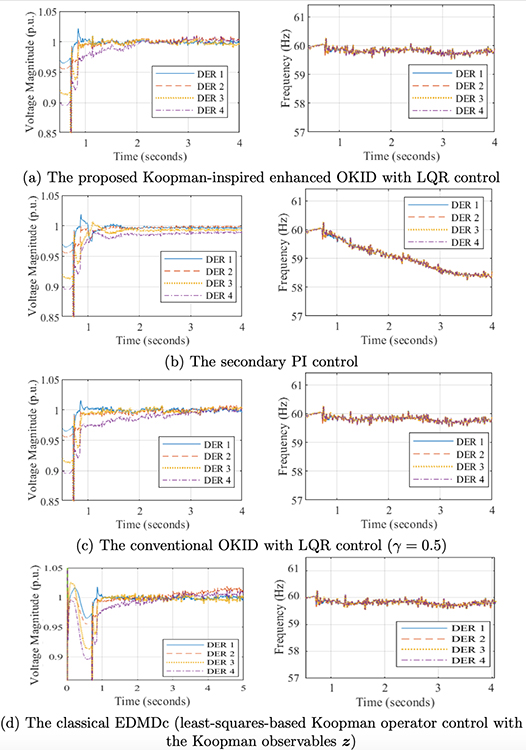
The research team validated the effectiveness of their data-driven approach through case studies involving two microgrid test systems: a four-bus microgrid and a thirteen-bus microgrid. These test systems simulated realistic scenarios, including mode transitions, load variations, and disturbances. In both case studies, the proposed Koopman-inspired OKID method with Linear Quadratic Regulator (LQR) control outperforms other control methods, including traditional PI control, conventional OKID with LQR control, and the classical Extended Dynamic Mode Decomposition control. The authors’ results demonstrated the method’s successful ability to restore voltage and frequency to nominal values rapidly and accurately, even in the presence of nonlinearities and uncertainties (see results in Fig. 4 for the four-bus microgrid).
In summary, Dr. Xun Gong and Professor Xiaozhe Wang’s developed a pioneering data-driven method to enhance the stability of microgrids. By leveraging Koopman operator theory and an enhanced OKID algorithm, the new method offers a practical and adaptive solution for secondary voltage and frequency control in microgrids, addressing the challenges posed by nonlinearity, uncertainty, and dynamic operating conditions.




Reference
Xun Gong, Xiaozhe Wang, A novel Koopman-inspired method for the secondary control of microgrids with grid-forming and grid-following sources, Applied Energy, Volume 333, 2023, 120631,