Advances in Engineering Advances in Engineering features breaking research judged by Advances in Engineering advisory team to be of key importance in the Engineering field. Papers are selected from over 10,000 published each week from most peer reviewed journals.

Significance Statement
A quadrature-based moment method technique, such as the conditional quadrature method of moment has the ability to solve polykinetic field by using a two-point quadrature representation of a multiphase particle velocity of particle density function where other approaches such as the Lattice Boltzmann and the multi-fluid method do not, due to use of various limiting unknowns leading to less viable results. The conditional quadrature method of moment is well-known for its ability to model non-hydrodynamic fluids at an Eulerian field-based continuum approach making it usable to characterize both Knusden number and Stokes number.
Dr. Dennis M. Dunn and Professor Kyle D. Squires from School for Engineering of Matter at Arizona State University demonstrated that the conditional quadrature method of moment provides the capability of modeling a fully 3D Eulerian dispersed phase along with a polykinetic field that captures particle trajectory crossing in a well-bounded high Stokes number flow. The research work is published in Journals of Fluid Engineering.
The authors considered a monodisperse and isothermal flow where the complete particle density function covers the polykinetic nature of solutions. Momentum transport of the particle density function was effectively achieved with the use of quadrature assumption on the quadrature-based moment of method. It was then followed by moment inversion which converts information from moment-space to the node-space with the aid of finite volume scheme.
A second-order accurate flux scheme with piecewise linear reconstruction at the faces coupled with a superbee slope and minrod slope limiter was also used by the authors. Numerical stability improvement was achieved for conditional quadrature method of moment with comparisons using dynamic numerical simulations fluid.
For 3D turbulent channel flow test case, a dynamic numerical simulation fluid with Reynolds number of 200 and two different Stoke numbers of 0.5 and 2.5 were used. The conditional quadrature method of moment solver with assumption of one-point quadrature for particle trajectory crossing showed that large concentration of particles accumulating in an unphysical manner at the wall creating a stream-wise velocity discontinuity. This result shows the cost effectiveness of conditional quadrature method of moment when operating across wide range of volume fractions.
The Two-point quadrature when assuming a polykinetic field for visible capture of particle trajectory crossing showed characteristics of conditional quadrature method of moment particle and dynamic numerical simulations in relation to their volume fraction and mean stream-wise velocity agreeing well with previous results from discrete particle simulation experiments. It was also discovered that both particles gathered near the wall before reaching a homogenous concentration ten times their initial value.
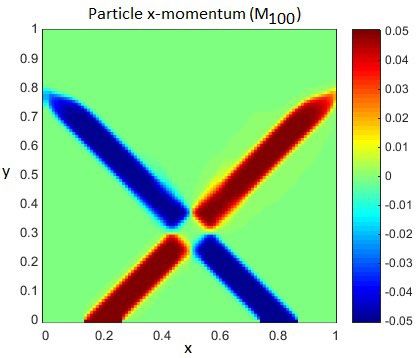
At a threshold range of 1 < ra ≤ 1.01, a much smaller magnitude of maximum particle density compared to the single node case was formed directly at the wall. At an increased threshold ra larger than 1.05, particles predominantly reflected off the wall and began to stagnate at an unphysical manner around the zero wall-normal instead of directly at the wall. This suggest that particle trajectory crossing occurred as particles reflects and leave the wall.
When observing instantaneous near-wall particle concentrations, particle trajectory crossing was seen to be significant for a large Stokes number of 2.5. A strong correlation was also found between conditional quadrature method of moment particle volume fraction and carrier fluid stream-wise velocity.
The authors were able to achieve a reduced-cost conditional quadrature method of moment approach in predicting particle trajectory crossing in multiphase flow when compared with other simulation techniques.
The conditional quadrature method of moments described in this study was able to successfully predicts physical features such as particle trajectory crossing, particle accumulation near the channel walls, and more uniform particle velocity profiles relative to the carrier flow


Journal Reference
Dennis M. Dunn , Kyle D. Squires. Modeling Dilute Gas–Solid Flows Using a Polykinetic Moment Method Approach, Journal of Fluids Engineering 138 (2015) 041303.
School for Engineering of Matter, Transport and Energy, Arizona State University Tempe, AZ 85287-6106
Go To Fluids Eng