Advances in Engineering Advances in Engineering features breaking research judged by Advances in Engineering advisory team to be of key importance in the Engineering field. Papers are selected from over 10,000 published each week from most peer reviewed journals.

Significance Statement
The use of electronic gadgets in climatically harsh areas result in moisture-related issues and failures, which are mainly corrosion due to water layer formation, leakage currents and open circuits caused by electrochemical migration. These are some of the primary issues found in outdoor electronic applications such as renewable energy devices and automotive applications. In a bid to increase reliability of electronic devices and components, it therefore becomes necessary to understand moisture transport into an electronic device enclosure under environmental conditions.
Adequate design of these electronic enclosures currently depends on years of practical exposures and experience as opposed to scientific knowledge. The major push towards breaking this trend is in the development of a set of more knowledge based modeling tools that can fortify further the quest for optimal design and humidity control alternatives. It is a good idea to have fast modeling tools considering that the computational time is important in the design, particularly in the preliminary product development stage.
FEM and CFD are useful tools that are widely used for moisture modeling; unfortunately, these methods are time consuming owing to computational effort. It is for that reason desirable to develop an adequately precise method with optimally reduced spatial resolution to compute the moisture response in the electronic systems within practical timeframes.
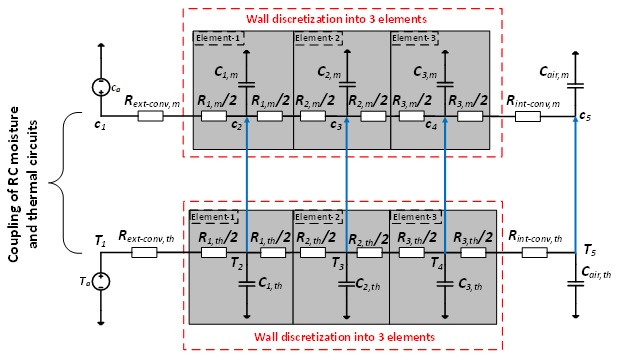
Zygimantas Staliulionis and colleagues at the Technical University of Denmark have built an in-house code based on the resistor-capacitor method for simulating coupled heat as well as mass transport into a closed electronic enclosure under non-isothermal conditions (fig. 1). Thereafter, the authors were able to predict the amount of moisture as well as heat transported through diffusion and heat conduction based on the developed code. Their research work is published in Microelectronics Reliability.
The authors’ in-house code based on resistor-capacitor method combines a 1-dimensional description of critical features of electronic enclosures with lumped components for describing the interiors of the polycarbonate enclosure. The 1-dimensional description of heat and mass transport in the enclosure walls was based on a finite volume method (FVM) discretization of heat conduction equation and Fick’s second law. Simultaneously, a lumped capacitance component demonstrated the enclosure volume. The authors then compared simulation results with experimental results and found a good agreement.
After the authors validated the code, they investigated material properties such as diffusivity, conductivity and solubility for their role in moisture control inside an enclosure. The next simulations ran in a bid to investigate the response of moisture as well as temperature inside a closed box.
The developed in-house code was very fast with less spatial resolution, and significantly less time consuming as compared to commercial CFD codes. This code could be improved further to incorporate condensation and couple with evaporation process – the direction of current research by the authors. The authors observed that the interior temperature responded fast to the ambient temperature owing to small thermal time constant. In addition, the latter showed a buffer effect in short period counting on wall thickness and the size of the box.
The moisture response inside a box was slow given that the time constant for the mass transport was larger. Analyzing the diffusivity and solubility indicated that both parameters were necessary for moisture control. For this reason, material choice needed to be done consistent with the application case. Thermal conductivity had negligible effects compared to solubility and diffusivity in controlling interior moisture response.




Reference
Ž. Staliulionis, S. Mohanty, M. Jabbari, J.H. Hattel. Mathematical modelling of moisture transport into an electronic enclosure under non-isothermal conditions. Microelectronics Reliability, Available online 15 May 2017.
Go To Microelectronics Reliability