Advances in Engineering Advances in Engineering features breaking research judged by Advances in Engineering advisory team to be of key importance in the Engineering field. Papers are selected from over 10,000 published each week from most peer reviewed journals.

Significance Statement
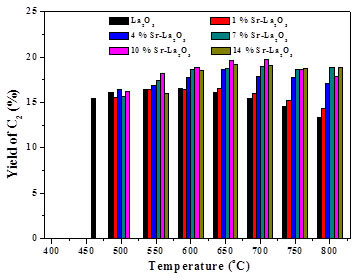
Currently ethylene is mainly from oil, yet oil resources are depleted; as combustible ice and shale gas were found, natural gas reserves increased. Therefore, oxidative coupling of methane (OCM) provides an important route for the natural gas utilization to replace petroleum resources. In our paper of “Monodisperse Sr-La2O3 hybrid nanofibers for oxidative coupling of methane to synthesize C2 hydrocarbons”, monodisperse hybrid Sr-La2O3 nanofibers catalysts with high OCM performance were prepared by incipient wetness impregnation method. At the temperature of 500 oC, methane conversion and C2 selectivity of 8.6 wt% Sr-La2O3 catalysts could reach to∼ 35% and 47%, and 20% C2 yield was achieved at 650 oC. HRTEM images indicate that Sr is highly dispersed on the surface of La2O3 nanofibers, and the crystal lattice fringes of Sr-La2O3 nanofibers increases compared to that of La2O3 nanofibers. XRD and theoretical studies also indicate that addition of Sr increases the lattice structure of La2O3 nanofibers, indicating that Sr is successfully inserted into La2O3 lattice. Above all, CO2-TPD-MS profiles of different catalysts show that introduction of Sr increases the basic site of La2O3 nanofibers, especially the number of strong basic sites. Besides, methane is methane activation is preferred over the (101) surface of Sr-La2O3 nanofibers, confirmed by DFT study. Sr-La2O3 nanofibers catalysts also have good ability to resist sintering and further avoid the loss of Sr, and no coke was found on the surface of spent catalyst. Preparation of Sr-La2O3 nanocatalysts not only provides a new type of catalyst wit high OCM activity, but also provides a new opportunity to apply this system into high temperature reaction.

Journal Reference
Song J, Sun Y, Ba R, Huang S, Zhao Y, Zhang J, Sun Y, Zhu Y.
CAS Key Laboratory of Low-Carbon Conversion Science and Engineering, Shanghai Advanced Research Institute, Chinese Academy of Sciences, Shanghai 201210, China. [email protected] [email protected].
Abstract
The synergistic effects from combinations of each component’s functionality in hybrid Sr-La2O3 nanofibers brought about an improved catalytic behaviour for oxidative coupling of methane carried out at high temperatures, which cannot be achieved over the conventional Sr doped La2O3 spherical catalyst.