Advances in Engineering Advances in Engineering features breaking research judged by Advances in Engineering advisory team to be of key importance in the Engineering field. Papers are selected from over 10,000 published each week from most peer reviewed journals.

Significance
To this account new research paper published in Optical Engineering and conducted by Dr. Yuehua An, Dr. Jiangwei Liu from the Guangdong Polytechnic Normal University and Dr. Ziyang Ma, Dr. Zhitao Deng, and led by Professor Zhensen Gao from the Guangdong University of Technology, researchers developed two integrated models: one for chaos synchronization between distributed-feedback lasers under common chaotic injection, and another for multi-channel entropy extraction via optical-frequency-comb generation with parallel filtering. The idea emerged from a long-standing limitation in single-channel chaotic systems—each additional gigabit per second of random output required more drive current and bandwidth, pushing the system toward instability. By using the inherent multi-line structure of an optical comb as simultaneous carriers of chaotic light, the researchers aimed to multiply the entropy channels without increasing per-laser complexity. In this framework, synchronization occurs not between a pair of narrowband oscillators but across a structured set of wavelength-separated subcarriers derived from a common comb. This parallelism promises both higher aggregate bit rates and improved resilience to external disturbances. The team further introduced delay-controlled beat-frequency processing to suppress residual correlations and enrich the spectral entropy. Their overarching goal was to demonstrate, at least in simulation, a scalable route toward multi-gigabit correlated randomness generation that would meet National Institute of Standards and Technology (NIST) randomness criteria. Such a system, if realized with commercial components, could underpin future optical key-distribution networks that operate entirely within classical channels yet approach the secrecy performance of quantum systems. The work therefore sits at the intersection of secure communications, nonlinear photonics, and chaos theory—fields that have long evolved separately but converge here in the shared pursuit of unbreakable randomness.
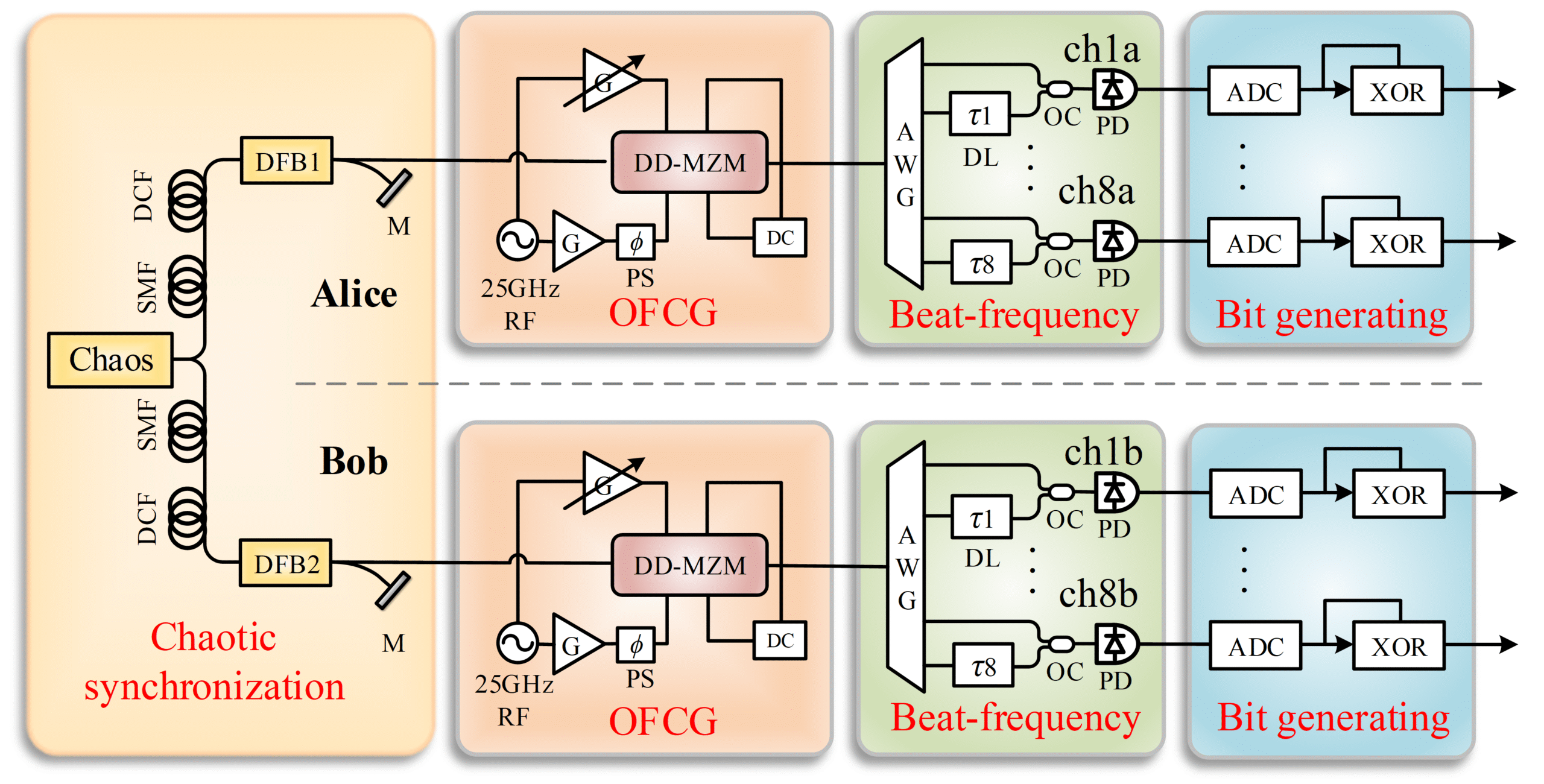
The team constructed a numerical model that mirrors a realistic fiber-optic setup connecting two legitimate users—Alice and Bob—each equipped with a closed-loop distributed-feedback (DFB) laser. A master semiconductor laser, subjected to mirror-based delayed optical feedback, acted as the chaotic driving source. Its output was split and transmitted over a 20-km single-mode fiber plus a 1-km dispersion-compensated segment to each user. By injecting this common chaotic signal into the remote DFBs, the researchers induced closed-loop chaos synchronization while ensuring that the public driving field revealed no recoverable information about the private outputs. The correlation between the drive and any individual DFB signal fell to 0.47, whereas the mutual correlation between Alice and Bob reached 0.99—a near-perfect alignment that confirmed secure synchronization.
Building on this foundation, the optical-frequency-comb generator was realized through a dual-drive Mach–Zehnder modulator (DD-MZM) driven by a 25 GHz radio-frequency signal. By tuning the phase shift and modulation depth between its two arms, the modulator produced a flat chaotic comb comprising nine equally spaced subcarriers across a ≈ 200 GHz optical bandwidth. Arrayed-waveguide gratings (AWGs) subsequently separated these subcarriers, each carrying a distinct chaotic waveform. Additionally, the authors introduced delay-dependent beat-frequency mixing, offset by 3.5 ns increments between neighboring wavelengths to weaken correlations among adjacent channels. This procedure generated eight quasi-independent chaotic outputs and showed enhanced spectral width and diminished mutual correlation. When the processed signals from Alice and Bob were mapped one-to-one, only matched channels retained high synchronization; unmatched pairs displayed no recognizable correlation, and confirmed secure channel multiplexing. The team also conducted stability tests and showed it simulated practical imperfections such as bias-voltage drift and radio-frequency delay mismatch. Even with ±0.9 V bias variation or 15 ps RF delay offset, the synchronization coefficient remained above 0.9, underscoring the robustness of the approach. Each chaotic channel was sampled at 2 GSa/s and quantized into binary form via a single-bit analog-to-digital converter using the median amplitude as threshold to balance zero-and-one probabilities. After a delayed XOR operation, eight correlated random sequences were merged through parallel-to-serial conversion, achieving an aggregate bit-generation rate of 16 Gb/s after 42 km of simulated transmission. All resultant sequences passed the 15 tests of the NIST SP 800-22 suite with p-values ≫ 0.0001, which confirmed statistical randomness and validating the physical entropy of the scheme.
In conclusion, Professor Zhensen Gao and colleagues designed models that can enable simultaneous production of multiple low-correlated chaotic subcarriers and their conversion into synchronized random bit streams. The novel approach achieved 16 Gb/s aggregate bit generation while satisfying NIST randomness standards, all using commercially viable photonic components. It indeed represents a scalable, classical route to secure key distribution through deterministic chaos. Actually, the architecture elegantly circumvents the spectral limitations of single-laser chaos by dividing entropy across parallel wavelength channels, each independently randomized and mutually synchronized through a common driving field. Such an approach redefines how secure keys may be distributed: rather than relying on probabilistic photon detection or quantum entanglement, it exploits deterministic chaos to produce statistically indistinguishable bit streams at remote nodes. The experimental verification of low cross-correlation and high NIST scores underscores both its physical unpredictability and computational irreversibility. From an engineering standpoint, the new work reveals a pathway toward terabit-class secure links simply by scaling the number of subcarriers and increasing sampling bandwidth. The demonstrated 16 Gb/s aggregate rate represents only a proof-of-concept; with modern electro-optic modulators exceeding 40 GHz and digital electronics capable of multi-gigabit analog-to-digital conversion, the potential throughput is orders of magnitude higher. Moreover, the robustness tests indicate that modest hardware imperfections—inevitable in field conditions—do not significantly compromise synchronization, an essential property for real-world deployment. In practice, such correlated entropy sources could serve as drop-in modules for optical-layer encryption, time-division multiplexed secure routing, or even hybrid classical–quantum communication systems where physical randomness complements quantum key distribution. Beyond security, the technique offers broader utility in random modulation for imaging, stochastic computing, and physical unclonable function generation.
Furthermore, Gao and colleagues successfully bridge two previously separate paradigms: chaos synchronization and frequency-comb engineering. The union of these disciplines yields an entropy architecture that is both spectrally rich and experimentally accessible. In the long term, integrating such chaotic comb generators on photonic chips could lead to compact, self-synchronizing encryption transceivers capable of operating at network backbone speeds. The study thus reframes the narrative of secure optics, showing that unpredictability need not be exotic or costly—it can emerge from the disciplined orchestration of classical nonlinear dynamics. Their findings mark a meaningful step toward the physical realization of private, high-rate correlated randomness that could underpin the next generation of secure optical networks.