 Advances in Engineering Advances in Engineering features breaking research judged by Advances in Engineering advisory team to be of key importance in the Engineering field. Papers are selected from over 10,000 published each week from most peer reviewed journals.

Significance
Free-form surfaces are important in precision manufacturing because their functional value often depends on geometry that is difficult to describe, machine, and verify using simple planar or rotational assumptions. In aerospace components, mold processing, and related high-value manufacturing contexts, surface form is actually part of the dimensional information needed for machining program generation and for later verification of surface quality. Once such parts enter a machining workflow, metrology must provide geometric information with sufficient accuracy, but also with enough practical robustness to operate under realistic surface and environmental conditions. Non-contact measurement methods provide dense and rapid surface acquisition in many cases, however their usefulness can be limited by material properties and measurement conditions. Highly reflective metal workpieces, blackened workpieces after heat treatment, and non-unloaded workpieces requiring in-site measurement can all create difficulties for optical methods. Chromatic confocal probes address some of these limitations, but their sensitivity to surface slope remains a concern for high-gradient free-form geometries. For this reason, contact measurement, particularly coordinate measuring machine and contact-probe-based on-machine measurement, remains central in free-form surface machining metrology. Its strength lies in robustness and measurement accuracy, but its efficiency is tied directly to the number and placement of probing points. In a recent research paper published in Precision Engineering, Dr. Ma Zhifu, Professor Lu Yong, Dr. Ma Shoudong, and Professor Deng Kenan from the Harbin Institute of Technology developed an adaptive sampling method in which a dense triangular mesh of a known free-form surface is simplified and the remaining vertices are used directly as contact measurement points. The method modifies edge-contraction mesh simplification by mapping contraction targets to existing vertices, defining boundary and corner-vertex constraints, and storing simplification cost in a vertex-indexed form.
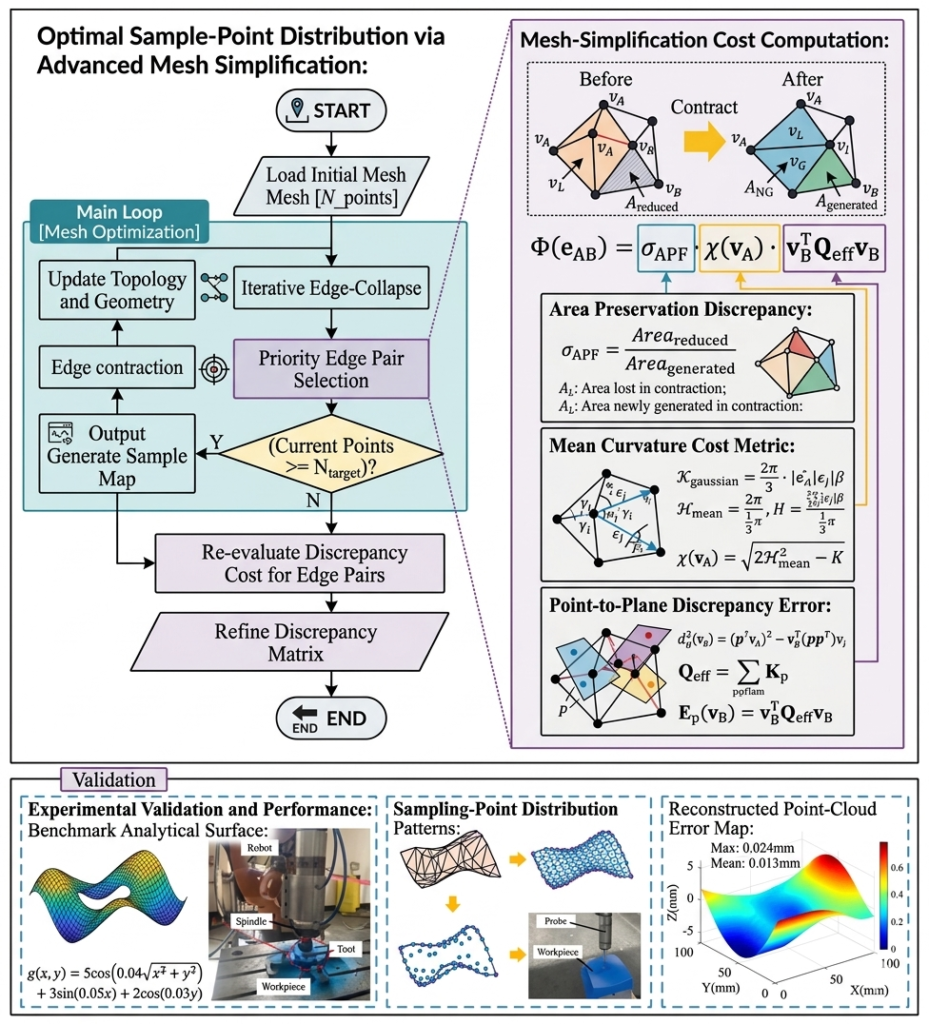
The researchers approached the sampling problem through the geometry of a triangular mesh. A dense mesh, obtained from the surface parametric equation or CAD model, served as the representation of the free-form surface. Rather than placing measurement points independently, the method simplifies this mesh and then uses the retained vertices as sampling points. This is a meaningful design choice: if the simplified mesh preserves both geometric information and reasonable spatial coverage, then its vertices become a natural measurement plan rather than an arbitrary set of probe locations. The simplification procedure was built around edge contraction, but with an important modification. Conventional quadratic error metric simplification determines a new contraction target vertex by solving for the position that minimizes the accumulated squared distance to adjacent triangle planes. That calculation can require an invertible coefficient matrix, and when such conditions are not satisfied, additional selection rules are needed. To reduce this source of complexity, the proposed method restricts contraction targets to existing vertices. An edge is contracted by mapping one vertex to another existing vertex, and the simplification cost is stored by vertex sequence rather than by all edge sequences. This changes the computational character of the simplification step while keeping the retained vertices on the original surface, which matters because those vertices later become the measurement points.
The authors gave also careful attention to boundary behavior. Boundary edges and internal edges are distinguished, with boundary vertices constrained to pair only with other boundary vertices. Corner vertices, defined by boundary-edge angles below 90 degrees, are excluded from vertex-pair contraction. These rules are not incidental implementation details; they protect the mesh from degradation during simplification and preserve the surface boundary structure that would otherwise be vulnerable during repeated contractions. Quadratic error alone was not sufficient for the authors’ purpose, because it can assign the same simplification cost to local configurations with different geometric features. Curvature was therefore incorporated through quadratic mean curvature, calculated from discrete Gaussian and mean curvature. Yet curvature weighting by itself can drive too many sampling points into high-curvature zones and leave low-curvature regions sparsely represented. The central technical addition is the area preservation factor, defined from the ratio between area lost during contraction and newly generated area. By linking contraction cost to triangle-area change, the method connects a local mesh operation to the spatial region effectively represented by each sampling point. This analytical strategy has a direct scientific consequence: it prevents feature-sensitive sampling from becoming excessively clustered, because each retained vertex is encouraged to carry a more balanced surface patch. Simulation on a wave surface provided the first evaluation. The researchers defined the surface over a square domain and discretized it into a dense triangular mesh before simplification. When mesh simplification used only QEM, elongated triangles appeared. Adding QMC increased concentration differences between high- and low-curvature regions, whereas the proposed multi-constraint method reduced the area ratio markedly, confirming the role of the area preservation factor in improving distribution uniformity. Accuracy followed the same pattern. Using 64 sampling points, the proposed method produced the smallest reconstruction errors, with a PVE of 0.13 mm and an RMSE of 0.033 mm, clearly lower than the comparison strategies. When the number of sampling points was varied, the proposed method retained a steadier accuracy response. Even after a substantial reduction in sampling points, the increase in PVE remained comparatively modest. The authors used a robot-milled wave surface on a polyoxymethylene block, followed by CMM measurement. A high-density uniform point set provided the reference surface parameters against which the reduced sampling strategies were compared. With 64 points, the proposed strategy reconstructed the surface with maximum and mean milling errors close to the high-density reference values. These deviations met the stated accuracy criteria and were closer to the reference values than those obtained by uniform, QEM, or edge-constrained sampling.
The engineering applications and implications of the work of Harbin Institute of Technology scientists are in improving contact-based inspection of free-form surfaces, especially when measurement accuracy must be maintained without collecting an unnecessarily large number of probing points. It is relevant to CMM inspection and contact-probe-based on-machine measurement, where point distribution controls inspection time, reconstruction accuracy, and surface-quality evaluation. We can think of a direct engineering implication is that inspection programs for known free-form surfaces can be made more efficient by deriving sampling points from a simplified mesh rather than using uniform or blind sampling. Uniform sampling is simple and widely usable, although it assigns the same sampling logic to regions whose geometry may vary substantially. By simplifying the CAD- or parametric-surface mesh under multiple constraints and using the retained vertices as measurement points, the sampling plan remains tied to the actual geometric character of the part rather than to a fixed grid. For industrial inspection, that is important because many free-form surfaces contain regions where curvature, local shape variation, and surface area coverage must be balanced rather than considered separately.
Optical measurement methods can be difficult when surfaces are reflective, blackened after heat treatment, or measured under less controlled in-site conditions, while chromatic confocal measurement can be limited by surface slope. The new study therefore positions contact measurement as a robust option for such cases. A better adaptive sampling strategy could help make contact-based inspection more practical in machining environments where dense probing would consume too much time but sparse probing could miss important geometric deviation. Another application is in reducing inspection time while preserving useful accuracy. In the simulation, the proposed method achieved lower reconstruction error than uniform sampling, QEM-based sampling, and edge-constrained sampling when using the same number of sampling points. The sampling-point quantity analysis also indicates that the method retains comparatively stable accuracy even when the point count is reduced. A robot-milled wave surface was measured using a CMM, and the proposed sampling strategy gave maximum and mean milling errors close to the high-density reference measurement. The reported deviations from the high-density reference remained within the stated accuracy criterion, supporting practical inspection of machined free-form surfaces rather than only numerical reconstruction. By combining quadratic error, quadratic mean curvature, and an area preservation factor, the method balances surface-feature sensitivity with sampling uniformity. The area preservation factor makes the sampling distribution more balanced, helping each measurement point represent a reasonable surface patch.



Reference
Ma Zhifu, Lu Yong, Ma Shoudong, Deng Kenan, An adaptive sampling method based on simplified mesh with multi-constraint for free-form surface measurement, Precision Engineering, Volume 96, 2025, Pages 757-769,
Go to Journal of Precision Engineering