Advances in Engineering Advances in Engineering features breaking research judged by Advances in Engineering advisory team to be of key importance in the Engineering field. Papers are selected from over 10,000 published each week from most peer reviewed journals.

Significance
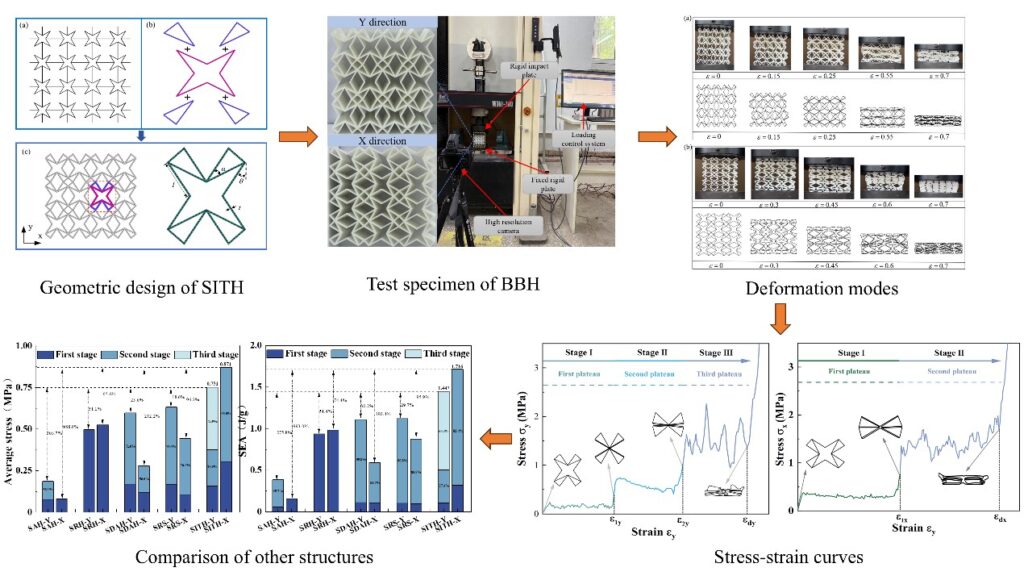
Under in-plane compression, many cellular architectures dissipate energy in an uneven way once local wall rotation gives way to unstable collapse, and that loss of order becomes a serious design problem when protection must persist beyond a single plateau. Lightweight cellular solids are attractive because they can combine low mass with load-bearing capacity and controlled crushing, however, the mechanical response that matters most in protective service is seldom governed by one property alone. Stress level, deformation sequence, lateral strain response, and the duration of stable crushing all become entangled once the unit cell starts folding. For structures intended for crashworthiness, packaging, or impact mitigation, the difficulty is not simply to absorb energy, but to do so progressively, predictably, and in more than one loading direction. Much of the earlier effort concentrated on auxetic and re-entrant topologies and those geometries can generate unusual deformation paths and favorable compressive behavior, but still they are limited. Large negative Poisson’s ratio effects may promote desirable folding modes, although they also make deformation control more demanding. Reinforcing ribs or hybrid inserts may steady the collapse, though each added feature narrows geometric freedom and complicates fabrication. Other approaches rely on thickness variation, rotation-based mechanisms, or mixed topologies to create secondary plateaus. Indeed, many reported systems provide only two-stage compression, or they express staged behavior in one in-plane direction while remaining less convincing in the orthogonal one. For engineering components exposed to uncertain loading paths, that directional asymmetry limits confidence in directional tunability. In a recent research paper published in Materials & Design, Qipeng Zhang, a master’s student at Northeast Forestry University, together with Professor Jie Jia of Northeast Forestry University, Lin Dong, a lecturer at Harbin University, and Guoliang Zhi, a PhD student at Southeast University, developed a star-isosceles triangular honeycomb that replaces the ribs of a star-shaped unit with isosceles triangular honeycomb that replaces the ribs of a star-shaped unit with isosceles triangular components while preserving a controllable relative-density formulation They also built a deformation-based theoretical model that predicts stage-specific plateau stresses and critical strains through plastic-hinge dissipation and external work balance. Distinct from earlier star-based hybrids that mainly produced secondary plateaus or directional staging, this architecture delivers three plateau stages under Y-direction compression and two under X-direction compression. The study also establishes an angular tuning framework linking θ and α to stage stresses, Poisson’s ratio evolution, and specific energy absorption.
The researchers built the honeycomb by tying the triangular hypotenuse length to the original star-cell wall length. The team fabricated PLA specimens by fused deposition modeling, measured the constitutive response of the printed material in tensile loading, and then compressed the cellular samples quasi-statically along both in-plane directions. In parallel, the authors constructed ABAQUS shell models with contact and friction to reproduce the experiments and to extend the analysis into an aluminum-alloy ideal elastic-plastic setting, where ductile buckling could be examined without the fracture behavior peculiar to PLA. The investigators demonstrated that the architecture does not crush in the same manner along the two principal directions and for instance under Y-direction loading, the star-derived oblique members rotated first and generated a layerwise collapse pattern, after which the triangularly defined rhombic region entered deformation and introduced a second transition. The measured response carried three plateau stages separated by two sharp stress rises. Under X-direction loading, the triangular units rotated inward at the outset, one major transition emerged when an oblique triangular side reached the horizontal position, and the structure then entered a second plateau regime driven by more complicated bending and contact. Indeed, the cell is not just stronger in one orientation than another; but its topology stores two different collapse logics and activates them according to loading direction.
The research team found close agreement between experiment and finite element prediction. For Y-direction compression, the reported differences between average experimental and numerical plateau stresses remained small across the three stages. The X-direction comparison showed the same pattern. The deformation images and the simulations tracked each other closely enough that the later parametric study had a credible foundation. At the same time, the paper also captures the more irregular part of the crushing response. Once internal contact intensified, the curves developed noticeable fluctuations, especially in the later stages where bending, rotation, and edge contact occurred simultaneously. The authors then developed a plastic-hinge and energy-conservation model for the staged deformation process and used it to predict plateau stresses and critical strains in both loading directions. They complemented that framework with angular parametric analyses. The calculations showed that the geometric angles had limited effect on average plateau stress and specific energy absorption in a global sense, though they altered the stress carried by individual stages much more strongly. The same parameter study revealed a directional difference in lateral strain response: under Y-direction compression, the structure moved from negative Poisson’s ratio behavior into positive values, while under X-direction compression it retained negative Poisson’s ratio behavior throughout. Smaller values of the angle θ generally increased specific energy absorption in both directions because they demanded larger rotations before compaction and generated more plastic hinges; increasing α generally reduced specific energy absorption, with one low-angle exception under X loading linked to a longer low-force first plateau.
To summarize, Professor Jie Jia, PhD Guoliang Zhi, and colleagues demonstrated that staged crushing can be programmed through morphological transitions that differ by loading axis but still remain intelligible enough to model. In many cellular systems, multi-plateau behavior appears after the fact as an observed curve shape. The paper showed, the plateaus are tied directly to identifiable geometric events: rotation of star-derived members, reorientation of triangular oblique sides, contact formation, and later hinge-dominated collapse. That shift from empirical description toward mechanism-led design has practical value. A designer who can associate each plateau with a structural transition gains a more disciplined route for tuning protection systems than one who slightly adjusts density and waits for the stress–strain curve to cooperate.
Hybridization in honeycomb design is often treated as a way to borrow strengths from two parent motifs, yet the paper makes clear that the real benefit may lie in how one motif restrains the failure tendencies of the other. The isosceles triangular addition contributes kinematic discipline. That pairing does not erase complexity; the later crushing stages still fluctuate once internal contact grows. In that sense, the triangular component does more than reinforce the cell. It organizes when and how the topology is allowed to deform, and that temporal control of collapse is what produces usable stress plateaus.
The comparison with previously reported star-based hybrid honeycombs strengthens this reading. Under equivalent relative density and loading conditions, the SITH configuration exceeded the compared structures in plateau stress and specific energy absorption, while also preserving staged behavior in both in-plane directions. The new study establishes that a star–triangle combination built around isosceles components can outperform several existing star-derived designs within the particular quasi-static framework examined here. A further consequence concerns constitutive simplification and modeling strategy and the paper opens a path toward geometry-driven design maps in which collapse sequence becomes a design variable. The authors point toward size effects and high-strain-rate response as the next questions and if the same transition-governed logic persists when inertia and scale enter the problem, this architecture could become useful in settings where loading is uncertain and directional robustness matters as much as total absorbed energy.




Reference
Qipeng Zhang, Jie Jia, Lin Dong, Guoliang Zhi, In-plane bidirectional quasi-static compression behavior of a novel multi-step star-isosceles triangular honeycomb, Materials & Design, Volume 259, 2025, 114836,
Go to Journal of Materials & Design