Advances in Engineering Advances in Engineering features breaking research judged by Advances in Engineering advisory team to be of key importance in the Engineering field. Papers are selected from over 10,000 published each week from most peer reviewed journals.

Significance
Atomic layer deposition provides precise control over surface coatings by introducing gaseous reactants one at a time, allowing each reaction to stop naturally when the available surface sites are filled. With nanoparticles, however, the very large surface area creates an added challenge: the precursor must travel through porous particle agglomerates to reach active sites buried within the structure. Fluidized bed atomic layer deposition addresses the need for high-throughput particle processing by dispersing nanoparticles in a gas stream while exposing them alternately to precursor and purge gases. Its performance depends on both reaction kinetics at the nanoparticle surface as well as how efficient each precursor moves through the hierarchical structures formed by cohesive particles.
Nanoparticles in a fluidized bed are not isolated objects and adhesive forces cause them to assemble into relatively stable primary agglomerates, typically a few micrometres in diameter. These units can then combine into much larger complex agglomerates with fractal structures extending to hundreds of micrometres or several millimetres. Complex agglomerates may break and recombine during fluidization, whereas the smaller primary structures are more resistant to fragmentation. Precursor transport must therefore proceed through several distinct environments: from the surrounding gas into a dispersion of complex agglomerates, through the outer structure of each complex agglomerate, and finally into the pores of its constituent primary agglomerates before adsorption and surface reaction can occur.
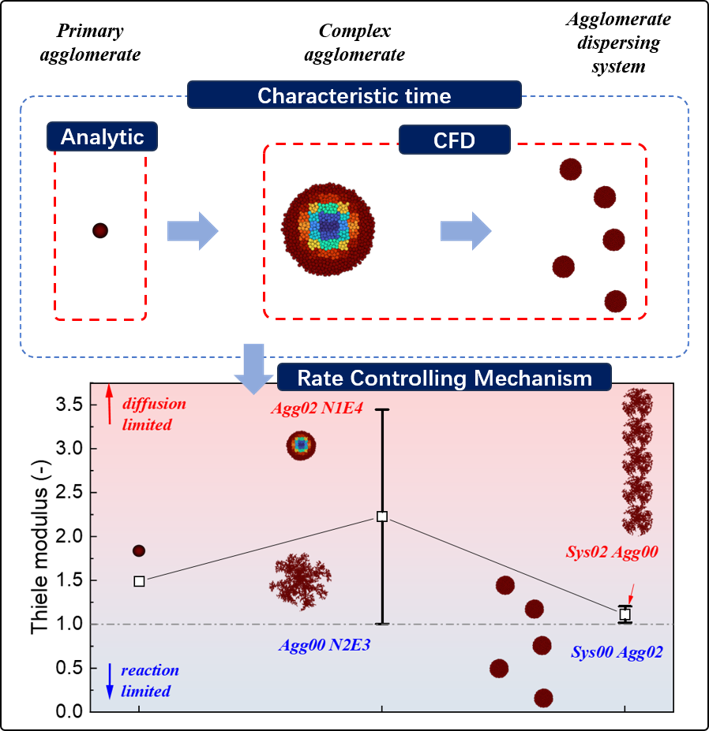
The challenge is to determine how much transport resistance arises at each structural level. Agglomerates have irregular internal structures, so their size, compactness, and fractal dimension determine how easily the precursor can move through them and how far it must travel. Existing descriptions have treated diffusion within pores, precursor utilization at the reactor scale, or particle coating in fluidized systems. What remained unclear was how the different levels of nanoparticle agglomeration affect precursor transport, surface saturation, and coating uniformity. In a recently published research paper in Chemical Engineering Science, Professor Daoyin Liu’s group from School of Energy and Environment at Southeast University, developed a CFD-DEM-based multiscale model that couples precursor transport with reversible adsorption and self-limiting atomic layer deposition kinetics across primary agglomerates, complex agglomerates, and monodisperse agglomerate systems. They introduced a generalized Thiele modulus that identifies whether reaction or diffusion dominates at each structural level. They also formulated a semi-empirical expression that predicts complex-agglomerate diffusion characteristic time from fractal dimension, agglomerate size, and primary-agglomerate saturation time.
In their modeling work, the trimethylaluminum-water process for alumina deposition served as the reaction system. Within each primary agglomerate, precursor penetration was represented through a lumped diffusion-reaction description. Transport around and between primary agglomerates was calculated directly for complex fractal structures and for systems containing several complex agglomerates. Reversible Langmuir adsorption, desorption, and irreversible surface reactions linked the local gas concentration to surface coverage and film growth. A primary agglomerate provided the reference state for evaluating larger structures. Agreement between the simulated mass-gain evolution and experimental quartz crystal microbalance data from the literature supported the treatment of the reaction kinetics.
After model validation, Zuyang Zhang et al further examined complex agglomerates with different fractal dimensions and numbers of primary agglomerates and found their internal coating patterns changed markedly with structure. In loose agglomerates, saturation depended strongly on position along the direction of precursor flow: upstream particles reacted first, followed by particles farther downstream. As the fractal dimension increased, the agglomerate became denser, and a particle’s position inside it mattered more. Particles near the surface received the precursor first and reached saturation sooner, while particles near the centre coated more slowly. The coating therefore moved gradually from the outside toward the centre. The authors found local resistance increased toward the centre of compact agglomerates and followed an approximately parabolic radial profile, whereas the variation was closer to linear in loose structures. Saturation time increased with both fractal dimension and the number of primary agglomerates. Large, compact agglomerates also developed broader growth-per-cycle distributions and lower mean growth than loose agglomerates containing the same number of primary units. Particles embedded near the centre experienced the greatest precursor depletion.
The team next compared isolated agglomerates with monodisperse systems having the same total surface area. A single-agglomerate calculation reproduced the system saturation time closely when the dispersion was loose or the constituent agglomerates were compact. Dense arrangements increased competition for precursor, particularly for downstream agglomerates. The coating history of one complex agglomerate can therefore represent a monodisperse assembly with useful accuracy under the conditions examined, although the correspondence depends on both agglomerate morphology and inter-agglomerate spacing.
The team pinned the complex agglomerate as the primary culprit for transport resistance. For process designers, this means reactor performance cannot be optimized simply by tracking total solids or surface area. In fact, two powder beds with identical nanoparticle mass will require completely different exposure times if their internal fractal structures and agglomerate sizes do not match. From a practical standpoint, the goal should be tuning fluidization conditions to prevent these dense agglomerates from forming in the first place. Keeping the structures small and open shortens internal diffusion paths, minimizes concentration gradients, and lets surface sites saturate much more uniformly. While the simulations show that longer exposure times can eventually force deep particles to saturate, doing so naturally drags out the entire deposition cycle.
To help navigate these trade-offs, the authors’ generalized Thiele modulus gives engineers a clear way to see whether diffusion or reaction kinetics dominate at any given structural level. In loose agglomerates, for instance, both forces usually come into play, meaning engineers will need to carefully coordinate temperature, precursor concentration, and exposure times to get the best results. The proposed diffusion-time correlation enables agglomerate transport behaviour to be represented in larger-scale reactor models. It estimates the diffusion characteristic time from agglomerate size, fractal dimension, and primary-agglomerate saturation time without resolving every nanoparticle individually. The resulting values can be incorporated into fluidized bed simulations through corrected adsorption rates, linking local agglomerate structure with reactor-scale precursor consumption and coating progress. Finally, the close correspondence between isolated agglomerates and loosely dispersed monodisperse systems indicates that representative single-agglomerate calculations can reduce computational cost.
Reference
Zuyang Zhang, Liyuan Zhang, Hongjian Tang, Daoyin Liu, Coupled precursor mass transfer and atomic layer deposition in nanoparticle agglomerates: From primary to complex structures via CFD-DEM simulation, Chemical Engineering Science, Volume 318, 2025, 122157,
Go to Chemical Engineering Science