Advances in Engineering Advances in Engineering features breaking research judged by Advances in Engineering advisory team to be of key importance in the Engineering field. Papers are selected from over 10,000 published each week from most peer reviewed journals.

Significance Statement
Just mix water and oil and a simple co-solvent such as ethanol to form a “simple” homogeneous and transparent solution. Such a trivial system – who would think that they contain structures similar to micelles, but formed without any surfactant? But this is precisely what happens, as could be proven recently by Kunz, Zemb and co-workers. What seems of a purely academic interest has significant consequences for the design of products. It clears also the way to surfactant-free and hence greener production processes. In formulations, substances incorporated in such micellar-like structures have a distinctly different vapour pressure and probably also a different diffusional behavior allowing to better design perfume and other fragrance formulations and even the performance of insect repellent products to mention just few examples.
References:
M. L. Klossek, D. Touraud, T. Zemb, W. Kunz, Structure and solubility in surfactant-free microemulsions, ChemPhysChem 13 (2012) 4116-4119.
J. Marcus, M. L. Klossek, D. Touraud, W. Kunz, Nano-droplet formation in fragrance tinctures, Flavour Frag. J. 28 (2013) 294-299.
Journal Reference
Colloids and Surfaces A: Physicochemical and Engineering Aspects. Available online 26 November 2013.
Julien Marcus, Martina Müller, Joseph Nistler, Didier Touraud, Werner Kunz.
Institute of Physical and Theoretical Chemistry, University of Regensburg, 93040 Regensburg, Germany.
Abstract
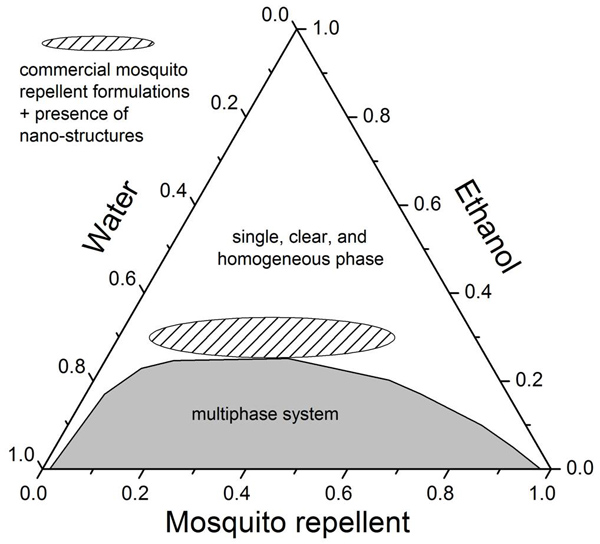
It was recently demonstrated that nano-structures were present in water/ethanol/oil systems, where the oil was either octanol or fragrance molecules. The goal of the present work is to check if such structures exist also in other, related systems and if a general concept can be deduced from these observations. To this purpose, natural and synthetic mosquito repellent molecules were investigated, which represent nearly all repellents used on the market. For the ternary water/alcohol (ethanol or isopropanol)/repellent systems ternary phase diagrams were established. The presence and the ordering of the nano-droplets were checked and characterized with dynamic and static light scattering and conductivity measurements. Based on these results it can be concluded that a nano-ordering with generally an organic continuum exists in hydro-alcoholic commercial mosquito repellents, and thus that these systems are not simply molecular solutions. This might have a consequence for diffusion processes in the skin.