Advances in Engineering Advances in Engineering features breaking research judged by Advances in Engineering advisory team to be of key importance in the Engineering field. Papers are selected from over 10,000 published each week from most peer reviewed journals.

Significance
Electric field concentration at nanometer-scale metal edges drives charge carriers into narrow current paths, producing localized current spikes that destabilize organic semiconductor junctions when device dimensions shrink below the wavelength of emitted light. Such behavior becomes unavoidable once conventional organic light-emitting diode architectures approach the submicrometer regime. Organic semiconductors tolerate large exciton binding energies and operate efficiently in multilayer vertical stacks, properties that historically allowed steady downscaling of OLED pixels for display technologies. Yet the physical processes governing charge injection and recombination change markedly when electrode dimensions contract to a few hundred nanometers. Sharp electrode contours intensify the electric field locally, distort the effective injection barriers, and alter the balance of charge transport across the organic layers. Current filaments can form at these locations, destabilizing the junction and frequently triggering irreversible breakdown. The problem grows acute when pixel densities exceed several thousand pixels per inch, a threshold already pursued in near-eye display technologies where visual artifacts arise from coarse pixel spacing. Conventional micro-OLED structures typically maintain lateral dimensions in the micrometer range, partly because smaller geometries encounter electrical irregularities that degrade performance. Organic semiconductors complicate this scaling effort in another way: their relatively low charge carrier mobilities make them particularly sensitive to variations in injection pathways. Once the injection process concentrates at nanoscale edge defects, transport across the device ceases to remain uniform. The recombination zone shifts unpredictably, and device behavior becomes dominated by uncontrolled conduction paths. Optical constraints emerge simultaneously. The emitted power of a pixel decreases approximately with the square of the ratio between its lateral dimension and the optical wavelength. Once pixel dimensions fall well below the emission wavelength, radiative efficiency declines sharply unless some mechanism redirects or concentrates the generated optical modes. Plasmonic structures offer one possible route. Metallic nanoantennas can couple excitonic emission into radiative modes that propagate into free space. Previous attempts integrated such structures into organic devices, yet these configurations usually relied on lateral device geometries that sacrificed the advantages of established multilayer OLED stacks.
A recent research paper published in Science Advances and conducted by Dr. Cheng Zhang, Dr. Björn Ewald, Dr. Leo Siebigs, Dr. Luca Steinbrecher, Dr. Dr. Maximilian Rödel, Dr. Thomas Fleischmann, Dr. Monika Emmerling, Professor Jens Pflaum, and led by Professor Bert Hecht from the University of Würzburg in Germany, the researchers developed a vertically stacked OLED architecture incorporating gold nanoelectrodes whose edges are insulated while a central nanoaperture defines the charge injection site. This geometry confines carrier injection to a region with uniform electric field distribution, preventing filament formation common in nanoscale electrodes. Integrated plasmonic patch antennas couple excitonic emission from the organic layer into radiative optical modes. The resulting system produces individually addressable OLED pixels with lateral dimensions of 300 nanometers.
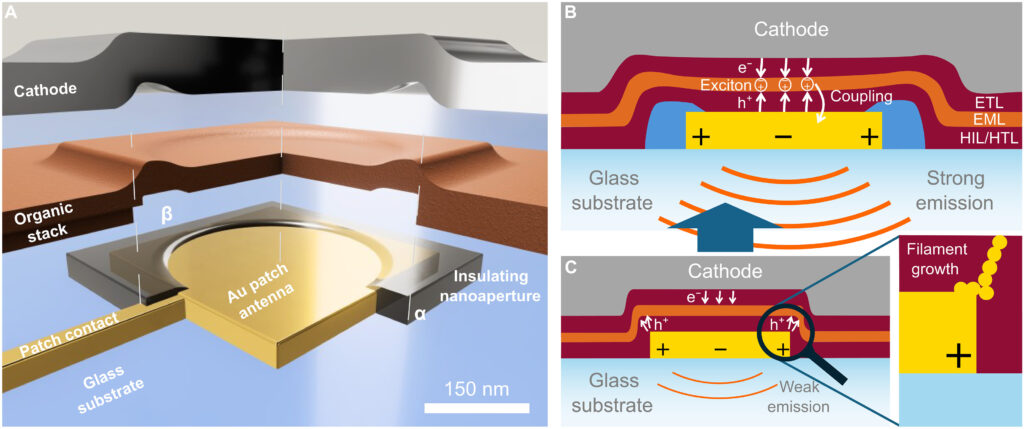
Briefly, the research team first examined whether nanoscale gold electrodes could function as reliable charge-injecting contacts when carefully engineered. Electrostatic simulations performed by the investigators revealed a pronounced amplification of the electric field along the edges and corners of square nanoelectrodes, reaching several times the field strength present at the electrode center. Those gradients provided a clear explanation for the erratic behavior commonly reported in nanoscale organic junctions. The researchers addressed this problem by covering the electrode with an insulating hydrogen silsesquioxane layer while leaving a small central opening that exposed only the flat interior region of the metal surface. Through this geometry, charge carriers entered the organic layers exclusively through the nanoaperture, eliminating the high-field injection sites located at the electrode perimeter. The investigators fabricated these structures using sequential electron-beam lithography steps that defined the gold patch electrodes and then patterned the insulating layer with a controlled gradient exposure. Development of the resist produced a nanoscale aperture positioned at the electrode center. Conductive atomic force microscopy measurements confirmed that electrical current flowed only through the exposed aperture, verifying that the insulating layer effectively blocked the edges. To verify the electrical characteristics of the concept before introducing light emission, the authors constructed hole-only junctions. The device stack incorporated a gold bottom electrode, an ultrathin HAT-CN interfacial layer that promoted hole injection, and an NPB organic transport layer. Measurements comparing nanojunctions with conventional macrojunctions revealed remarkably similar current density levels despite the enormous difference in device area. The research group fitted the electrical behavior using a space-charge-limited current model combined with Poole–Frenkel transport, obtaining hole mobility values consistent with established literature data. Interestingly, the nanoscale junction displayed slightly higher mobility parameters, an observation attributed to the smaller number of trap states present within the minute active volume of the device.
A more revealing comparison emerged when the investigators tested electrodes lacking the insulating aperture. Under repeated voltage cycling those structures displayed abrupt jumps in current, behavior consistent with the formation and rupture of metallic filaments driven by the concentrated electric fields at the electrode edges. Devices containing the nanoaperture remained stable throughout the same tests and exhibited only minor hysteresis during operation. Long-duration measurements under constant voltage reinforced the difference: electrodes without edge passivation failed within minutes, whereas the nanoaperture structures continued operating throughout the full measurement period. Having established stable charge injection, the study advanced to full light-emitting devices. The researchers fabricated vertically stacked nano-OLED pixels measuring 300 by 300 nanometers. Organic layers included a hole-transport region, a thermally activated delayed fluorescence emissive layer, and an electron-transport region, followed by a metal cathode. The gold patch electrode simultaneously acted as a plasmonic antenna. When voltage was applied, excitons formed in the emissive layer and coupled to resonant plasmonic modes supported by the patch antenna beneath the nanoaperture. The research team recorded electroluminescence beginning at approximately five volts and measured external quantum efficiencies approaching one percent. Even at this extreme scale the pixels reached luminance levels around three thousand candela per square meter and switched rapidly enough to exceed video refresh rates. Those observations demonstrated that the stabilized injection geometry preserved balanced charge transport within the multilayer stack while enabling nanoscale optical emission.
To summarize, miniaturization of optoelectronic devices frequently encounters limits that originate from electric field distributions rather than material properties alone. The new work of Professor Bert Hecht and colleagues illustrates how geometric control of the injection interface can redefine those limits. When a nanoelectrode injects carriers uniformly across its central region while the high-field edges remain electrically inactive, the organic semiconductor experiences a nearly planar injection boundary even though the electrode itself remains nanoscale. That geometric intervention changes the physical origin of device instability. Filament formation becomes improbable because the localized field maxima responsible for initiating metallic migration never participate in the conduction path. Such stabilization alters how nanoscale OLED architectures can be designed. Conventional scaling strategies usually attempt to preserve the same layered device structure while shrinking the lateral dimensions. The Würzburg study demonstrates that the injection interface must evolve simultaneously with device size. By confining charge injection to a defined nanoscale aperture, the recombination zone becomes spatially predictable. Excitons form above the aperture and interact consistently with the surrounding optical environment. In the present device that environment includes a plasmonic gold patch antenna, which converts localized excitonic energy into radiative optical modes that propagate through the substrate.
When emitters couple to resonant antenna modes, the spectral distribution and radiation pattern of the emitted light depend strongly on the geometry of the metal structure. Electromagnetic simulations performed by the research group indicated that vertical and horizontal dipole orientations excite distinct antenna modes, with the dominant resonance occurring near 650 nanometers. Experimental spectra matched the simulated convolution of the molecular emission profile with the antenna outcoupling efficiency, demonstrating that the antenna modes shape the final emission spectrum. This spectral reshaping is not merely an aesthetic effect. It implies that nanoscale OLED pixels could be engineered to tailor their emission profiles through antenna geometry alone, without altering the molecular emitter. Practical implications extend beyond display technology. Individually addressable emitters with dimensions far below the optical wavelength open possibilities for on-chip photonic circuits, nanoscale sensing platforms, and spatially structured optical sources. Integration density becomes a central parameter in those contexts. The devices demonstrated here already operate at pixel dimensions that approach theoretical limits for OLED scaling. Future improvements will likely depend on refinements of the organic stack and antenna geometry. The present prototype exhibits some imbalance between electron and hole transport, leading to charge accumulation at higher voltages. Incorporating doped transport layers and optimized confinement structures—techniques widely used in commercial OLED engineering—should reduce operating voltages and increase efficiency. Scaling to extremely dense pixel arrays introduces additional design constraints. Neighboring antennas may interact optically or electrically if their spacing becomes too small. Any practical implementation must coordinate lithographic patterning, organic layer design, and antenna resonance tuning. Success in that direction could produce emissive arrays exceeding ten thousand pixels per inch, densities appropriate for emerging light-field displays and integrated photonic systems.


Reference
Zhang C, Ewald B, Siebigs L, Steinbrecher L, Rödel M, Fleischmann T, Emmerling M, Pflaum J, Hecht B. Individually addressable nanoscale OLEDs. Sci Adv. 2025;11(43):eadz8579.