Advances in Engineering Advances in Engineering features breaking research judged by Advances in Engineering advisory team to be of key importance in the Engineering field. Papers are selected from over 10,000 published each week from most peer reviewed journals.

Significance Statement
Research on polymer nanocomposites has been at the frontier of polymer science and engineering in the past few decades. Polymer nanocomposites integrate nanoparticles into a polymer matrix, and often exhibit excellent thermal, mechanical, electrical and optical features when compared with pure polymeric materials. The fabrication of polymer nanocomposites as well as their processing calls for an in-depth understanding of their viscoelastic properties. At the heart of the viscoelasticity of polymer nanocomposites is the coupling between the motion of nanoparticles and the relaxation dynamics of polymer matrix chains.
Experiments, computer simulations, and theoretical studies have demonstrated that the dynamical coupling between nanoparticles and linear polymers depends on the diameter of the particles with respect to the entanglement mesh size of the polymer. If the diameter is smaller than the mesh size, the nanoparticle motion is coupled to the unentangled dynamical modes of local chain segments, resulting in subdiffusive motion before Fickian diffusion. If the diameter is larger, the particles are confined by the entanglement mesh for time scales longer than the relaxation time of entanglement strands.
One active research topic is the dynamical coupling between nanoparticles and polymers with non-linear architectures, such as star, branched, and ring polymers. Recently, Prof. Michael Rubinstein and Dr. Ting Ge at the University of North Carolina in the USA studied nanoparticle motion in nonconcatenated ring polymers. “Nonconcatenated ring polymers are of particular interest, owing to their unique topology that gives rise to distinctive conformational and dynamic properties” said Prof. Rubinstein. “Moreover, non-concatenated ring polymers are good models of biopolymers commonly found in many biological systems such as bacterial and mitochondrial genomes, as well as DNA plasmids.” Other researchers contributed to the study included Prof. Jagannathan Kalathi at Indian National Institute of Technology Karnataka in India, Dr. Jonathan Halverson at Max Planck Institute for Polymer Research in Germany, and Dr. Gary S. Grest at Sandia National Laboratories in the USA. The research work is now published in Macromolecules.
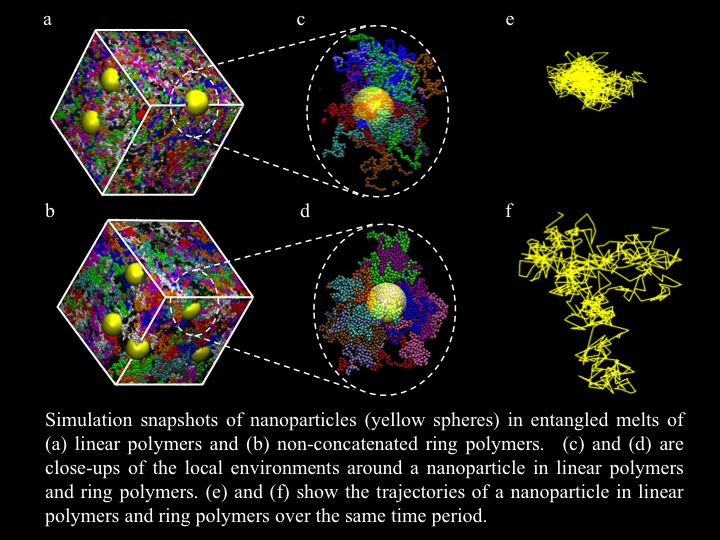
The team performed molecular dynamics simulations of nanoparticles in melts of entangled linear and entangled nonconcatenated ring polymers. They employed the bead-spring model to simulate the polymers. Neighboring beads in a polymer were connected by the finitely extensible non-linear elastic (FENE) potential. Nanoparticles were modelled as smooth spheres that interact with each other via repulsive potential. The interactions between nanoparticles and polymers were weakly attractive, so the particles were well dispersed in the polymers. “Our simulations were built on a solid foundation,” said the first author Ting Ge. “Previously, Prof. Kalathi had extensively simulated nanoparticles in linear polymer melts, while Dr. Halverson had performed systematic simulations of pure non-concatenated ring polymers. Dr. Grest, a world-renowned computational physicist, offered invaluable guidance on setting up the new simulations.”
The simulations by the authors revealed the stark contrast between nanoparticle motion in linear polymers and in non-concatenated ring polymers. Nanoparticle motion was strongly suppressed before Fickian diffusion in entangled linear polymers. The strong suppression occurred progressively as the diameter of nanoparticles exceeds the entanglement mesh size. In contrast, the motion of nanoparticles with diameters larger than the entanglement spacing in ring polymers was not as strongly suppressed as in linear polymers. The decrease in the diffusion coefficient with increasing particle diameter in ring polymers was more gradual compared to the steep drop of the coefficient in linear polymers.
The authors analyzed the nanoparticle motion in linear chains on the basis of the hopping diffusion mechanism proposed by Rubinstein’s group. For nanoparticles in rings, the authors developed a scaling theory for the coupling between the nanoparticle motion and the self-similar dynamics of entangled rings. The comparison of nanoparticle motion in linear polymers and non-concatenated ring polymers demonstrated the significance of polymer architecture in the dynamical coupling between nanoparticles and polymers in nanocomposites.




Reference
Ting Ge, Jagannathan T. Kalathi, Jonathan D. Halverson, Gary S. Grest, and Michael Rubinstein. Nanoparticle Motion in Entangled Melts of Linear and Nonconcatenated Ring Polymers. Macromolecules 2017, 50, pages 1749−1754.
Go To Macromolecules