Advances in Engineering Advances in Engineering features breaking research judged by Advances in Engineering advisory team to be of key importance in the Engineering field. Papers are selected from over 10,000 published each week from most peer reviewed journals.

Significance
The recent technological advancement of nanostructured materials has helped unveil their novel properties that enable their diverse applications in various fields such as in medicine, photonics, and optoelectronics among others. Presently, copper oxides are the most promising amongst the available semiconducting nanostructured materials. As of now, high-temperature processes are most used in the synthesis of copper oxides. These processes encompass several detrimental shortcomings such as the fact that they limit control over the interfacial characteristics of the thin films, and the use of templates and colloidal synthesis methods which leads to low adherence over conducting substrates. Recently, electrochemical anodization has been successfully employed in the fabrication of several nanostructures. Unfortunately, little has been published regarding electrochemical preparation of copper oxide/hydroxide nanostructures that elucidates on the oxidation mechanisms.
To this note, a collaboration Chilean scientists led by Diego P. Oyarzún Jerez and Argentinian researchers at National University of Cordoba led by Omar E. Linarez Pérez proposed a study whose main objective was to comprehend the chemical processes involved during the anodization of copper in alkaline water/ethylene glycol media containing fluoride ions. The research team hoped to successfully obtain specific nanostructures from their proposed method. Their work is currently published in Journal of Electroanalytical Chemistry.
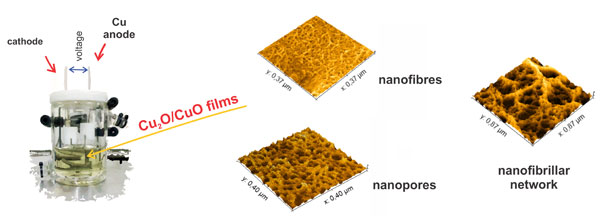
Briefly, the research method employed commenced by correlating the dependence of the morphology and chemical composition of the anodized copper surfaces to the experimental conditions. The team then proceeded to study the morphology of the formed nanostructures using field-emission scanning electron microscopy. Eventually, they obtained the chemical compositions of the resulting nanostructures by means of Raman and X-Ray photoemission spectroscopy.
The authors observed that in the absence of fluoride, the anodization of copper in alkaline water/ethylene glycol media produced mainly Copper (II) species meanwhile, in fluoride-containing media, Copper (I) oxide formation took place. On the other hand, the researchers realized that the subsequent oxidation to Copper (II) species occurred in the more alkaline media.
The Diego P. Oyarzún Jerez and colleagues study has demonstrated that the anodization of copper in alkaline water/ ethylene glycol media containing fluoride ions generates different nanostructured oxide films. It has been seen that by modifying the anodization conditions nanofibrillar and nanoporous Copper (I) oxide or Copper (II) oxide/copper hydroxide films are obtained. Moreover, the Raman and X-Ray photoemission spectroscopy measurements have provided high quality information about the chemical states of the nanostructured films for the experimental conditions employed. To this end, these findings may allow tuning both the chemical species and the film morphology to generate specific nanostructured materials for potential use in a wide range of applications.




Reference
Diego P. Oyarzún Jerez, Manuel López Teijelo, Wilkendry Ramos Cervantes, Omar E. Linarez Pérez, Julio Sánchez, Guadalupe del C. Pizarro, Gabriela Acosta, Marcos Flores, Ramiro Arratia-Perez. Nanostructuring of anodic copper oxides in fluoride-containing ethylene glycol media. Journal of Electroanalytical Chemistry, volume 807 (2017) page 181–186.
Go To Journal of Electroanalytical Chemistry