 Advances in Engineering Advances in Engineering features breaking research judged by Advances in Engineering advisory team to be of key importance in the Engineering field. Papers are selected from over 10,000 published each week from most peer reviewed journals.

Significance Statement
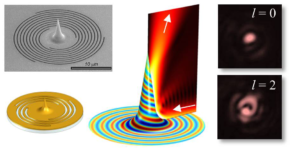
Dr. Yuri Gorodetski from Ariel University in Israel in collaboration with the group of Dr. Francesco De Angelis at Istituto Italiano di Tecnologia in Genova, Italy developed a method for generating far-field propagating optical beams having an angular momentum using a smooth optical mode transformation between plasmonic vortex and free-space Laguerre-Gaussian modes . Recently, it was shown that surface-confined collective helical modes – plasmonic vortices – can be excited by means of axially symmetric surface structures. It was also demonstrated, that these modes can carry an orbital angular momentum corresponding to the helical phase topology. However, due to the evanescent character of these waves, their angular momentum is limited to a subwavelength region in the vicinity of the surface. Here the authors used a gold adiabatically tapered nanotip placed at a center of a spiral slit milled in a gold film. This architecture enabled to smoothly transfer the near-field plasmonic vortex mode to a far-field beam. They proposed an optimized and highly reproducible method of the nanostructure fabrication by using a secondary electron lithography technique.
The authors controlled the shaping the conical tip geometry and showed that the plasmonic vortex excited by the spiral structure can be adiabatically guided on the cone, carrying well defined angular momentum. Controlling the smoothness of tip basis is important in achieving the best light thtoughput. Their results showed that an increase in curvature of the conical structure will reduce the light scattering and improve the transmission. In addition, the cone tapering leaded to a gradual mode acceleration (a group velocity increase) up to the point where the plasmonic mode could be perfectly matched to the free space and the vortex beamed out. This scheme, according to the authors, enabled to produce highly efficient far-field beaming with large range of angular momentum values. This method was also shown to generate m almost pure circular polarization eigenstate. The optimized structure locks the emitted polarization handedness to the vortex topology providing an output polarization contrast of 83%.
The simulations showed that the proposed structure can work as an excellent coupler of focused Laguerre−Gaussian beam to plasmonic vortices. They corroborated the results using leakage radiation microscopy which demonstrated the generation of the near-field plasmonic vortex distribution.
The results of this study will advance the applications of singular optical beams in super-resolution imaging, optical tweezers, and telecommunications.
Journal Reference
Denis Garoli1, Pierfrancesco Zilio1, Yuri Gorodetski2, Francesco Tantussi1, and Francesco De Angelis1. Beaming of Helical Light from Plasmonic Vortices via Adiabatically Tapered Nanotip. Nano Letters, 2016, 16 (10), pp 6636–6643.
[expand title=”Show Affiliations”]- Istituto Italiano di Tecnologia, via Morego 30, I-16163 Genova, Italy
- Mechanical Engineering Department and §Electrical Engineering Department, Ariel University, Ariel, 40700 Israel
Go To Nano Letters