 Advances in Engineering Advances in Engineering features breaking research judged by Advances in Engineering advisory team to be of key importance in the Engineering field. Papers are selected from over 10,000 published each week from most peer reviewed journals.

Significance Statement
Substantial efforts have been made to review the fundamental nature of fuel sprays and associated phenomena, such as spray behaviors under different injection pressures, different environment conditions, and different fuel properties. These investigations in the past years show that the high-speed relative motion between the liquid jet and environment gas are the key factors causing the jet disintegration and atomization. Due to the highly transient and multiphase process of fuel injection, the inherent mechanism of spray atomization and evaporation has not been conclusively determined.
In a collaborative research, Dr. Weidi Huang and Dr. Seoksu Moon from National Institute of Advanced Industrial Science and Technology and Dr. Katsuyuki Ohsawa from Tottori University in Japan, the researchers determined the relationship between the nozzle internal flow and liquid-jet dynamic and solved the problem of lack of sufficient measurement methods. It is a known fact that, the precise control of injection event contributes greatly to the optimization of engine performances and the reduction in pollutant emissions. The research is now published in peer-reviewed journal, Fuel.
Huang et al. (2016) in view of overcoming the problem came up with X-ray phase-contrast imaging XPCI technique, to analyze the diesel spray. The high-energy and short-pulse X-ray beam enables the direct imaging of the needle motion through the steel nozzle tip and high-speed jet in the near field without severe scattering and absorption. By this technique, several investigations have been conducted to analyze the needle motion under the actual operating conditions, near-nozzle jet dynamics, and structures of diesel jets.
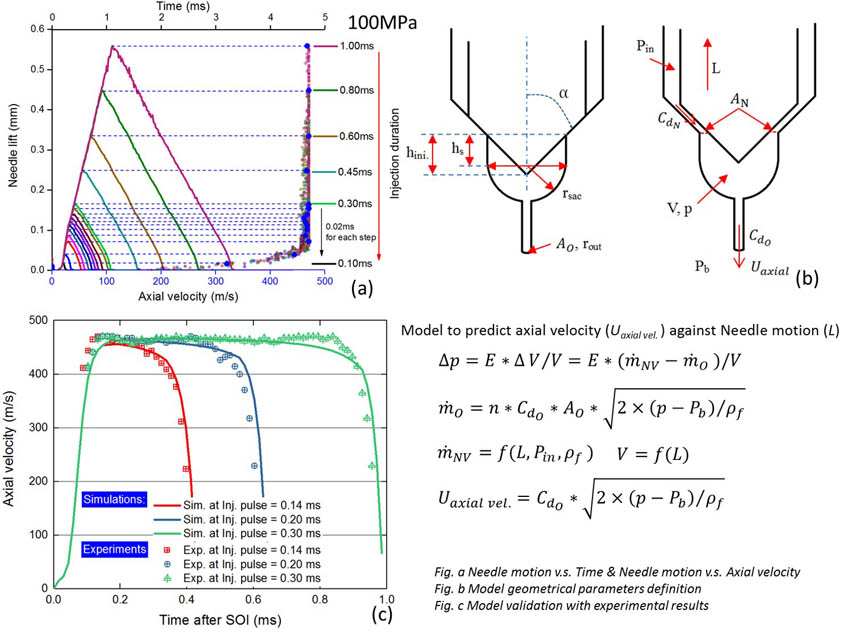
At higher injection pressure, the needle opening speed was observed to increase and the needle can be lifted to the higher location. And the duration of needle opening stage approximately equals to the injection-pulse duration. A stronger lifting force is conducted to the needle at higher injection pressure, thereby causing the needle moving faster and extending the injection-pulse duration do not affect the needle dynamics. To specific, regardless of the injection-pulse duration, the axial velocity increases exponentially at the initial needle-opening stage. During the steady state, the distance of the needle lift increases or even partly decreases after reaching its peak, the axial velocity keeps unchanged, explained the research team.
The injection pressure was varied, causing the steady-state axial velocity to increase, but the needle-lift dependence of axial velocity appears similar. The existence of critical needle-lift clearly points out that in the multiple-injection strategies, the insufficient needle lift under the short injection-pulse duration may hurt the initial spray momentum and flow performance. Research team find out that the needle-lift at which the jet axial velocity reaches its maximum in the opening stage is larger than that in the closing stage.
The sac pressure in the nozzle governed by the mass flow balance can be used to characterize the near-nozzle jet dynamics with the needle lift and an analytical model was established to predict the transient jet axial velocity. The adequacy of the proposed model has been widely validated by the experimental data, which provides a deep insight into the influencing mechanism of needle lift on the liquid jet dynamics.
In this study and with the newly developed X-ray phase-contrast imaging XPCI, the authors were able to measure the in-nozzle needle motion and the liquid-jet dynamics in the near-nozzle field in a wide range of injection-pulse durations. In obtaining a steady-state jet axial velocity under the corresponding injection pressure, the needle lift peak should be higher than 80 μm for the recent investigated injector.
Journal Reference
Weidi Huang1, Seoksu Moon1, Katsuyuki Ohsawa2, Near-Nozzle Dynamics of Diesel Spray under Varied Needle Lifts and its Prediction Using Analytical Model, Fuel 180 (2016) 292–300.
[expand title=”Show Affiliations”]- Research Institute for Energy Conservation, National Institute of Advanced Industrial Science and Technology, 1-2-1 Namiki, Tsukuba, Ibaraki 305-8564, Japan.
- Department of Mechanical Engineering, Tottori University, 4-101 Koyama-cho Minami, Tottori 680-8550, Japan.
Go To Fuel