Advances in Engineering Advances in Engineering features breaking research judged by Advances in Engineering advisory team to be of key importance in the Engineering field. Papers are selected from over 10,000 published each week from most peer reviewed journals.

Significance
The effect of light polarization plays a vital role in many applications, such as; fiber lasers, fiber gyroscopes, optical communication networks, and interferometric devices. Narrowing down to optical fibers, environmental perturbations coupled with fabrication imperfections induce a random birefringence and lead to an unpredictable output. Consequently, this translates into an unwanted behavior in the two polarization eigenmodes which can ultimately lead to polarization instability as a result of the induced mode competition. Fortunately, this shortcoming can be fixed by using polarization-maintaining fibers, which have the capacity to eliminate evolution of the unpredictable polarization. However, further research input into this stabilizing mechanism is necessary as the efficiency of the currently used systems is not satisfactory. Moreover, it is beneficial to show computationally that fiber devices can be implemented in negative curvature fibers to filter and maintain the polarization, thereby enabling efficient and compact all-fiber devices.
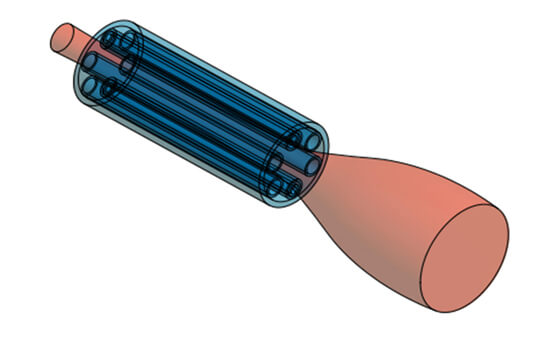
Recently, the collaborative effort among Prof. Chengli Wei from the University of Mary Hardin-Baylor, Prof. Jonathan Hu from Baylor University, and Prof. Curtis R. Menyuk from the University of Maryland, Baltimore County led to a proposal for a relatively simple negative curvature fiber with a high birefringence and a high differential loss between the two polarizations of the fundamental core modes. Their goal was to find a fiber structure where the coupling between the cladding modes and the fundamental core modes in the two polarizations occurs within different parameter ranges. Their work is currently published in the research journal, Optics Express.
In brief, the research method employed encompassed the development of a polarization-filtering and polarization-maintaining negative curvature fiber in which two nested resonant tubes were added to a standard negative curvature fiber with one ring of tubes. They then utilized the coupling between the glass modes in the nested resonant tubes and the fundamental core modes. Lastly, they showed that the coupling between one polarization of the fundamental air core mode and the glass mode increases the birefringence and differential loss for the fundamental core modes in the two polarizations.
The authors showed computationally that the birefringence and the loss ratio between the modes in the two polarizations could reach 10−5 and 850, respectively. They also observed that the low-loss mode had a loss rate that was lower than 0.02dB/m. The researchers also commented that the developed fiber design made it possible to combine the nonlinear polarization rotation and polarization filtering in one device by splicing a standard fiber with the proposed fiber design, which enables fast saturable gain in passively mode-locked lasers and more efficient fiber laser designs.
In summary, the study proposed a novel polarization-filtering and polarization-maintaining negative curvature fiber that included two nested resonant tubes. Generally, the developed design contains at most two glass layers, which has been demonstrated to be feasible to fabricate. Altogether, the relatively simple design of polarization-filtering and polarization-maintaining low-loss negative curvature fibers will be useful in systems that require a polarization filter that can be integrated with other optical fibers.



References
Chengli Wei, Curtis R. Menyuk, Jonathan Hu Polarization-filtering and polarization-maintaining low-loss negative curvature fibers. Volume 26, Number 8 | 2018 | Optics Express 9528.
Go To Optics ExpressChengli Wei, R. Joseph Weiblen, Curtis R. Menyuk, and Jonathan Hu. Negative curvature fibers. Volume 9, Number 3 | Sep 2017 | Advances in Optics and Photonics 405.
Go To Advances in Optics and Photonics