Advances in Engineering Advances in Engineering features breaking research judged by Advances in Engineering advisory team to be of key importance in the Engineering field. Papers are selected from over 10,000 published each week from most peer reviewed journals.

Significance
There has been significant technology advances in fabrication of biomaterials for use in various medical prosthesis applications. Unfortunately, most of the available biomaterials are susceptible to numerous infections which render most of them unfit for medical use. This has resulted in unsafe repeated surgical operations and permanent malformations. This has attracted significant attention of many researchers with the aim of reducing infection resulting from the biomaterials.
Despite the use of strict aseptic surgical procedures and antibiotic prophylaxis, the infection rate has still been on the rise. To this end, researchers have been looking for an alternative method for developing biomaterials with surface antibacterial functions to prevent bacterial infections. Among the available materials for the joint prosthesis and fracture fixation, silver nanoparticles are the commonly used antibacterial agent owing to its excellent properties including low resistance and longer lifespan. However, the addition of silver to titanium material has been identified as a good approach not only for improving the antibacterial property but also to reduce corrosion and release of ions in the surgical wounds.
To this note, several techniques such as plasma injection and ion-beam-assisted deposition have been developed for producing nano-silver coatings on the titanium surface. However, the methods are associated with some limitations like poor bonding of the coating to the substrate and uncontrolled release of silver ions which may result in further infections and medical complications. Friction stir processing technique for processing matrix nanocomposites has been recently identified with the potential of overcoming the aforementioned limitations. Even though it has been widely used in other applications like aerospace, its applicability in the medical field has not been fully explored. Consequently, the effects of surfaces modified by friction stir processing method on adhesion and increase of bacteria have not been investigated.
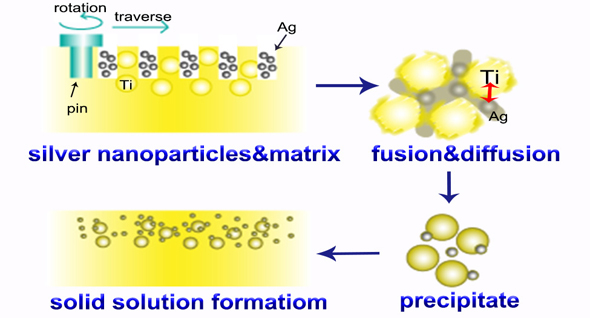
Recently, a group of researchers at Shanghai Jiao Tong University led by Professor Liqiang Wang and Professor Yuanfei Fu utilized friction stir processing method to deposit silver nanoparticles on titanium substrate. They further investigated the effects of friction stir processing and the addition of silver nanoparticles to titanium surface on the microstructure, corrosion, and antibacterial properties. They managed to improve the antibacterial property of the nanocomposite. The work is published in the journal, ACS Applied Materials and Interfaces.
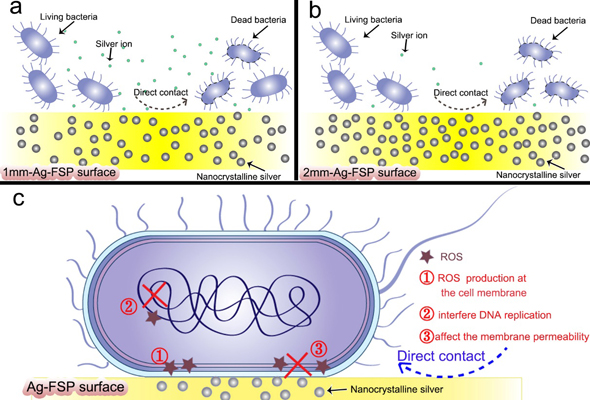
The authors observed that the silver nanoparticles were homogenously distributed on the titanium surface. Both friction stir processing and the addition of silver increased the corrosion resistance of the modified samples. For instance, the sample reduced the bacterial strain and adhesion with no any resulting cytotoxicity to the bone stem cells. Furthermore, the release of silver ions had negligible effects on the antibacterial effect as compared to the number of deposited silver nanoparticles on the surface.
The study by Zhi Yang and colleagues will therefore advance fabrication of biomaterials with high-level biocompatibility and improved antibacterial properties for medical applications. The approach is promising for efficient controlling the cytotoxicity of the infection-related biomaterials due to its excellent properties like good corrosion resistance, cytocompatibility and desired antibacterial capability.


Reference
Yang, Z., Gu, H., Sha, G., Lu, W., Yu, W., & Zhang, W., Fu, Y., Wang, K., & Wang, L. (2018). TC4/Ag Metal Matrix Nanocomposites Modified by Friction Stir Processing: Surface Characterization, Antibacterial Property, and Cytotoxicity in Vitro. ACS Applied Materials & Interfaces, 10(48), 41155-41166.
Go To ACS Applied Materials & Interfaces