Advances in Engineering Advances in Engineering features breaking research judged by Advances in Engineering advisory team to be of key importance in the Engineering field. Papers are selected from over 10,000 published each week from most peer reviewed journals.

Significance Statement
There have been a few studies on the nucleation and propagation of a crack in a cellular material and within the cellular core of a sandwich panel. The focus of these studies was the formation of an inter-layer crack and skin delamination of sandwich panels. Cracks formed in sandwich cores trigger overheating in the vicinity of crack. The intensity factor of the temperature gradient is brought in to calculate the thermal energy gathered around the crack tip.
Dr. Abdolhamid Akbarzadeh from McGill University, in collaboration with Dr. Damiano Pasini (McGill University) and Dr. Zengtao Chen (University of Alberta), and their colleagues analyzed the role of crack position, relative density of the foam core, and other geometric parameters of the panel on evolution of temperature within cracked sandwich panels. The research work is now published in the peer-reviewed journal, International Journal of Thermal Sciences (2016, vol. 102, pp. 263-273).
During the manufacturing process, the flaws produced are the reasons for crack formation in cellular solids. Due to the imperfections in the core of sandwich panels, the prediction of thermal impact became challenging in thermal management applications. A conventional method used widely to study heat conduction in crack problems is Fourier heat conduction which has limitations in its efficiency and accuracy at very low temperature and short-pulse thermal heating.
The authors came up with a dual-phase-lag method to explore heat transport within layered composites of dissimilar porous materials. This method found to have a considerable effect on energy factors of cracked medium. It was observed that the thermal wave propagation have been caught when the sandwich panel is subjected to a thermal shock.
Moreover, microstructural interactions also found to be play an important role when the heat transfer occurs. Through authors suggested dual phase lag of heat flux, fast transient thermal waves can be propagated through cracked sandwich panels. So the study of authors focused on a sandwich panel made of foam core with insulated crack according to the disturbed temperature field.
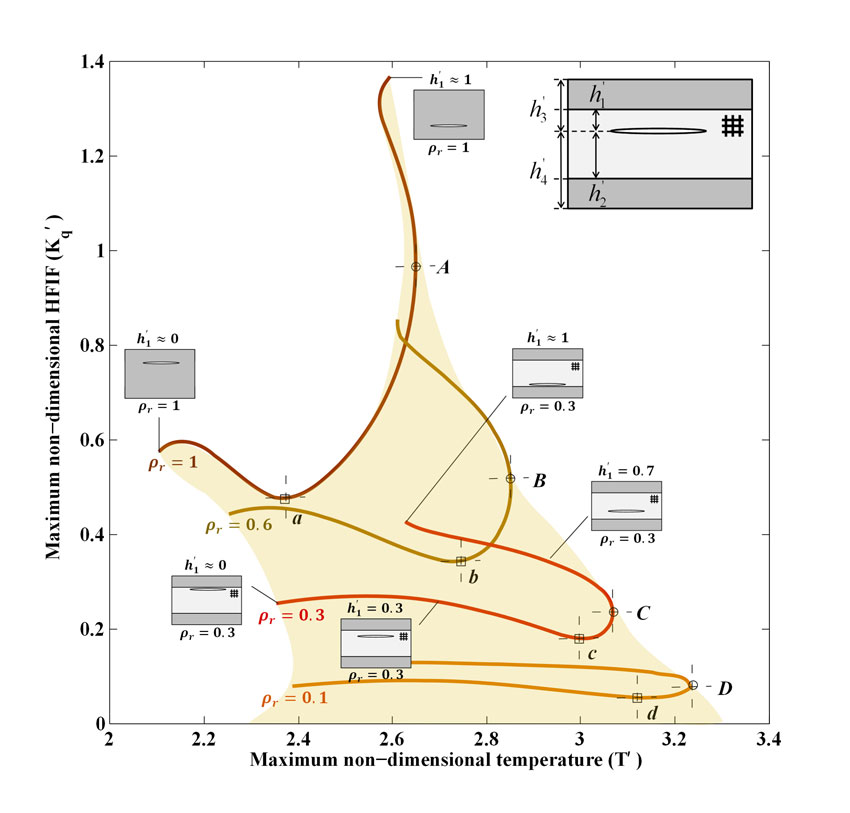
This study implemented a non-Fourier heat conduction method called dual-phase-lag for thermal examinations within the foam core of sandwich panels to find the singularity of the heat flux field at the crack tip. The approach proposed by the authors help in analyzing the role of phase-lags, relative density, skin thickness, and crack position on heat transport in cracked cellular media. The results of this study also help in explaining geometric parameters of the skin and core of a sandwich panel subjected to a thermal shock.

Journal Reference
J.W. Fu1, A.H. Akbarzadeh2,3 , Z.T. Chen4, L.F. Qian1, D. Pasini3 , Non-Fourier heat conduction in a sandwich panel with a cracked foam core, International Journal of Thermal Sciences, Volume 102, 2016, Pages 263–273.
[expand title=”Show Affiliations”]- Department of Mechanical Engineering, Nanjing University of Science and Technology, Nanjing 210094, China.
- Department of Bioresource Engineering, McGill University, Ste-Anne-de-Bellevue, Island of Montreal, QC H9X 3V9, Canada.
- Department of Mechanical Engineering, McGill University, Montreal, QC H3A 0C3, Canada
- Department of Mechanical Engineering, University of Alberta, Edmonton, AB T6G 2G8, Canada.
Go To International Journal of Thermal Sciences