 Advances in Engineering Advances in Engineering features breaking research judged by Advances in Engineering advisory team to be of key importance in the Engineering field. Papers are selected from over 10,000 published each week from most peer reviewed journals.

Significance Statement
Fracture in delaminated plates are modelled by using four equivalent single layers providing an accurate description of the mechanical fields as well as the 3D J-integral.
Journal Reference
European Journal of Mechanics – A/Solids,Volume 55, January–February 2016, Pages 73–99.
András Szekrényes
Budapest University of Technology and Economics Department of Applied Mechanics, Műegyetem rkp. 5, 1111 Budapest, Building MM, Hungary
Abstract
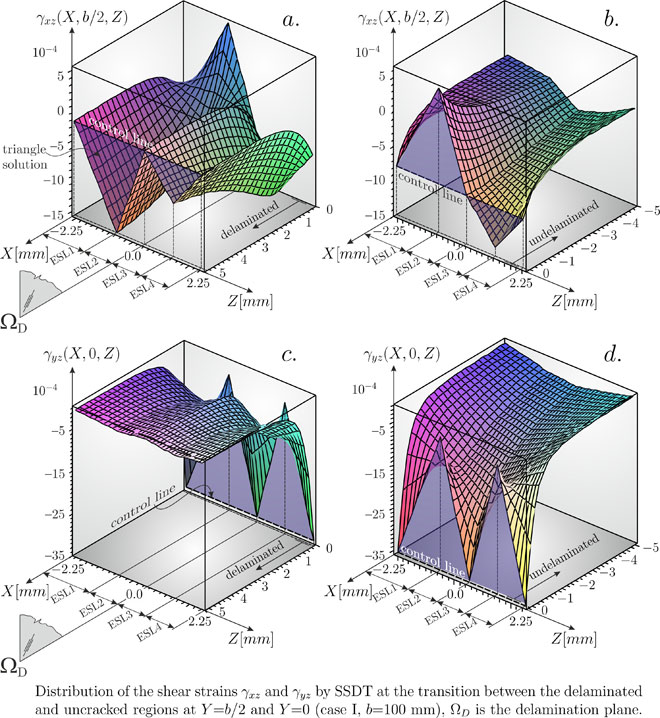
In this work the second- and third-order laminated plate theories are applied to model delaminated composite plates with material orthotropy. The method of four equivalent single layers is proposed and a general third-order displacement field is utilized in each layer. The kinematic continuity between the layers is established by the system of exact kinematic conditions. Apart from the continuity of the in-plane displacements between the interfaces of the layers even the continuity of shear strains, their derivatives and curvatures is imposed. As a novelty a so-called shear strain control condition is introduced, which means that the shear strains at two or more points located along the thickness are imposed to be the same. Using the proposed conditions the equilibrium equations are derived for the delaminated and undelaminated regions of the plate. Plates with different boundary conditions are solved as examples and the theorem of autocontinuity is introduced, which is essentially related to the continuity conditions between the delaminated and undelaminated parts. The stress and displacement fields as well as the J-integral are determined in the examples and compared to finite element calculations. The results indicate that the control condition works very well in the case of the second-order plate theory, in contrast it is rather a disadvantage in the case of the third-order approximation.
Go To European Journal of Mechanics – A/Solids