Advances in Engineering Advances in Engineering features breaking research judged by Advances in Engineering advisory team to be of key importance in the Engineering field. Papers are selected from over 10,000 published each week from most peer reviewed journals.

Significance Statement
The surface air permeability of concrete is found with the application of Torrent’s testing method. The test for simulating surface air permeability is done by considering molecular flow in various circular tubes of different radii.
Drs. Yuya Sakai and Toshiharu Kishi from Institute of Industrial Science at The University of Tokyo obtained the coefficient of surface air permeability numerically by giving correct porosity as input and also observed its validation with Torrent’s testing method along with the theoretical Computation. This was obtained by considering the relationship between the surface air permeability, porosity (effective area) and the pore (tube) radius.
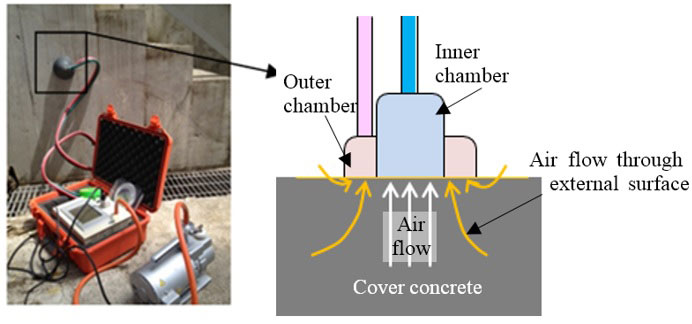
In order to simulate surface air permeability the correlation between the Surface air permeability and various parameters such as Water absorption rate, Carbonation depth and the diffusion coefficient of a chloride ion is considered. Torrent’s method found the pressure change in inner chamber of a double-chamber cup attached with concrete by vacuum. This pressure change happened due to air flow through concrete and was used in the calculation of Surface air permeability keeping the equivalent pressure in both the chambers.
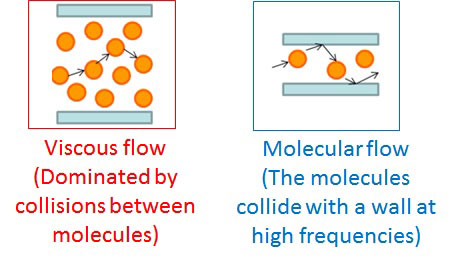
In this process of calculation, the value of porosity as fixed with the value 0.15 and the effect of non-unidirectional flow causing problem is eliminated. Hence air permeability coefficient (kT) and effective depth (L) were calculated and validated with the assumption of having viscous flow. The calculated permeability was not applicable to concrete as it has molecular flow dominant in them. For appropriate evaluation of validity of concrete, the effect of porosity has to be included. Various effects such as effect of the diameter and volume of pores on the Surface air coefficient and effective depth were considered. As per Torrent’s method, the pores in the concrete are considered to be straight circular tubes. Researchers simulated the coefficient assuming molecular flow in circular tubes and also considered the pore diameter and pore volume directly.
The authors found satisfactory agreement in finding the surface air coefficient between the theoretical computation and simulation method. It was observed that the pressure was increased with the increase in tube radius and porosity. The inference from simulation also showed increase in the effective depth as radius of the tube is increased. For varying radius of tube from 2 to 100 nm, it was noticed that the effective depth varied 100 times causing surface air coefficient to vary 10 times. Various parameters were computed in this method such as conductance and Diffusion coefficient.
This study obtained relationship among three parameters such as air permeability, pore radius and pore volume. The gap between conductance in viscous and molecular flow is decreased by choosing a decreased value of tube radius. Assuming the viscous flow can also lead to appropriate value of surface air coefficient provided pore (tube) radius is not considered explicit.
This method implies that accurate value of porosity is essential to obtain a valid surface air coefficient. Hence Torrent’s method was employed with accurate porosity to simulate surface air coefficient and effective depth assuming molecular flow and those simulated values were also found in agreement with evaluation done theoretically.

Journal Reference
Yuya Sakai, Toshiharu Kishi, Numerical Simulation of Air Permeability in Covercrete assuming molecular flow in circular tubes, Construction and Building Materials, Volume 125, 2016, Pages 784-789.
Institute of Industrial Science, The University of Tokyo, Be406, 4-6-1 Komaba, Meguro, Tokyo 153-8505, Japan.
Go To Construction and Building Materials