Advances in Engineering Advances in Engineering features breaking research judged by Advances in Engineering advisory team to be of key importance in the Engineering field. Papers are selected from over 10,000 published each week from most peer reviewed journals.

Significance
Systems, models and elements of nature have been immensely applied to solve complex human problems across numerous fields and especially in medicine. For instance, new technologies today at micro and nanoscale levels are inspired by biomimicry solutions. To this end, biomimetic micro-structured surfaces exhibiting excellent features such as sliding properties and optical reactivity have been created thereby attracting significant attention of researchers.
Unfortunately, the production of artificial biomimetic structures is difficult due to their complex nature just like in the cases of plants and animals that demonstrate such functionalities. Therefore, more efficient methods for production of such artificial structures are highly required and one-shot fabrication technique has been identified as a promising solution.
Among the available fabrication methods, those used in the semiconductor processes like the electron beam lithography are capable of manufacturing nano-scale surfaces. However, it has several drawbacks that make it difficult to be applied in the fabrication of biomimetic microstructures. Consequently, other available techniques like two-photon-absorption micro stereolithography are also not suitable for these structures.
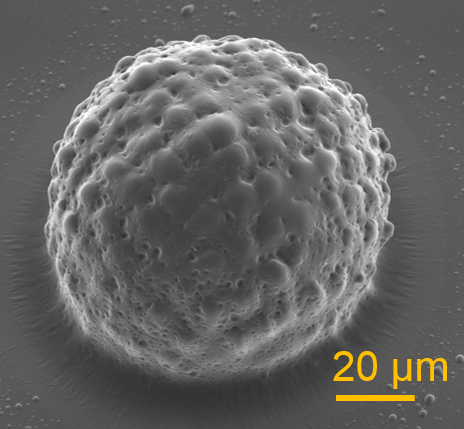
To this note, University of Tokyo researchers: Yuki Suzuki, Kunikazu Suzuki, Dr. Masaki Michihata, Professor Kiyoshi Takamasu and Professor Satoru Takahashi investigated a biomimetic surface structure in the form of a hemisphere with a relief structure. They then proposed a one-shot stereolithography method to fabricate the structure. Their work is published in the journal, Precision Engineering.
Briefly, the proposed technique used the refraction generated due to the modulation of light intensity distribution as well as the difference in the refractive indices of two media. When a focusing light in a medium of high refractive index enters the boundary emanating from the low refractive index medium, radial broadening of the light energy from the focus point on the boundary takes place. This also leads to a corresponding solidification of the resin into a desired hemispherical form. An additional theoretical model was developed and the functionality was verified through simulations using the Lambert-Beer law and Snell’s laws. Consequently, experiments for hemisphere formation and controlling of cured resin direction were conducted and validated by a target micro-hemisphere enclosed in a complex structure.
It was also necessary to develop an apparatus to achieve the proposed method. The authors observed that the method was ideally useful for the fabrication of a dual-scale biomimetic structure like a hemisphere looking form covered in a relief structure, without using complicated, high cost and time-consuming processes.
Technically, the developed method is simplified and less expensive as compared to the initial conventional methods. It will, therefore, advanced fabrication of mimicry structures at both micro and nanoscale levels to solve ever arising human and technological problems. Also, the experimental results strongly indicate that the method can be extended to structures exhibiting antifouling and superior water repealing characteristics. The work does not contradict the existing techniques but instead proposes an alternative technique. It majorly focused on qualitative simulation and therefore it can be improved by taking into consideration of numerical simulations in future works.





Reference
Suzuki, Y., Suzuki, K., Michihata, M., Takamasu, K., & Takahashi, S. (2018). One-shot stereolithography for biomimetic micro hemisphere covered with relief structure. Precision Engineering, 54, 353-360.
Go To Precision Engineering