Advances in Engineering Advances in Engineering features breaking research judged by Advances in Engineering advisory team to be of key importance in the Engineering field. Papers are selected from over 10,000 published each week from most peer reviewed journals.

Significance Statement
The conventional production of bleached pulp for papermaking is too polluting for a world where the demand for paper products is still increasing. Wood is collected, cooked with caustic soda and sodium sulphide (kraft pulping), bleached with chlorine dioxide, refined at high energetic cost, etc. Even recycling generates a large amount of sludge.
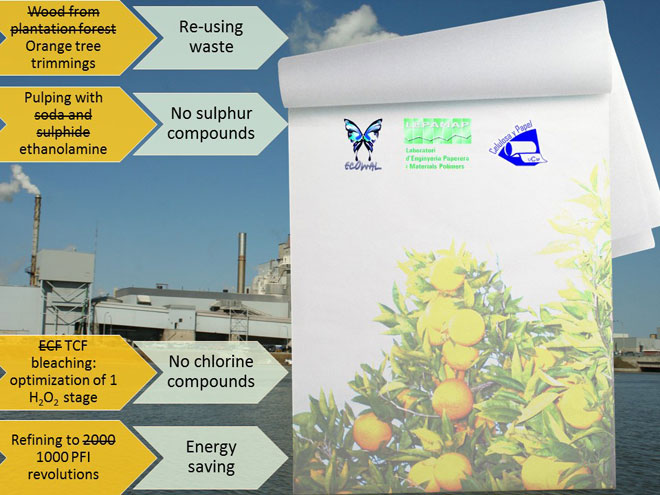
In the first place, although wood is generally obtained from plantation forests in the developed countries, they are usually monoculture plantations, which have less potential to mitigate climate change than native forests. And in the developing countries, unfortunately, it is easy to find real deforestation for papermaking. That is why we look with interest at the woody part of orange tree trimmings. They are agricultural residues which usually end up being open-burnt, but we could re-use them towards papermaking. Wood from alternative angiosperm trees could partially replace Eucalyptus wood, the most widely used raw material for the manufacturing of paper. What we propose is environmentally friendly in at least two ways: re-using waste and using less wood from monoculture plantations.
Then you have the emissions of sulphur dioxide from the pulping stage. Sulphur dioxide, an air pollutant that affects human health and animal life and may cause acid rain. Add the bad odours from the pulp mills, due to small emissions of thiols (again, more sulphur-containing compounds). Furthermore, the manufacturing of pulp and paper has the highest water consumption per tonne of product of all industries. Instead of aqueous solutions of caustic soda and sodium sulphide, we use ethanolamine, an organic solvent, mixed with water, avoiding the problems originated by sulphur compounds. Organosolv pulping, moreover, results in large water savings compared to kraft pulping, since we need less cooking liquor per tonne of pulp. While the yield of kraft pulp is usually 50-60%, for one of our organosolv pulps the yield was as high as 81%.
Regarding bleaching, at least we can say that chlorine has been commonly replaced by chlorine dioxide, less hazardous… but still hazardous. Its reaction with unbleached pulps produces organic chlorinated compounds, persistent pollutants going to wastewater. Fortunately, we found that one-step bleaching with hydrogen peroxide, no chlorine involved, of organosolv pulps from orange tree trimmings is enough to increase brightness from 38% to 70%.
Nonetheless, paper sheets from organosolv pulps cannot be expected to have the strength a sheet from a good kraft pulp would have. Despite the environmental issues, kraft pulping is named this way for a reason: the German noun Kraft means strength. But we reached acceptable values of mechanical properties after refining, a mechanical treatment to strengthen the fibre network. Not high enough for package paper, but good enough for printing paper. 1000 revolutions in a PFI mill were enough to reach freeness values (a way to express how the interactions between fibres is improved) for which Eucalyptus wood needs more than 2000 revolutions. We can call this energy saving.
The list of environmental advantages coud be summed up as: solving a waste issue, needing less wood from plantation forests, saving water, saving energy, releasing no sulphur or chlorine compounds.



Journal Reference
Journal of Cleaner Production, Volume 112, Part 1, 20 January 2016, Pages 980-986.
Ana Moral1, , , Roberto Aguado1, Pere Mutjé2, Antonio Tijero3
[expand title=”Show Affiliations”]- ECOWAL Group, Molecular Biology and Biochemistry Engineering Dpt., Pablo de Olavide University, 41013 Seville, Spain
- LEPAMAP Group, Chemical Engineering Dpt., University of Girona, 17071 Girona, Spain
- Pulp and Paper Group, Chemical Engineering Dpt., Complutense University of Madrid, 28040 Madrid, Spain
Abstract
One of the most popular ways to carry out the re-use of wastes from agriculture is the pulping, refining and bleaching of those residues for papermaking. Spain annually produces more than 300 thousand tonnes of Citrus sinensis (orange tree) trimmings, crops being concentrated in the East and the South of the country. Their chemical composition is similar to that of common hardwoods.
This work aims to show the suitability of ethanolamine cooking when applied to orange tree trimmings, and to study the effect of peroxide bleaching and refining on some key properties. As for bleaching, we used a design of experiments to discuss the influence of peroxide concentration, time and temperature on the yield, brightness, viscosity, kappa number of pulps and mechanical properties of paper sheets. Refining was studied by analysing the diminishment in freeness and the mechanical properties of paper sheets formed. Results showed that even a mild bleaching process gives out a high relative brightness gain, but a multiple-step process is necessary to achieve enough brightness for printing paper. Mechanical properties of non-refined pulps were found to be too low for paper of any grade, but they were greatly improved by refining.
Go To Journal of Cleaner Production