Advances in Engineering Advances in Engineering features breaking research judged by Advances in Engineering advisory team to be of key importance in the Engineering field. Papers are selected from over 10,000 published each week from most peer reviewed journals.

Significance Statement
Researchers from Space Technology Synthesis Laboratory at Department of Aerospace Engineering in Chosun University (Korea) aimed to use micro-jitter attenuation in investigating the performance of a novel pseudoelasic SMA mesh washer gear wheel. The study is published in Smart Materials and Structures.
Aerospace Engineers uses multi-axes gimbal-type stepper-actuated antenna pointing mechanism to effectively transmit large quantities of real-time image data from high-resolution satellites to ground stations. However, the gimbal-type antenna inevitably produces undesirable micro-jitter disturbances during its on-orbit operation and the micro-jitter disturbances significantly degrade the image quality of the high-resolution observation satellite. To achieve high resolution satellite images, elimination of micro-jitters is essential.
In view of eliminating this problem, conventional technical approach was to use a low torsional stiffness spring-blade for an existing external spur gear wheel. In this method, the low torsional stiffness spring-blade was the main feature for attenuating the micro-jitter disturbances induced by antenna activations. This design approach provided a reliable technical solution that can be easily implemented without making major modifications on the antenna design. However, in such a system, plastic deformation of the spring-blade gear may occur if an unexpected over-driving torque is induced, into the weak elements of the spring-blade, by an alignment shift of the gear axis.
An alignment shift may occur due to excessive launch vibration loads or thermal deformation of the blades under extreme thermal environments. These misalignments of the gear axis can be critical factors leading to a serious structural failure of the spring-blades with relatively lower torsional stiffness. This problem can be easily solved by increasing the stiffness of the spring-blades to guarantee the structural safety of the gear itself under conditions in which a much higher driving torque is induced. However, this approach might cause a degradation of the micro-jitter attenuation capability because the capability for attenuating the micro-jitter heavily depends on the torsional stiffness of the spring-blade gear.
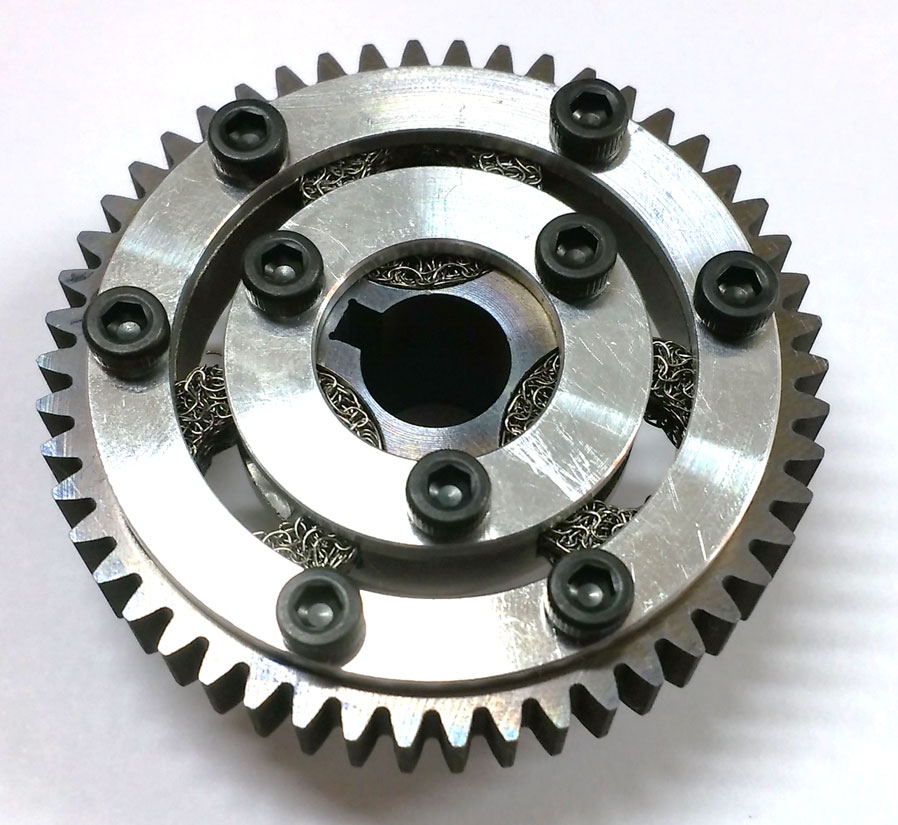
The researchers introduced a novel gear with micro-jitter attenuation capability for stepper-actuated mechanism. The use of a shape memory alloy SMA mesh washer is presented to overcome the aforementioned drawbacks and develop a novel gear that exhibits advantages of both micro-jitter attenuation and hyper elastic capabilities. The SMA mesh washer, whose characteristics has helped to attain the hyperelasticity can experience significant deformations under excessive loading condition and recover its original shape upon unloading, without undergoing plastic deformation due to its pseudoelastic or super elastic SMA behavior, which is caused by a stress induced phase transformation.
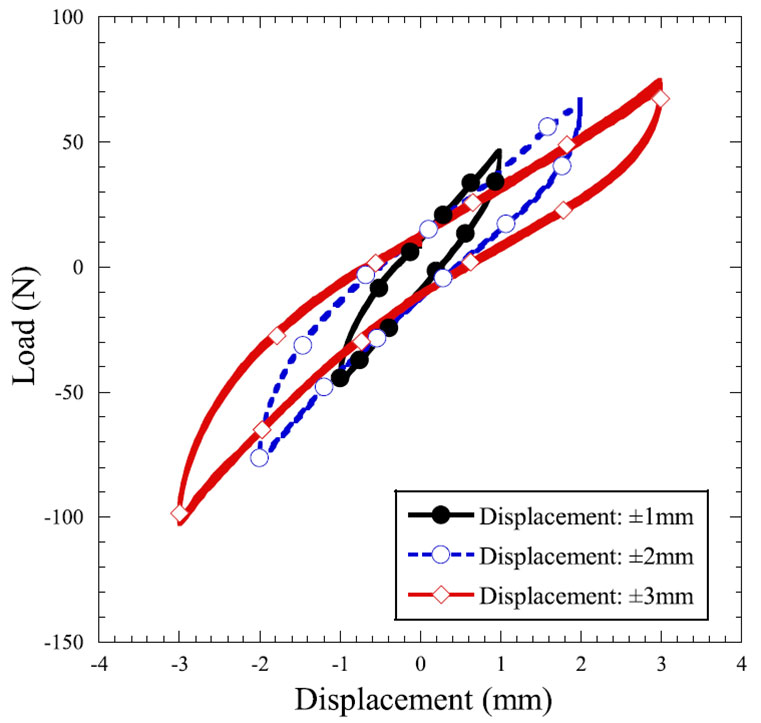
Results indicate the stiffness of the SMA mesh washer increased with increasing compressive displacement, because its internal space was filled with wires that experienced stress. In the case of the steel washer made out of the STS-310S material, which had the same geometry as the SMA mesh washer used in this study, it became plastically deformed and did not recover its original shape when the washer was deformed. The test results also indicated that mesh washer along the radial direction exhibited hysteresis and hyperelastic behavior.
The stiffness of the ring-type SMA mesh washer decreases when the deflection range increases in contrast with the static test results in the thickness direction of the SMA mesh washer. The geometry of the mesh washer causes it to be more sensitive to a delamination between the stacked layers of the compressed washer during loading in the radial direction. In the case of constant velocity phase, the micro-jitter disturbances were primarily caused by the azimuthal rotating movement of the antenna by stepper-actuated motor actuations. The differences in the azimuthal movement of the antenna on the x-y plane were noted, and this is identical to the main jitter sources induced by stepper motor activations in the azimuthal.
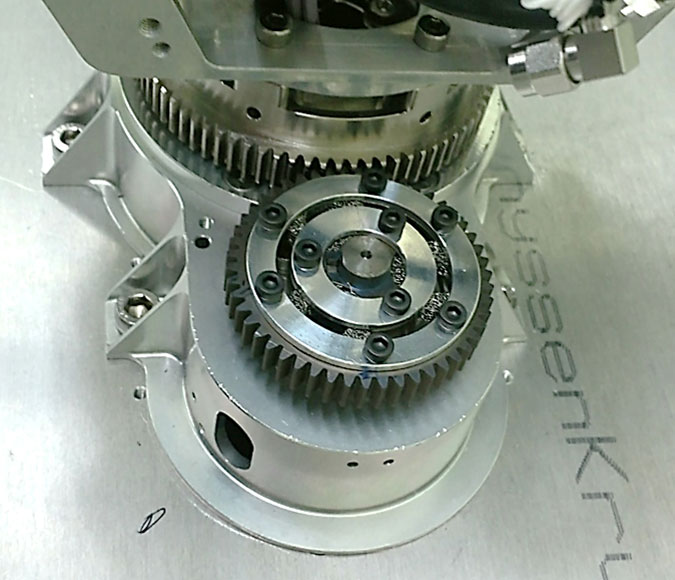
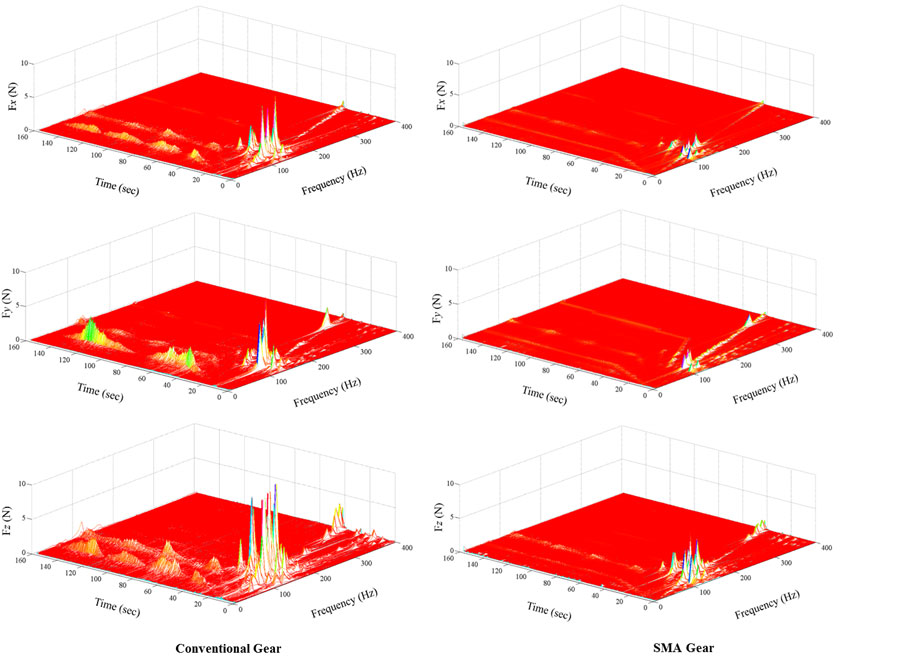
The effectiveness of the proposed SMA gear for isolating the micro-jitter was demonstrated via micro-jitter measurement tests by using a stepper-actuated X-band antenna under a constant azimuthal rotating velocity condition. The results of the micro-jitter measurement tests with conventional gear and newly proposed SMA gear indicated that the micro-jitter from the antenna activations was considerably reduced by the relatively lower torsional stiffness of the SMA gear compared to the conventional gears. The structural safety of the SMA gear was also investigated through structural analysis.


Journal Reference
Seong-Cheol Kwon, Su-Hyeon Jeon and Hyun-Ung Oh. Performance investigation of a novel pseudoelastic SMA mesh washer gear wheel with micro-jitter attenuation capability, Smart Materials and Structures, Volume 25, Number 5, 2016, 055004 (14pp).
Space Technology Synthesis Laboratory, Department of Aerospace Engineering, Chosun University, 375 Seosuk-dong, Dong-gu, Gwangju 501-759, Korea
Go To Smart Materials and Structures