Advances in Engineering Advances in Engineering features breaking research judged by Advances in Engineering advisory team to be of key importance in the Engineering field. Papers are selected from over 10,000 published each week from most peer reviewed journals.

Significance
The accelerating pace of climate change has intensified the search for viable and long-term solutions to reduce atmospheric carbon dioxide (CO₂) levels. There has been significant technological advancements in carbon capture and storage however, the question of how to permanently and safely sequester captured CO₂ remains a pressing scientific and engineering challenge. Among the various strategies proposed, mineral carbonation has emerged as one of the most promising due to its ability to lock CO₂ into stable, solid mineral forms that are geologically permanent and resistant to leakage. This process essentially mimics natural geological transformations that have occurred over millions of years, but attempts to accelerate them to a timescale meaningful for climate mitigation efforts. Peridotite, an ultramafic rock rich in the mineral olivine, stands at the forefront of this strategy because of its high magnesium content and global abundance. When exposed to CO₂-rich fluids, olivine reacts to form stable carbonate minerals, primarily magnesite, effectively sequestering CO₂ in solid form. In theory, this reaction offers a permanent and irreversible method for carbon storage. However, translating this natural process into a scalable, engineered solution has proven to be remarkably difficult. The primary obstacle lies in the fundamental nature of the carbonation reaction itself. As the reaction progresses, it generates significant volumes of solid reaction products, which can rapidly clog the pore spaces within the rock. This pore clogging reduces permeability, cutting off the pathways necessary for fluids to reach unreacted mineral surfaces, effectively halting further carbonation. This challenge raises critical questions about the long-term viability of in-situ peridotite carbonation as a CO₂ sequestration solution. If the reaction stops prematurely due to self-sealing effects, the vast theoretical storage capacity of these rock formations becomes practically inaccessible. Moreover, earlier hypotheses have suggested that the crystallization pressure generated by growing carbonate minerals might create new fractures within the rock, a mechanism known as reaction-induced fracturing. This could, in principle, counteract the clogging effect by opening new fluid pathways, allowing the reaction to continue. Yet, despite its theoretical appeal, this phenomenon has not been conclusively observed under controlled experimental conditions, leaving a significant gap between theoretical models and experimental evidence. To this account, new research paper published in International Journal of Rock Mechanics and Mining Sciences and conducted by Professor Jinfeng Liu from the Sun Yat-Sen University, Dr. Timotheus Wolterbeek who is now at Shell Global Solutions International B.V. and Professor Christopher Spiers from the Utrecht University investigated how carbonation reactions affect both the mechanical integrity and permeability of crushed peridotite under realistic stress, pressure, and temperature conditions, the researchers sought to determine whether reaction-induced fracturing is a viable mechanism and to what extent pore clogging limits the progress of carbonation.
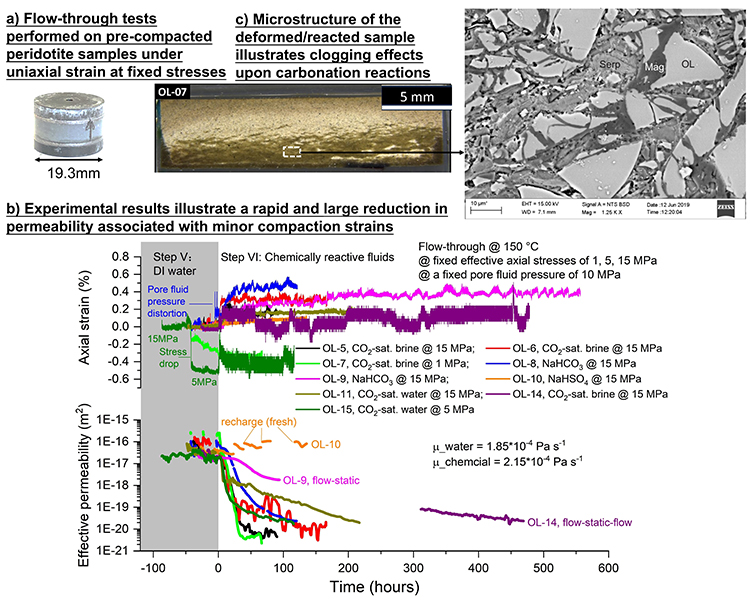
The authors fabricated nine disc-shaped samples from pre-compacted Åheim dunite powder—a material selected not by chance, but because of its high olivine content and chemical reactivity, making it an ideal analogue for natural peridotite formations. These samples weren’t just inert test subjects; they were engineered to replicate the fractured and porous nature of real geological systems, where CO₂ sequestration might one day be attempted. Each was placed under tightly controlled thermal and mechanical conditions, held at a steady 150°C and subjected to effective axial stresses between 1 and 15 MPa, mirroring the pressures encountered roughly one kilometer beneath the surface. Once stabilized, the researchers introduced a suite of chemically reactive fluids—CO₂-saturated water, CO₂-rich brines, and sodium bicarbonate solutions—all under a constant pore pressure of 10 MPa. What unfolded was not the sustained reaction front or progressive fracturing some models had optimistically projected. Instead, the behavior of the system turned decidedly self-limiting. Within just 20 to 40 hours, permeability didn’t gradually decline—it collapsed, dropping by as much as four orders of magnitude. Fluid pathways that were initially open and accessible became blocked with startling efficiency. Despite long-standing theories suggesting that the crystallization of carbonates might generate sufficient internal stress to fracture rock matrices and create new conduits for fluid flow, the experimental reality told a different story. There was no detectable fracturing, no mechanical liberation of fresh surfaces. Instead, the newly formed magnesite—dense and crystalline—and layers of serpentine minerals quietly filled the narrowest pore spaces, systematically choking off the remaining pathways. Mechanical measurements further reinforced this outcome. Axial compaction remained modest throughout, never exceeding 0.4% strain, effectively ruling out any significant reaction-driven expansion. When the experiments concluded and the samples were sectioned for microscopic analysis, the imagery was striking. Former flow channels were visibly clogged with mineral precipitates, and the once-reactive olivine surfaces stood isolated, cut off from the chemical agents needed for further transformation.
In conclusion, the study of Professor Jinfeng Liu, Dr. Timotheus Wolterbeek and Professor Christopher Spiers is timely in the research efforts of global conversation on carbon sequestration, and provide a much-needed reality check on the challenges of turning theoretical promises into workable solutions. For years, peridotite has been hailed as a near-perfect candidate for mineralizing CO₂, its olivine-rich composition seemingly ideal for locking carbon away in stable, solid forms. Yet, what the new study so clearly shows is that nature rarely cooperates so neatly. When subjected to subsurface conditions that accurately mimic those found deep beneath the Earth’s surface, peridotite doesn’t rise to the occasion—it resists it. Instead of facilitating sustained CO₂ uptake, the rock responds by shutting itself down, literally sealing off the very pathways required for the reaction to continue. That discovery carries far-reaching implications, particularly for those banking on passive, large-scale in-situ carbonation as a viable climate mitigation strategy. The experiments demonstrate, unequivocally, that without deliberate and ongoing intervention—whether through mechanical stimulation, pressure cycling, or chemical treatments—these systems will falter well before reaching their theoretical capacity. This forces us to confront a sobering reality: effective carbon storage is not a set-it-and-forget-it process. It will demand carefully engineered solutions to maintain the delicate balance between reactivity and permeability, and this balance is far more fragile than many previous models have suggested. Equally important is the methodological contribution this work makes. The precise control of experimental parameters—stress, pressure, and chemical environment—paired with rigorous post-reaction analyses, establishes a new standard for how these complex processes should be studied. It moves the discussion beyond optimistic projections and grounds it firmly in reproducible, data-driven insight.



Reference
Jinfeng Liu, Timotheus K.T. Wolterbeek, Christopher J. Spiers, Volumetric response and permeability evolution during carbonation of crushed peridotite under controlled stress-pressure-temperature conditions, International Journal of Rock Mechanics and Mining Sciences, Volume 182, 2024, 105886,
Go to International Journal of Rock Mechanics and Mining Sciences