Advances in Engineering Advances in Engineering features breaking research judged by Advances in Engineering advisory team to be of key importance in the Engineering field. Papers are selected from over 10,000 published each week from most peer reviewed journals.

Significance Statement
In recent article by Bobrova et al. (2016) and published in International Journal of Hydrogen Energy, series of experiments were done in a laboratory scale plate-type reactor aiming to obtain information on kinetics of methane steam reforming reaction on a conventional Ni + YSZ/YSZ anode half-cell catalyst and Ni + YSZ/YSZ planar half-cell catalyst wash coated by layer of Ru + Ni-doped perovskite-based nanocomposite (Ru + Ni/LaPrMnCr/YSZ).
Lab-scale data were up-scaled for the case of steam reforming of neutral gas on a package of three stacked parallel Ni-Al foam Ru + Ni-doped perovskite-based nanocomposite.
Solid oxide fuels (SOFCs) in principal areas of modern green chemical and process engineering has an advantage over other fuel cell types due to its fuel flexibility. According to Zhang et al. (2015), fuel flexibility of SOFCs is enabled by the capability to convert different types of fuel to syngas containing hydrogen.
SOFCs systems generally have faster reforming reactions than anode H2 and O oxidation process which also enables cogeneration of synthesis gas directly by proper selection of anode materials. This combination offers advantage in terms of heat utilized by endothermic reforming reactions from exothermic oxidation reactions.
The dominance of nickel yttria stabilized zirconia (Ni/YSZ) anodes in SOFCs application is due to excellent catalytic and electronic conducting properties. However, conventional Ni-YSZ cermet anodes exhibit degradation in cell performance due to carbon formation and loss of activity overtime due to sintering of active nickel phase in presence of steam, hydrogen and methane. Nanocomposite materials exhibiting mixed ionic and electronic conductivity with oxygen mobility can be used as anode materials and catalyst in steam or auto-thermal internal reforming of gas and liquid fuels. One way of enhancing catalytic activity and stability of cermet Ni/YSZ in direct reformation of methane is their modification by promoters (Sadykov et al, 2010). The most efficient promoter for NI/YSZ in steam-methane reforming has proved to be flourite-like or perovskite-like oxides with small amounts of Pt, Pd and Ru.
The plate type catalytic reactor system enables an effective dissipation of reaction heat by conductional heat transfer and rapid response to load fluctuation which is an innovative design of steam-methane reformers for fuel cell systems (Ogden, 2001). Optimization of overall performance characteristics and practical application of this small-scale reformer deals with complex interactions of transport phenomena and chemical kinetics for specific catalyst formulations. Fundamental knowledge towards the simulations and catalysis science are very essential for optimization coupled reforming and electrochemical reactions and necessary to advance SOFC technology development process.
From the experiment, doped complex nanocomposite comprising of Perovskite oxides La0.8Pr0.2Mn0.2Cr0.8O3 in combination with NiO and YSZ (50% La0.8Pr0.2Mn0.2Cr0.8O30) + 30%NiO + 20% (LaPrMnrCrO/NiO/YSZ) were deposited as washcoat into surface of structure support substrate and prepared via organic polymerized complex method.
The external resistance to mass transfer in plate-type parallel passage has been elucidated. At specified reaction conditions, vales of rate constant KCH4 and mass transfer coefficient Km was estimated to be 0.0132m/s and 0.7644m/s. Values of effective diffusion coefficient DCH4 and gas viscosity was estimated to be 1.85×10⁻⁴m2s and 1.21×10⁻⁴ PaS respectively. The results indicates that for the range of experiment conditions, the rate of gas/solid mass transfer was sufficiently large compared to the rate of catalytic reactions in order for diffusional limitation to be safely neglected.
A mechanism independent power-law kinetic model derived from atmospheric pressure experiments was applied to reveal difference in catalytic performance of conventional Ni/YSZ cermet anode and nanocomposite coated Ni + YSZ/YSZ plate. At 6500C and time of 26h, conventional Ni/YSZ showed decrease in methane conversion at steam-to-carbon ratio of 1:1 and changes in H2 concentrations decreases significantly from 31.5 to 26.4% while at a longer time of 255h and temperature of 6000C for nanocomposite coated Ni + YSZ/YSZ in steam to methane ratio of 2:1, initial methane conversion decreased from 68% to 55% and H2 concentration declined more slowly from 36 to 33v/v%.
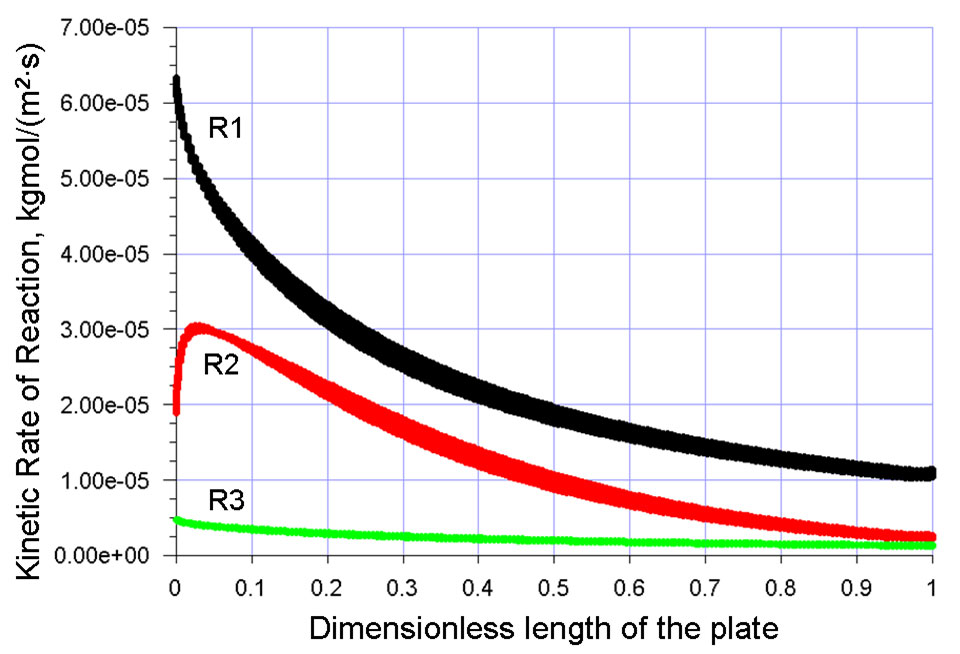
A one dimensional pseudo-homogenous plug-flow model was applied to calculate reaction rate and concentration profiles in flow channels of the two catalytic plates. At temperature of 7000C and residence time of 0.08s, conversion of methane for nanocomposite promoted plate is 68.6% while Ni + YSZ/YSZ anode half-cell was 44.8%.
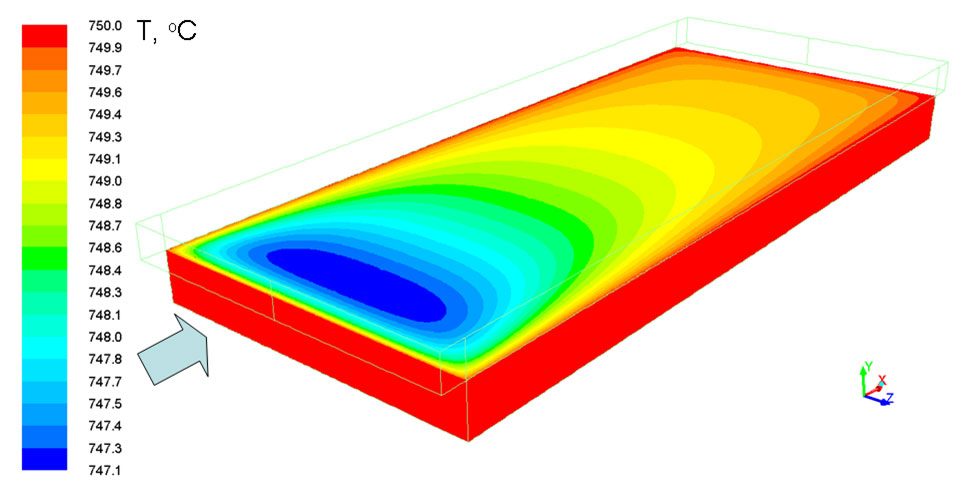
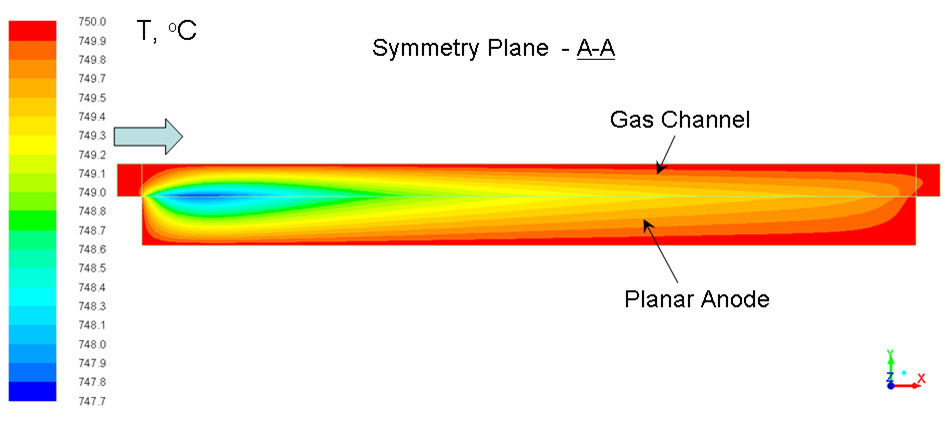
CFD simulations from laboratory experiment on phenomenological chemical kinetic model for Ru + Ni/LaPrMnCr\/YSZ nanocomposite shows that an extremely effective dissipation of reaction heat in the highly conductive support material of catalytic plate is achieved, hence higher thermal conductivity of metallic support results in more efficient heat transfer and lower temperature gradient following an approximately linear relationship.
Bobrova et al. concluded that structured catalyst based on Ni + YSZ/YSZ anode half-cell and Ni-Al foam substrates promoted by layers of Ru + NiLaPrMnr/YSZ nanocomposite demonstrated a high performance in steam reforming of methane in intermediate temperature range in feeds with low excess of steam. These results are quite promising, since they meet target of operation for intermediate temperature solid oxide fuel cells with internal reforming.
REFERENCES
Ogden MJ. Review of small stationary reformers for hydrogen production. Report to the International Energy Agency. Princeton, NJ: Center for Energy and Environmental Studies, Princeton University; 2001.
Sadykov V, Mezentseva N, Alikina G, Bunina R, Pelipenko V, Lukashevich A, et al. Nanocomposite catalysts for steam reforming of methane and biofuels: design and performance. In: Reddy B, editor. Nanocomposite materials, theory and applications. Vienna: INTECH; 2010. p. 909e 4.6.
Zhang X, Chan SH, Ho HK, Tan S-Chi, Li M, Li G, et al. Towards a smart energy network: the roles of fuel/electrolysis cells and technological perspectives. Int J Hydrogen Energy 2015; 40(21):6866 e 919.





Journal Reference
Ludmilla N. Bobrova1, Vladislav A. Sadykov1,2, Natalya V. Mezentseva1,2, Vladimir V. Pelipenko1, Nadezhda V. Vernikovskaya1,2, Oleg P. Klenov1, Oleg L. Smorygo3. Catalytic Performance of Structured Packages Coated with Perovskite-Based Nanocomposite in the Methane Steam Reforming Reaction. International Journal of Hydrogen Energy, Volume 41, Issue 8, 2016, Pages 4632–4645.
[expand title=”Show Affiliations”]- Boreskov Institute of Catalysis, 630090, Novosibirsk, Russia
- Novosibirsk State University, Novosibirsk, 630090, Russia
- Powder Metallurgy Institute, Minsk, 220005, Belarus
Go To International Journal of Hydrogen Energy