 Advances in Engineering Advances in Engineering features breaking research judged by Advances in Engineering advisory team to be of key importance in the Engineering field. Papers are selected from over 10,000 published each week from most peer reviewed journals.

Significance
Small hydropower offers a practical route for generating electricity from local water resources, but its success depends strongly on turbine reliability under real operating conditions. Small-scale facilities are different from large installations, because usually they rely on simpler supporting infrastructure and have less room for costly debris-removal equipment. In such settings, the hydraulic machine is expected to extract energy efficiently and also to tolerate water conditions that may include foreign matter. This requirement places unusual pressure on runner design, because the same blade passages that guide the flow and transfer angular momentum can also become sites of blockage. When debris accumulates inside a small turbine, the problem is not just a local mechanical inconvenience; it directly threatens one of the principal advantages of hydropower, namely the ability to provide stable power from a continuous hydraulic resource.
A single blade centrifugal sewage pump offers an interesting route around this constraint because its wide internal passage is naturally suited to the transport of foreign matter. When operated in reverse, such a pump can function as a turbine, creating the possibility of a non-blocking water turbine based on an existing pump architecture. That idea, however, brings its own fluid-dynamic complications. A single blade runner is strongly asymmetric, and earlier studies have treated radial thrust and whirling as central reliability concerns. In turbine mode, another issue becomes equally important: the internal flow path was originally designed for pump operation. The blade angles, volute geometry, runner passage, clearances, and outlet flow arrangement therefore encounter a reversed operating condition in which efficiency and performance stability become strongly dependent on the internal flow.
The scientific challenge is to move beyond average turbine performance and identify how hydraulic losses are generated inside this strongly asymmetric turbomachine. For conventional multi-blade pump-as-turbine systems, much prior work has dealt with predicting turbine-mode performance from pump-mode behavior and with improving performance through blade or runner modifications. For the single blade reverse-running case, the analysis is more demanding because the flow structure changes markedly with runner rotation, so losses cannot be understood as steady, circumferentially uniform quantities. The relationship between turbine-mode internal flow and hydraulic loss generation had not been clarified, which leave an important gap between the practical appeal of the non-blocking runner and the hydraulic knowledge needed to improve it.
In a recent research paper published in International Journal of Heat and Fluid Flow, Professor Yasuyuki Nishi and Ms. Natsumi Itoh from Ibaraki University, developed a turbine-mode hydraulic loss analysis method for a single blade reverse running pump turbine. The method separates effective head into theoretical head and individual hydraulic losses, including runner friction loss, runner loss, casing loss, inlet pipe loss, and outlet pipe loss. Its distinct contribution is that it uses unsteady CFD data over one runner rotation to evaluate both time-averaged and instantaneous loss components. This allowed the authors to connect phase-dependent hydraulic losses directly to suction-surface separation, outlet vortices, casing pressure behavior, and blade-inlet backflow.
Nishi and Itoh in their study combined performance measurements, particle image velocimetry at the blade inlet, unsteady three-dimensional CFD, and a turbine-mode loss analysis method. The test machine they used was a closed single blade centrifugal runner installed in a volute casing and operated in reverse at 900 min−1. The experimental program measured head, torque, output, and efficiency while also resolving the circumferential and radial velocity components near the blade inlet. The numerical model reproduced the turbine geometry, including the volute, runner, inlet and outlet pipes, and clearances around the shrouds, so that the computation could be used as a performance predictor and also a spatially resolved diagnostic of loss formation.
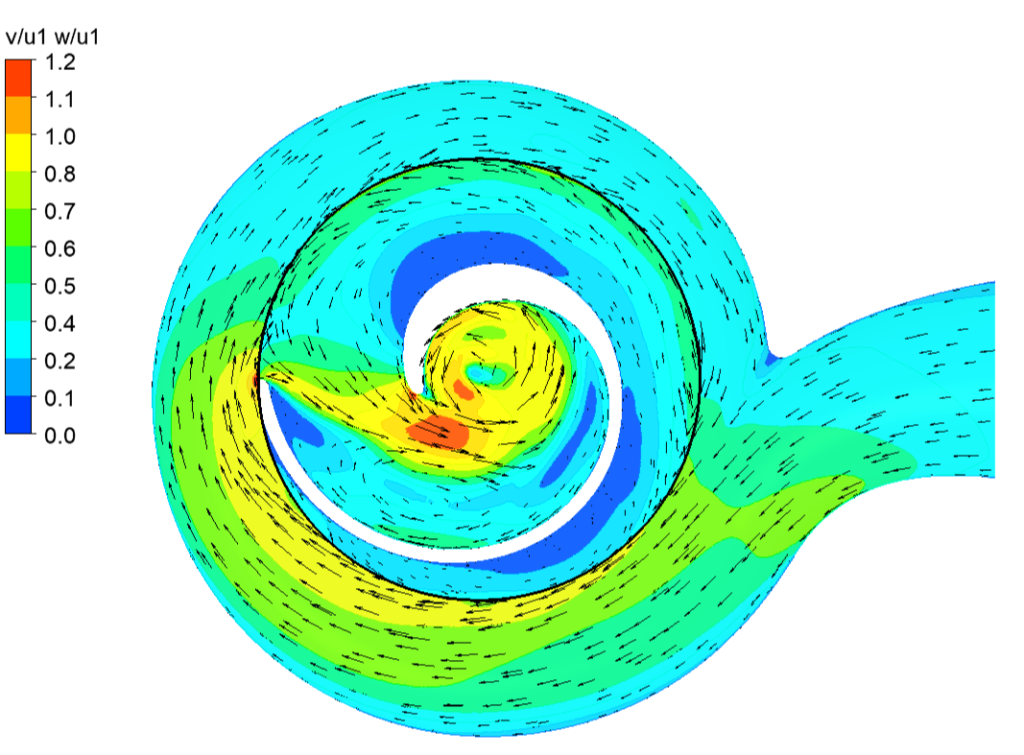
The authors’ CFD results reproduced the measured performance with reasonable agreement, especially near the maximum efficiency flow coefficient of φ = 0.051, where the experimental efficiency was about 0.560. The circumferential component of the absolute velocity at the blade inlet, which dominated the blade inlet flow, was also captured well. Differences appeared in the radial component at some circumferential positions and phases, but the main swirl-dominated character of the inlet flow was represented sufficiently for the authors’ loss analysis.
The team found turbine did not behave as a quasi-steady axisymmetric machine and for instance at the maximum efficiency flow rate, the head coefficient, output coefficient, and efficiency changed strongly with blade phase angle. The head and output coefficients reached their largest values near θ* = 40° and then decreased toward a minimum near θ* = 325°. Efficiency followed a related but not identical pattern, reaching its maximum near θ* = 206° because the output coefficient had a local maximum around θ* = 185°. This phase dependence is central to the study and shows that the single blade runner creates an uneven flow field and also continuously reorganizes the balance between theoretical head, hydraulic loss, and power extraction as it rotates.
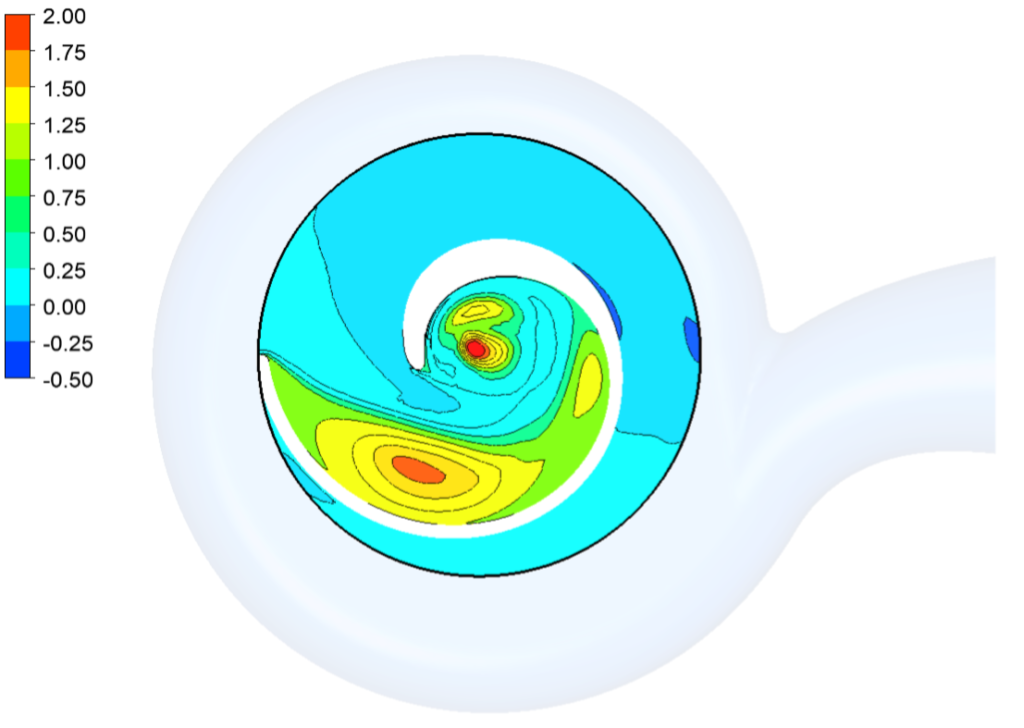
The loss analysis separated the total hydraulic loss into runner friction loss, runner loss other than friction, casing loss, inlet pipe loss, and outlet pipe loss. At the maximum efficiency flow rate, runner loss dominated the total hydraulic loss, accounting for 55.9%, followed by outlet pipe loss at 26.7% and casing loss at 10.4%. Runner friction loss contributed 6.7%, and inlet pipe loss was only 0.3%. This distribution gives the study its interpretive focus: the major performance penalties were not distributed evenly through the machine, nor were they controlled primarily by simple wall friction.
A decisive physical link emerged between runner loss and separation at the blade inlet. Flow entered the runner locally from the suction-surface side of the blade inlet end rather than uniformly across the inlet. This local inflow produced separation on the blade suction surface, and the region of high total pressure loss expanded or contracted with blade phase. When the separated region extended over much of the suction surface, the runner loss increased. The design consequence is direct: the compatibility between blade inlet angle and turbine-mode inflow controls the scale of inlet separation, and that separation controls much of the runner loss.
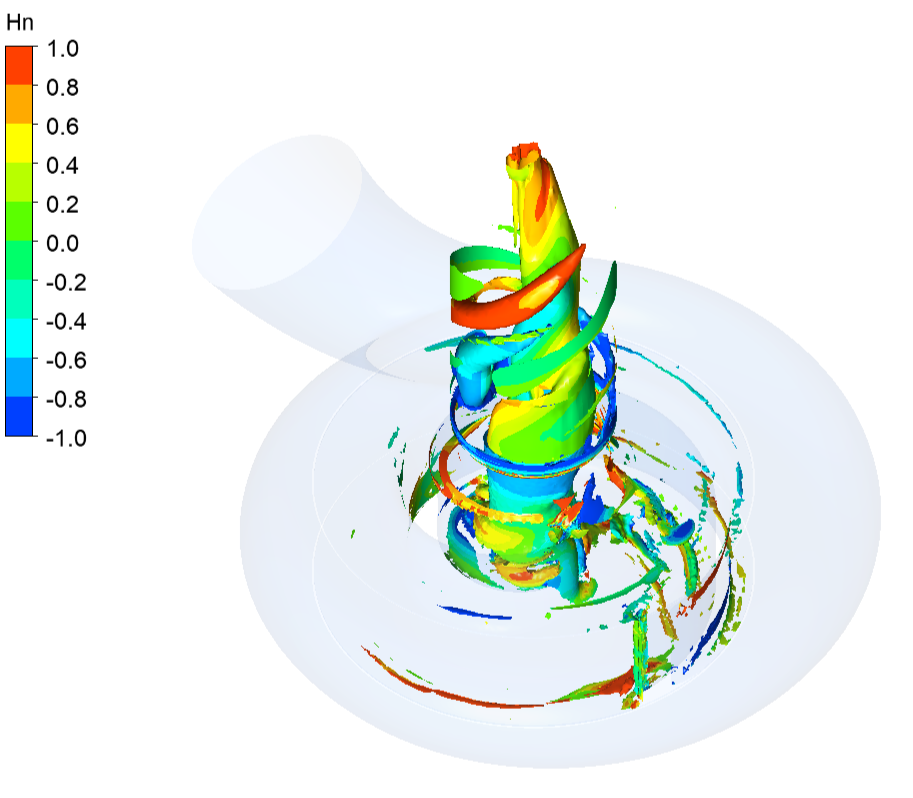
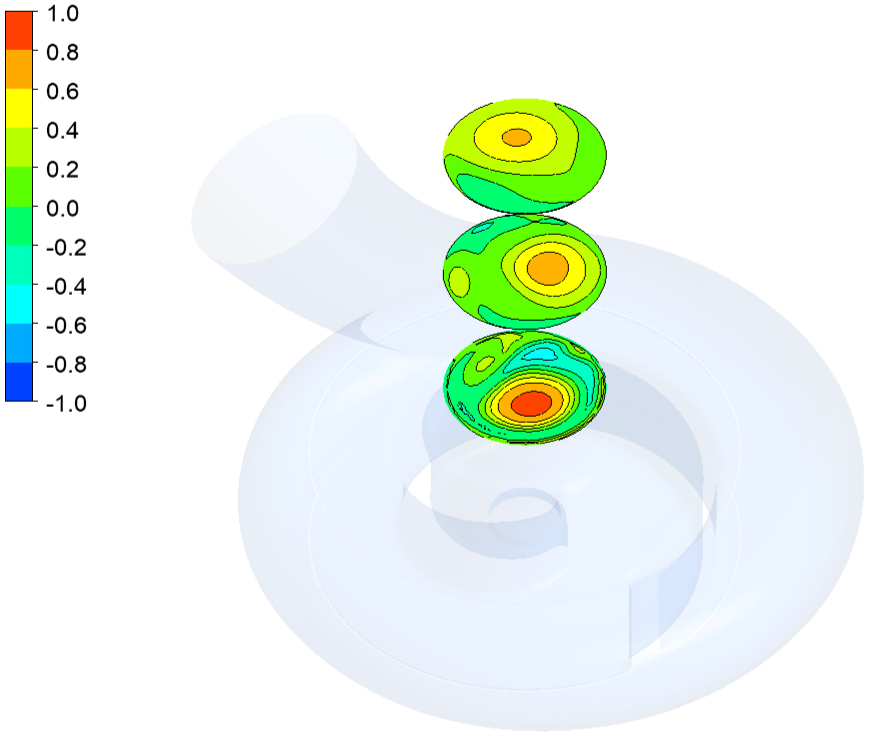
The outlet pipe loss had a different origin and the downstream of the runner, the calculations identified a large central vortex and additional vortices generated near the blade outlet on the shroud side and near the runner outlet. Regions of high total pressure loss aligned with these vortex structures. The large central vortex changed relatively little with runner rotation, while the vortices near the blade outlet and runner outlet expanded at phases associated with higher outlet pipe loss. As the blade outlet and runner outlet deliver different vortex structures into the outlet pipe, the local vortex-induced total pressure loss rises or falls.
The findings of Professor Yasuyuki Nishi and Ms. Natsumi Itoh have direct engineering value for the design of non-blocking small hydropower turbines based on reverse-running sewage pumps. The wide passage of a single blade centrifugal pump is attractive where foreign matter can enter the flow, but the study shows that hydraulic performance depends strongly on how the reverse turbine flow interacts with the blade inlet, runner passage, casing, and outlet pipe. One application is runner redesign for turbine-mode operation. Since the dominant runner loss is caused by separation on the suction surface at the blade inlet, the blade inlet angle and blade angle distribution can be reconsidered for reverse-flow operation rather than being evaluated only from the standpoint of pump-mode design. This could guide practical modifications such as reshaping the blade inlet, adjusting the incidence condition, or developing a runner geometry that reduces separated flow while preserving a wide flow path.
A second application is loss-targeted optimization of pump-as-turbine systems. The study quantified the loss distribution, showing that runner loss, outlet pipe loss, and casing loss are the major contributors at the maximum efficiency condition. This helps engineers prioritize design effort. Instead of treating low efficiency as a general problem of single blade machines, the work identifies where improvement is most likely to matter: suppressing blade-inlet separation, reducing vortex-related outlet pipe losses, and moderating phase-dependent casing losses. The findings are also useful for improving operational stability as the head coefficient, output coefficient, efficiency, and hydraulic losses changed with runner rotation, meaning that unsteady performance is inherent to this configuration. Understanding which flow structures cause these variations can support designs with smaller performance fluctuations, reduced vibration risk, and more stable output. For small hydropower installations, this matters because reliability and continuous operation are as important as peak efficiency. In practical terms, the study by Nishi and Itoh provides a hydraulic map for turning single blade sewage-pump geometry into a more viable reverse-running turbine technology.
Reference
Yasuyuki Nishi, Natsumi Itoh, Internal flow and hydraulic losses of a single blade reverse running pump turbine, International Journal of Heat and Fluid Flow, Volume 116, 2025, 109964,
Go to International Journal of Heat and Fluid Flow