Significance Statement
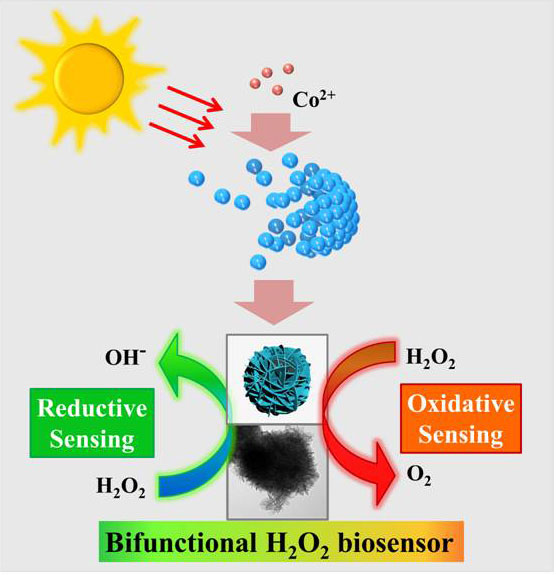
Preparation of nanostructured materials by sustainable energy sources at room temperatures has been always fascinating, but also challenging. On the other hand, hydrogen peroxide is one of the Preparation of nanostructured materials by sustainable energy sources at room temperatures has been always fascinating, but also challenging. On the other hand, hydrogen peroxide is one of the family of reactive oxygen species, causing drastic damages in diverse biological systems. Regulation and detection of HPreparation of nanostructured materials by sustainable energy sources at room temperatures has been always fascinating, but also challenging. On the other hand, hydrogen peroxide is one of the family of reactive oxygen species, causing drastic damages in diverse biological systems. Regulation and detection of H2O2 becomes a major concern recently, and affordable H2O2 biosensors are thus desired for biomendical industry. Due to the high production cost of noble metals and short storage time of enzymes, inexpsnsive and highly stable nanostructured metal oxides are promising alternatives. But sensing activites of metal oxides need to be improved to satisfy the purpose of effective sensing. Bifunctional sensing can be an effective strategy to address that issue. This work demonstrates an easy, green preparation of nanostructured cobalt oxides under sunlight at room temperature along, and the effect bifunctional sensing activities for hydrogen peroxide in biocompatiable conditions. In addition to good stability and reproducibility, the bifunctional sensing enhanced the selectivity toward H2O2 detection. This report may open the new concepts of solar-energy-assisted preparation of high-performance nanomaterials.


About the author
Prof. Chun-Hu Chen is now a faculty member of chemistry department, National Sun Yat-sen University in Taiwan. He received his Ph. D degree in chemistry at University of Connecticut in 2010. Later he conducted the postdoctoral research at Ohio State University. Prof. Chen’s research group is mainly focusing on understanding the materials/graphene hybrid interfaces and applications of graphene-enhanced properties for biosensors, heterogeneous catalysis, electrocatalysts, and clean energy. His group also works on green synthesis of diverse nanostructured metal oxide materials for biosensors and batteries.
Journal Reference
Electrochimica Acta,Volume 190, 1 February 2016, Pages 588-595.
Chia-Yung Su, Wen-Jie Lan, Chieh-Yu Chu, Xiao-Jie Liu, Wei-Yao Kao, Chun-Hu Chen
Department of Chemistry, National Sun Yat-sen University, Kaohsiung, 80424, Taiwan
Abstract
Photochemically synthesized cobalt oxide hydroxide (PCOH) under UV light has been successfully achieved without the addition of surfactants, templates, or organic solvents at ambient temperatures. PCOH samples can be converted to spinel cobalt oxide (PCO) after the calcination at 500 °C. The in-situ growth of hierarchical nanostructures was demonstrated with a three-stage mechanism in the photochemical preparation. The development of nanostructures and elemental condensation under different irradiation time governs the bifunctional-sensing performance of the cobalt oxide products. The formation of nanostructured cobalt oxides involves a free-radical oxidation mechanism in the acidic condition. We further demonstrate that the preparation of sensor-active cobalt oxides under nature sunlight (Solar-2H) is feasible. Compared to the multi-component bifunctional electrocatalysts comprised of enzymes and noble metals, our greenly prepared electrocatalysts, as the single-species sensor, achieve bifunctional hydrogen peroxide detection effectively. The as-produced electrocatalysts utilize electro-oxidative and electro-reductive signals together as bifunctional sensor, maximizing the wide detection range of 0.005–35 mM, a low detection limit of 0.7 μM, selective H2O2 detection, and ∼3000-time higher sensitivity than commercial cobalt oxides.
Go To Electrochimica Acta
 Advances in Engineering Advances in Engineering features breaking research judged by Advances in Engineering advisory team to be of key importance in the Engineering field. Papers are selected from over 10,000 published each week from most peer reviewed journals.