Advances in Engineering Advances in Engineering features breaking research judged by Advances in Engineering advisory team to be of key importance in the Engineering field. Papers are selected from over 10,000 published each week from most peer reviewed journals.

Journal Reference
Sensors and Actuators A: Physical, Volume 206, 1 February 2014, Pages 178-185.
Pit Pillatsch, Eric M. Yeatman, Andrew S. Holmes.
Optical and Semiconductor Devices Group, Electrical and Electronic Engineering, Imperial College London, SW7 2AZ London, UK.
Abstract
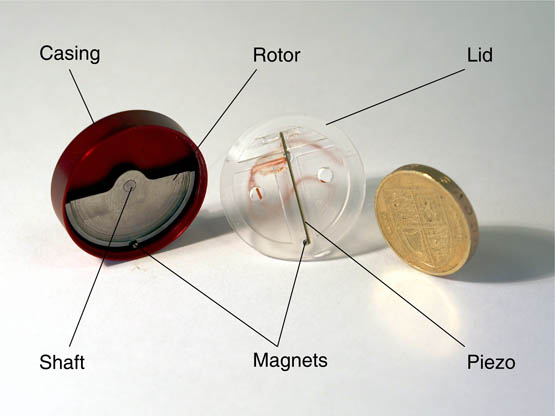
Energy harvesting from human motion faces the challenges of low frequency and random excitation. One strategy that has been successful in the past is frequency up-conversion. This paper introduces an inertial device that combines this principle, in the form of piezoelectric beam plucking through magnetic coupling with a rotating proof mass. The advantages rotational systems can have for body movements are discussed. The prototype is described and tested in a real world environment during a running race and later on in a laboratory environment on a custom built linear excitation table. Throughout these tests it is confirmed that such a device can operate over a broad range of frequencies and under varying orientations, making it suitable for this intended application. Across frequencies between 0.5 and 4 Hz and accelerations between 1 and 20 m/s2 power outputs in the range of tens of microwatts were achieved, with a peak value of 43 uW at 2 Hz and 20 m/s2 when the rotor went into a continuous rotation.