Advances in Engineering Advances in Engineering features breaking research judged by Advances in Engineering advisory team to be of key importance in the Engineering field. Papers are selected from over 10,000 published each week from most peer reviewed journals.

Significance
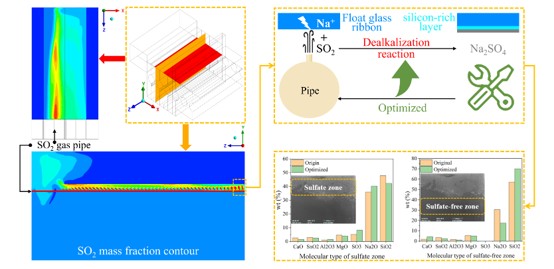
Float glass manufacture depends on a sequence of tightly coupled thermal, chemical, and transport processes that continue to influence surface quality after the ribbon leaves the tin bath. In the lift-up roller area, where the glass ribbon passes from the tin bath toward the annealing lehr, surface chemistry remains active enough for in-line dealkalization treatment. Sulfur dioxide is introduced through perforated pipes beneath the ribbon, and its reaction with the hot glass surface promotes sodium migration and the formation of a silica-rich surface region. For soda-lime-silicate float glass, this step is important because surface defects associated with scratches, abrasion, and hydrolysis are strongly connected to the near-surface chemical state of the glass. The main difficulty is whether SO2 can reach the active glass surface in sufficient concentration and with adequate cross-width uniformity during the short residence time available in industrial production. The temperature and exposure time in the lift-up roller region are largely fixed by the production process, and increasing the total SO2 input is not a straightforward solution because excess gas can contaminate the tin bath and contribute to additional defects. The same gas input must be delivered more effectively to the underside of a moving glass ribbon within a confined, recirculating, multigas environment. In a recent research paper published in Chemical Engineering and Processing – Process Intensification Dr. Tianlin Chen, Dr. Shimin Liu and Professor Shiqing Xu from Yanshan University working together with Dr. Zhiyong Zhang from Shahe Safety Industrial Co., Ltd developed an integrated finite-element and experimental methodology for optimizing SO2 perforated-pipe geometry in the lift-up roller area of float glass production. The technically distinct contribution is the direct coupling of hole diameter, spacing, and angle effects to SO2 mass-fraction distribution on the lower glass surface, followed by validation through ATR-FTIR and SEM-EDS surface chemistry. The optimized pipe design increased effective SO2 exposure, improved cross-width uniformity and also produced good evidence of stronger dealkalization and silicon-rich surface-layer formation.
The researchers first built a three-dimensional finite element model of the lift-up roller region, including the tin bath exit, the annealing lehr entrance, the glass ribbon, lift-up rollers, baffles, graphite blocks, and SO2 gas pipes. The new model treated the region as a multicomponent gas-flow problem, coupling mass, momentum, energy, and species transport. Because the geometry contains small pipe holes and narrow flow passages, the mesh strategy was chosen to capture localized jet behavior without making the calculation impractical. Boundary conditions reflected the industrial situation: one pipe supplied an N2– SO2 mixture, another supplied nitrogen, the tin bath introduced an N2–H2 atmosphere, and vents and pressure outlets allowed gases to leave the system.
The baseline simulation clarified why the original pipe arrangement gave uneven treatment. SO2 did not simply rise from the pipe and coat the underside of the ribbon uniformly. Part of the gas moved along the first lift-up roller toward the lower slag chamber; part passed downstream through the gap near the second roller; and recirculation near the ribbon edges carried gas into the baffle space before it was exhausted. Across the ribbon width, the SO2 mass fraction was higher near the edges than near the center. This pattern was tied to both pipe pressure and the internal circulation field. Pressure decreased from the pipe inlet toward the center, reducing outlet driving force, while mixed-gas circulation and dilution by N2–H2 further weakened the central SO2 concentration.
The team then examined how hole diameter, hole spacing, and hole angle altered the mass fraction and uniformity of SO2 on the lower glass surface. They found smaller holes increased jet velocity and improved the ability of SO2 to reach the glass surface, but very small openings raised concerns over corrosion-related clogging in the water-vapor and SO2 environment. The selected diameter therefore remained 2 mm, reflecting a process-relevant balance between gas delivery and pipe durability. Hole spacing had a different effect. Wider spacing increased internal pipe pressure and strengthened gas delivery to the surface, but the most concentrated condition was not automatically the most uniform one. At 120 mm spacing, the coefficient of variation reached a low value, whereas larger spacing raised SO2 concentration at the cost of cross-width uniformity. Hole angle proved especially influential because it changed the direction in which the gas jet entered the roller region. The authors found as the angle increased, SO2 was directed more effectively toward the high-temperature region near the first lift-up roller, where surface reaction was more favorable. At 60 degrees, the simulated lower-surface SO2 concentration and distribution uniformity were both improved. The design choice of tilting the holes therefore had a clear scientific consequence: it shifted SO2 exposure toward a region where the ribbon was still hotter and reduced ineffective downstream dispersion.
The combined optimized pipe used 2 mm holes, 120 mm spacing, and a 60-degree hole angle. Under the same total gas input, the integrated SO2 mass fraction on the lower glass surface increased by 47.6 %, and the cross-width coefficient of variation decreased from 19 % to 6.4 %. The authors performed experimental validation and found that ATR-FTIR spectra showed stronger S–O absorption in sulfate regions where the model predicted higher SO2 exposure. After optimization, the Na-associated non-bridging oxygen signal decreased near the ribbon edges, while bridging oxygen and Si–O–Si-related signals increased, consistent with sodium depletion and formation of a silicon-rich surface layer. SEM-EDS measurements added a second line of confirmation. Sulfur appeared in sulfate-rich regions rather than sulfate-free glass regions, and the Na/Si mass ratio in the surface layer decreased from 53.3% to 24.9% after optimization.
The findings of Professor Shiqing Xu and colleagues have direct engineering relevance for float glass production lines where surface quality depends not only on glass composition and thermal history, but also on the way reactive gases are delivered in confined process zones. In the lift-up roller area, the available reaction time is short, the ribbon temperature is already decreasing, and the surrounding gas field is affected by rollers, baffles, graphite blocks, tin-bath atmosphere, nitrogen injection, and exhaust pathways. The study shows that a more effective route is to redesign the gas pipe so that the same SO2 input reaches the glass surface with higher local concentration and better cross-width uniformity. For industrial glass manufacturers, this provides a practical design principle: dealkalization performance can be improved through controlled pipe-hole geometry. Adjusting hole diameter, spacing, and angle changes pipe pressure, jet velocity, gas penetration, and the position where SO2 contacts the lower glass surface. The optimized configuration identified in the paper increased the effective SO2 mass fraction at the ribbon surface and reduced cross-width non-uniformity, which is important for producing glass with more consistent surface chemistry across its width. This is especially relevant for large-width float glass ribbons, where edge-to-center differences can lead to uneven treatment and variable surface durability.
The work also supports simulation-guided process optimization. A finite element model can be used to evaluate pipe designs before production-line modification, reducing trial-and-error adjustments in an industrial environment where access is limited and operating conditions are demanding. By linking simulated SO2 distribution with ATR-FTIR and SEM-EDS measurements, the study gives engineers a way to connect gas-flow design with measurable surface outcomes such as sulfate formation, sodium depletion, and development of a silicon-rich layer. The broader application is in the design workflow for reactive gas delivery in float glass manufacturing: model the local flow field, identify where useful gas exposure is being lost, modify pipe geometry to improve contact with the glass surface, and validate the result through surface chemical analysis. This new approach can help improve scratch resistance, water resistance, and surface stability while avoiding unnecessary increases in SO2 consumption or added risk to the tin-bath environment.


Reference
Tianlin Chen, Shimin Liu, Zhiyong Zhang, Shiqing Xu, The effect of the SO2 gas pipe structure of the lift-up roller area on the dealkalization efficiency of float glass, Chemical Engineering and Processing – Process Intensification, Volume 218, 2025, 110541,
Go to Chemical Engineering and Processing – Process Intensification