 Advances in Engineering Advances in Engineering features breaking research judged by Advances in Engineering advisory team to be of key importance in the Engineering field. Papers are selected from over 10,000 published each week from most peer reviewed journals.

Significance
Understanding and manipulating the polarization of light is crucial for many optical applications. Polarization is an important property of light that even affects those optical systems that do not explicitly measure it. In particular, it has been reported that the polarization-phase state of a laser beam plays a substantial role in sharp focusing and in laser radiation-matter interaction. Consequently, optical devises that facilitate transformation of polarization properties of electromagnetic radiation are gaining increasing interest for practical applications. One of the compact and wavelength-independent instruments used for polarization transformations is the anisotropic crystal.
A review of preceding studies has established that most were devoted to investigating the propagation of singular beams along the crystal axis or under a slight slope to the crystal axis. This is due to the fact that when a circularly polarized beam propagates along the crystal axis, the spin angular momentum is transformed into an orbital angular momentum (OAM). Regardless, further work is needed, particularly focusing on the polarization-dependent effect of the astigmatic transformation of vortex beams focused perpendicular to the axis of a uniaxial crystal.
Recently, Professor Svetlana N. Khonina from the Image Processing Systems Institute of the Russian Academy of Sciences (Samara, Russia) and Associate professor Alexey Porfirev at Samara National Research University (Samara, Russia) presented a study in which a detailed assessment of the effects of astigmatic transformation of vortex Gaussian beams focused perpendicular to the axis of an anisotropic crystal was studied. Specifically, the two researchers engaged in theoretical, numerical and experimental explorations and investigations for different polarization states of the incident beams. Their work is currently published in the research journal, Optics Communications.
Sharp focusing of vortex Gaussian beams was used to intensify the astigmatic effect and make it visually evident. The researchers then showed the polarization dependence of the astigmatic transformation. The scholars proceeded to investigate in detail the influence of the initial polarization state on the individual components of the electric field of ordinary and extraordinary beams, both theoretically and numerically. Lastly, the dependence of the transformation on the polarization state of a beam incident on a crystal was studied numerically in detail.
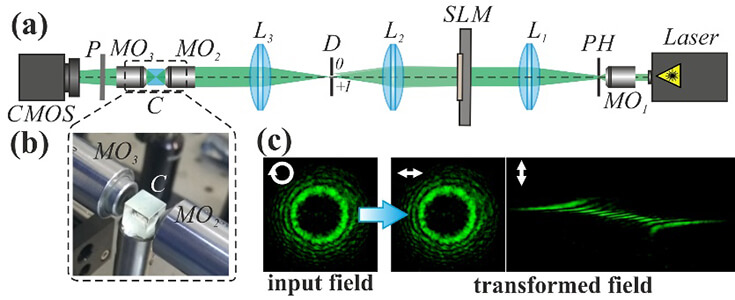
Remarkably, the authors theoretically showed that a beam propagating perpendicular to the crystal axis has an undistorted distribution (as in an isotropic medium) in the component perpendicular to the crystal axis and an astigmatically transformed distribution in the component parallel to the crystal axis (see Figure). In addition, they established that by altering the polarization at the input plane and using a polarization analyzer, one could dynamically control the field intensity distribution at the crystal output.
In summary, Khonina-Porfirev study presented a theoretical, experimental and numerical evaluation of the effect of the astigmatic transformation of vortex Gaussian beams focused perpendicular to the axis of an anisotropic for different polarization states of the incident beam. Most important, the experimental results were seen to be in good agreement with theoretical results. Altogether, the results obtained can be used for the generation and detection of optical vortex beams in optical communication systems and in the field of polarization-controllable optical manipulation of nano- and microparticles.
This work was financially supported by Russian Foundation for Basic Research (grant No. 16-29-11698-ofi_m).


Reference
S.N. Khonina, A.P. Porfirev. Polarization-dependent transformation of vortex beams when focused perpendicular to the crystal axis. Optics Communications, volume 428 (2018) page 63–68
Go To Optics Communications