 Advances in Engineering Advances in Engineering features breaking research judged by Advances in Engineering advisory team to be of key importance in the Engineering field. Papers are selected from over 10,000 published each week from most peer reviewed journals.

Significance
Water scarcity is an important global issue and only a tiny fraction of people has access to fresh water. With seawater comprising over 97% of the global water supply, desalination seems like an obvious answer. Yet, the standard methods—thermal distillation, reverse osmosis—come at a steep cost, not just economically but environmentally. They guzzle energy, often from fossil fuels, and create highly concentrated brine waste that is difficult to manage responsibly. This has left researchers searching for smarter, cleaner alternatives methods that can be adopted by communities with limited infrastructure. For instance, solar interfacial evaporation, has shown real promise which uses sunlight directly to heat and evaporate water from the surface, and by this dramatically improves energy efficiency. But even this approach is held back by a common problem: the materials. Many solar evaporators are made from synthetics—metal nanostructures, carbon nanotubes, and designer polymers—that either raise toxicity concerns, require multi-step fabrication, or are simply too costly for widespread use. To this account, new research paper published in Small Journal and conducted by PhD candidate Wenjing Geng and Professor Cheng Chen from the Anhui Agricultural University together with Associate Professor Hongjie Zhang (Quanzhou Normal University), Professor Weiwei Lei (RMIT University in Australia), Professor Xiaoli Zhao (Chinese Research Academy of Environmental Sciences), researchers chose sunflower pollen as their starting point. Pollen grains are small, robust, and structurally rich, naturally built to withstand environmental extremes. More importantly, they contain interconnected micropores that are excellent for transporting fluids. Still, raw pollen isn’t ready-made for solar evaporation. It disperses too easily in water and doesn’t absorb sunlight efficiently. To solve this, the team developed a method to thermally carbonize the pollen, effectively welding the grains into a dark, porous, and cohesive monolith. What’s striking is that they achieved this without any added chemicals—just controlled heat. The result is a structure that can both survive harsh conditions and also actively facilitates water purification under sunlight.
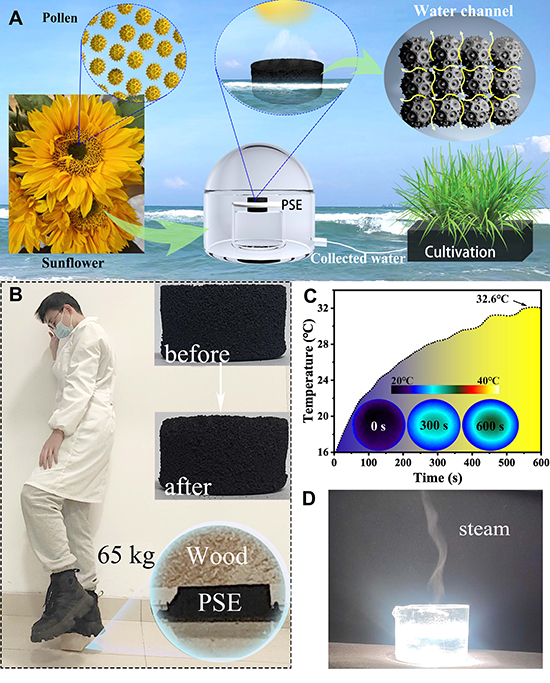
In brief, the researchers subjected grains to a one-step carbonization process, varying the temperature from 100°C to 700°C, and simply watched how the material responded. At around 300°C, some color changes began to appear—grains took on a darker tone and began sticking together slightly. But it was at 500°C that everything clicked. The structure fused into a coherent, porous solid with a blackened surface ideal for absorbing sunlight. They called this optimized form PSE5. The authors used scanning electron microscopy imaging to see the transformation from discrete grains to a continuous 3D matrix. While the original pollen shape wasn’t entirely lost, it had clearly evolved. Importantly, this new structure retained plenty of internal channels—essential for capillary-driven water transport. Contact angle tests showed strong hydrophilicity, confirming that PSE5 readily pulled in water, which is exactly what you want at the evaporation interface. Thermal imaging under simulated sunlight also painted a promising picture: fast heating, stable surface temperatures, and strong photothermal response. Afterward, they subjected PSE5 to a series of durability tests and demonstrated It resisted deformation under a 65 kg load. Moreover, after being soaked in solutions at pH 1 and pH 14 for a full day, it still held its structure and maintained a compressive strength of 3.44 MPa. That kind of chemical resilience is rare, especially in something derived from plant matter. In functional terms, its performance was even more telling. The authors reported that the evaporator achieved an evaporation rate of 1.86 kg/m²/h under standard sunlight, putting it on par with, or ahead of, many synthetic systems. It removed dyes and antibiotics from water with over 99% efficiency, and perhaps most surprisingly, it handled salt without fouling. After 50 cycles—even in brines up to 21% salinity—the structure kept going. Surface salt simply dissolved away through passive flows driven by heat and concentration gradients.
In conclusion, the real value of the research work and Professor Cheng Chen and his collaborators lies in what it enables across two deeply interconnected fronts: access to clean water and the ability to grow food sustainably. The innovative method does not depend on high-end manufacturing, and no reliance on expensive membranes or hard-to-source materials. The core of the device is pollen—something biologically abundant, renewable, and often discarded without a second thought. With basic tools and heat, this material can be converted into a functioning evaporator. It means that small communities, especially in drought-prone or coastal regions, could build and use these systems independently. That sort of decentralization isn’t just practical—it’s empowering. It puts agency into the hands of people who are usually on the receiving end of global water stress. Additionally, the new technique is sustainable and performance wasn’t sacrificed to make this greener. On the contrary, the evaporator holds its own against much more complicated systems. And it does so without synthetic binders, without chemical additives, and without waste.





Reference
Geng W, Zhang H, Lei W, Zhao X, Chen C. Welding Pollen-Based Solar Evaporator for Clean Water Production. Small. 2025 Jan;21(2):e2408576. doi: 10.1002/smll.202408576.