Advances in Engineering Advances in Engineering features breaking research judged by Advances in Engineering advisory team to be of key importance in the Engineering field. Papers are selected from over 10,000 published each week from most peer reviewed journals.

Significance
Building and construction industry have rapidly grown in recent decades in response to the population and economic demands. An emerging strategy to improve the sustainability of civil structures is to employ construction materials with high fire resistance, good seismic performance, and environmental protection capabilities. Cold-formed steel has the potential to meet these demands. Despite major advances in civil engineering, providing solutions to prevalent secondary disasters such as the post-earthquake fires has remained a challenge. Based on recent findings, researchers suggested the need to consider the changes in fire resistance performance due to damages in the cold-formed steel walls for the proper understanding of the cold-formed steel behavior during combined earthquakes and fire tragedies.
To address the aforementioned challenges, a team of researchers at China University of Mining and Technology: Professor Wei Chen, Professor Jihong Ye, Qiang Wang (Ph.D. Student), and Professor Jian Jiang, in collaboration with Mr. Yafei Qin from Shangai Beststeel Streel Structure Building Systems Company, presented a new strategy for the investigation of the post-earthquake fire performance of cavity-insulated cold-formed steel shear walls with gypsum as face layer sheathing. Rather than using double-layer gypsum plasterboards as base-layer sheathing, calcium silicate boards were considered better in terms of seismic, mechanical, and post-earthquake fire performance. Their work is currently published in the research journal, Thin-Walled Structures.
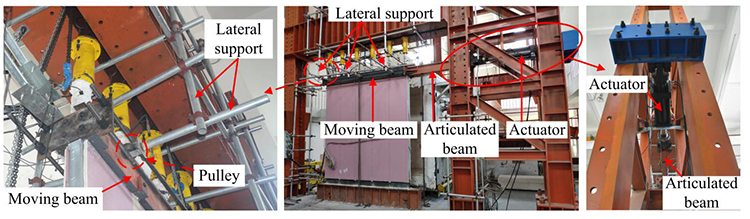
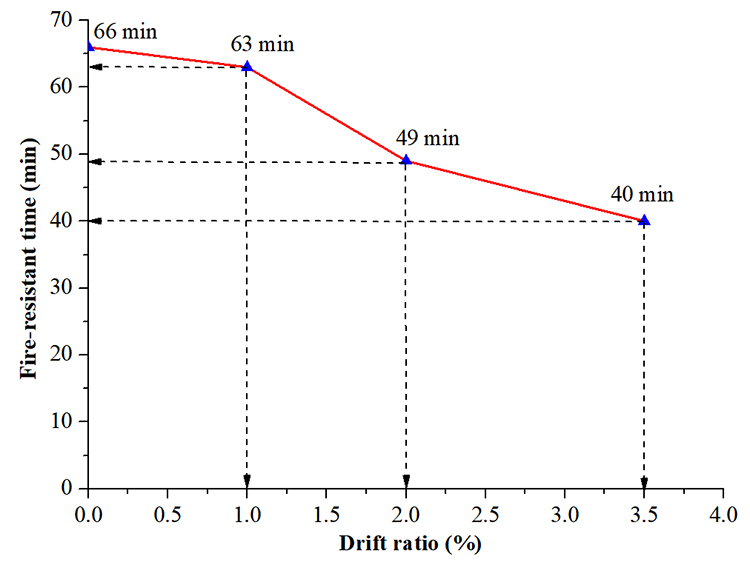
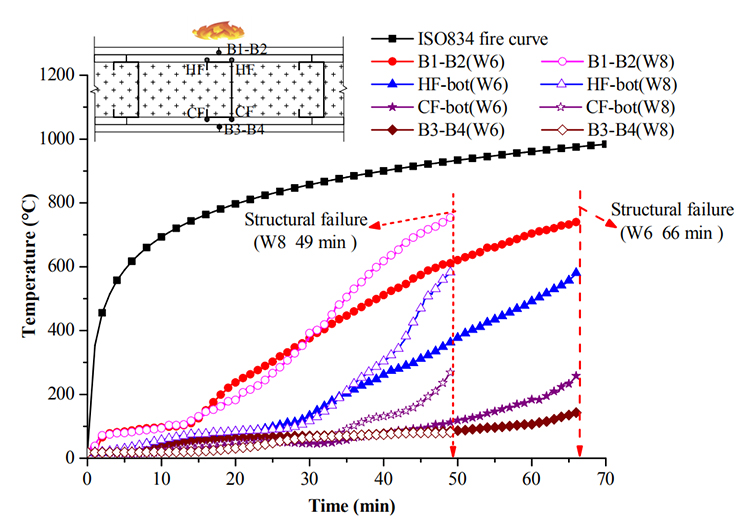
In the reported experimental work, four identical specimens were investigated. The first specimen was subjected to fire without seismic damage, while the remaining three were first subjected to cyclic loading tests of different drift ratios followed by fire experiments. Results showed that substituting the gypsum boards with calcium-silicate improved the residual fire resistance time and the shear behavior of the cold-formed steel walls. The relationship between the drift ratios and fire resistance time was explored, considering a load ratio of 0.27. The fire resistance performance of the cold-formed steel shear walls was unlikely to be affected by earthquakes when the drift ratio is less than 1%. However, an increase in the drift ratio from 2% to 3.5% respectively, resulted in a fire-resistance time of 17 and 26 minutes less than the walls without earthquake damage.
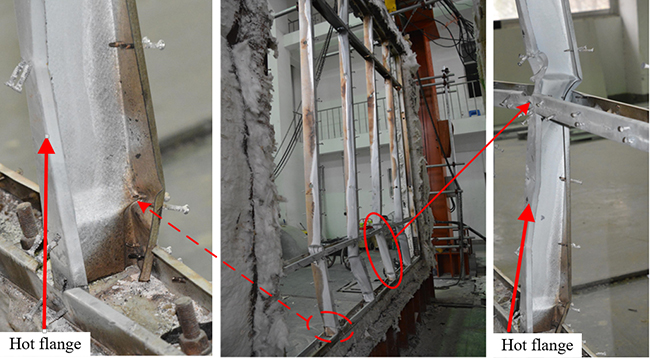
Insulation, integrity, and structural failure modes of the GP-CS sheathed cold-formed steel were discussed. The structural fire was generally caused by local buckling of hot stud flange under both fire and post-earthquake fire conditions. The failure location of the steel studs shifted from the top frame towards the bottom with an increase in the drift ratio. Furthermore, the authors noted that avoiding overlapped board joints on the same sides on double-layer sheathing was useful in improving the repeatability, fire resistance time and time-temperature curves of the cold-formed steel walls. Instead, an excellent practical design should incorporate cold-formed steel walls with GP and CS sheathing, especially for mid-rise buildings.
In summary, the study presented a post-earthquake fire performance investigation of cavity-insulated cold-formed steel shear walls with gypsum and calcium-silicate sheathing. The feasibility of the approach was successfully demonstrated using four identical specimens where it was reported that using calcium-silicate instead of gypsum for base-layer sheathing significantly improved the shear properties and fire resistance time. In a statement to Advances in Engineering, the authors pointed out that their findings will help protect building structures against secondary disasters like post-earthquake fires.



Reference
Chen, W., Ye, J., Wang, Q., Jiang, J., & Qin, Y. (2020). Postearthquake fire performance of cavity-insulated CFS shear walls with gypsum and calcium-silicate sheathing. Thin-Walled Structures, 148, 106597.