Advances in Engineering Advances in Engineering features breaking research judged by Advances in Engineering advisory team to be of key importance in the Engineering field. Papers are selected from over 10,000 published each week from most peer reviewed journals.

Significance
Thin films have a vast range of applications including microelectronics and energy conversion owing to their unique properties. Numerous technologies are available for fabricating thin films. They majorly rely on the assembly of molecules and atoms as their elemental building blocks. For example, growth and nucleation of thin films in chemical and physical vapor deposition methods depend on surface diffusion, adsorption, and chemical binding. Unfortunately, the presence of defects in thin films impacts negatively on their functional and structural properties. Therefore, proper understanding and control of these defects will give way to fabricating structures with efficient structural and functional properties.
Presently, clusters have been used as the building blocks for nanostructured thin films. This is due to the increasing interest in the gas phase deposition. Cluster beam deposition (CBD) technology, for example, allows deposition of clusters on a substrate produced in the gas phase thus enabling fabrication of efficient nanostructured thin films and devices. It does not alter the individual properties of the nanoscale building blocks during the assembly process. Consequently, supersonic cluster beam deposition (SCBD) is an improvement of the CBD to enhance deposition rate and lateral resolution. It also enables control of various parameters of nanostructured films such as the roughness which is a key consideration in tailoring their structural and functional properties.
However, microscopic mechanisms that influence the structuring and growth of the nanostructured thin films have not been fully explored experimentally. Among the proposed theoretical models to describe the growth of the cluster-assembled films in the sub-monolayer level is the deposition diffusion and aggregation (DDA) model. Despite taking into consideration all the three main physical mechanisms, it still experiences challenges just like the other models.
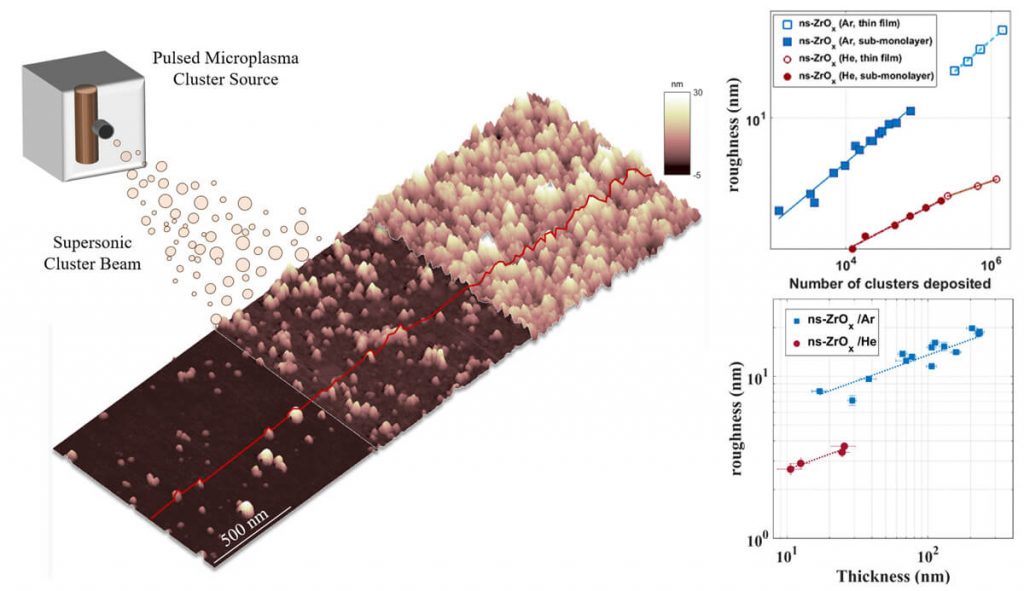
Italian scientists: Dr. Francesca Borghi, Professor Alessandro Podestà, Dr. Claudio Piazzoni, and Professor Paolo Milani at Università degli Studi di Milano investigated the microscopic mechanisms influencing the growth and structural properties of cluster-assembled films using atomic force microscopy. The authors used cluster-assembled zirconia films deposited by the supersonic cluster beam deposition method. They purposed to investigate the influence of the dimensions of the building blocks on the growth mechanisms and the final surface roughness of the resulting nanostructured films. Furthermore, the growth process from the submonolayer to thin film regime was also investigated. The work is published in the journal, Physical Review Applied.
The authors observed that before deposition, the cluster sizes affect the growth dynamics. For instance, small cluster sizes favor nucleation and surface diffusion on silicon substrate leading to two-dimensional growth while the large cluster sizes favor three-dimensional growth mode by acting as nucleation sites. In addition, various morphological properties of the cluster-assembled films were determined by the growth dynamics in the submonolayer regime. However, roughness evolution with respect to the number of clustered deposited exhibited growth exponent equivalent to that of ballistic deposition model.
The study has successfully provided adequate information regarding the effects of the microscopic mechanisms on the structuring and growth of the nanostructured thin films and especially during the transition from the submonolayer to the thin-film regime. With the possibility to control the nanostructuring and mesostructuring of the nanostructured films, the study will advance its applications in large scales.
Reference
Borghi, F., Podestà, A., Piazzoni, C., & Milani, P. (2018). Growth Mechanism of Cluster-Assembled Surfaces: From Submonolayer to Thin-Film Regime. Physical Review Applied, 9(4).
Go To Physical Review Applied