 Advances in Engineering Advances in Engineering features breaking research judged by Advances in Engineering advisory team to be of key importance in the Engineering field. Papers are selected from over 10,000 published each week from most peer reviewed journals.

Achieving sustained nuclear fusion requires a plasma to reach temperatures and densities at which fusion reactions produce enough energy to maintain the process without continuous external heating. This condition, known as ignition, is a central goal of magnetic confinement fusion research. Reaching it is difficult because the plasma continuously loses energy through radiation and transport, while the heat generated by fusion reactions can also affect its stability.
The classical Lawson criterion describes the conditions required for ignition in terms of plasma density, temperature, and energy confinement time, which measures how long the plasma retains its thermal energy. It provides an important measure of fusion performance, but meeting this requirement does not necessarily mean that a reactor can reach ignition under realistic operating conditions. The plasma must pass through a sequence of changing temperatures, densities, and heating requirements before fusion reactions can sustain themselves.
Several physical processes influence this transition. Alpha particles produced during deuterium–tritium fusion transfer energy back to the plasma, gradually reducing the need for external heating. At the same time, energy escapes through transport and radiation. Helium produced by fusion reactions can accumulate and dilute the fuel, while impurities released from plasma-facing components introduce additional radiation losses. Tungsten is a particular concern because even small concentrations can substantially increase the amount of energy lost from the plasma.
The relationship between plasma heating and stability adds another difficulty. Fusion reactions become more frequent at higher temperatures, potentially creating a feedback process in which additional heat produces still more fusion reactions. This can lead to thermal runaway unless other physical processes provide sufficient damping.
Understanding ignition therefore requires more than calculating the balance between energy production and losses. It also involves determining which operating conditions are physically accessible and whether the plasma can remain stable after reaching them.
In a recent research paper published in Physical Review Letters, Dr. Luis Delgado-Aparicio, Dr. Masayuki Ono, and Dr. Jonathan Menard from Princeton Plasma Physics Laboratory developed a unified theoretical framework to investigate these connected problems. Their approach combines established ignition criteria with plasma energy balance, impurity radiation, confinement behavior, and thermal stability to examine the conditions needed for sustained fusion operation.
Experiments and Findings
The researchers developed a time-dependent energy balance model for deuterium–tritium plasma that accounts for external heating, energy deposited by fusion-produced alpha particles, energy transport, and radiation losses. The calculations also include helium accumulation, fuel dilution, and impurities that can enter the plasma from surrounding materials.
They first investigated how radiation changes the conditions required for ignition. In an ideal plasma, the Lawson criterion establishes the minimum combination of density, temperature, and confinement time needed for fusion self-heating to balance energy losses. Including helium and heavier impurities raised this requirement considerably.
Tungsten had a particularly strong effect. At a concentration of approximately one part in 100,000, the calculations indicated that ignition could become inaccessible below a plasma temperature of about 14 keV. Even at higher temperatures, the additional radiation could substantially increase the pressure needed to reach ignition. These calculations show why impurity concentration must be considered alongside temperature and confinement when evaluating reactor performance.
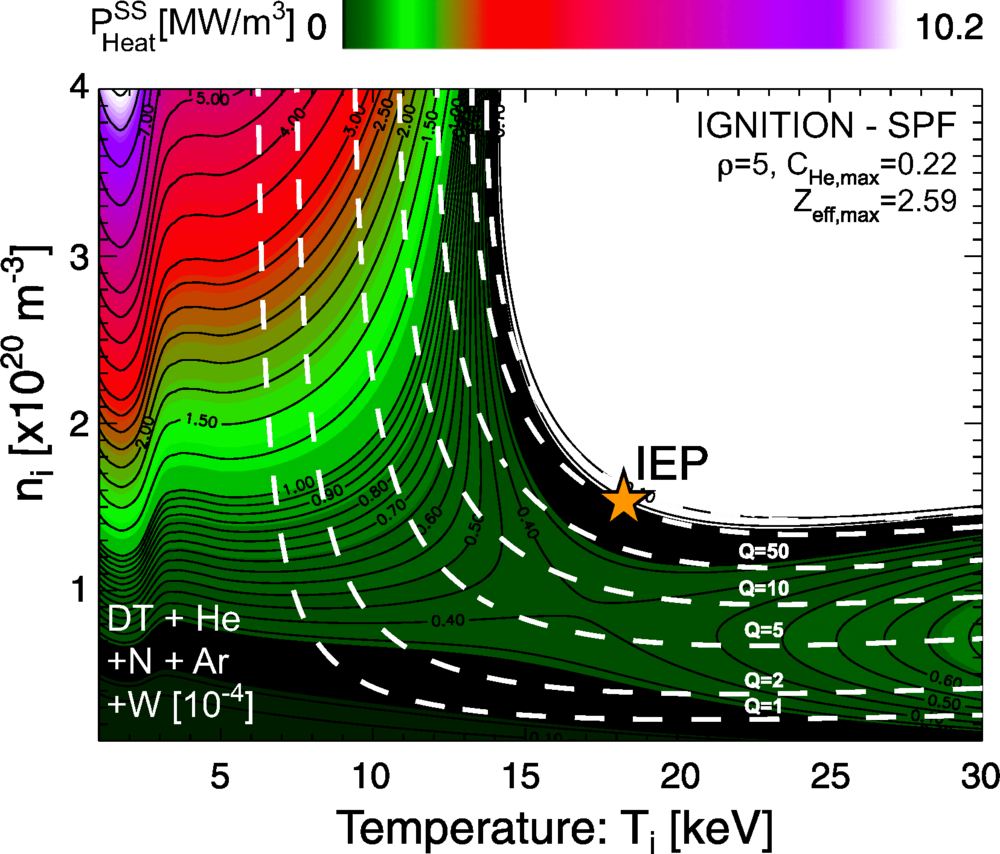
The next question was how these losses affect the route toward self-sustained fusion. To address this, the team calculated the external heating power required across different plasma temperatures and densities. The resulting operating maps identified several important features, including the marginal ignition ridge, the Cordey saddle, and the ignition entry point.
The marginal ignition ridge marks a boundary in the plasma operating conditions associated with the transition toward self-sustained burning. The Cordey saddle identifies a favorable route through this region, while the ignition entry point represents the lowest-pressure point on the self-sustained ignition boundary. Examining these features together allowed the researchers to determine how the path toward ignition changes when realistic energy losses are included.
Increasing impurity radiation shifted the favorable operating regions toward higher temperatures and densities. At a tungsten concentration of approximately one part in 10,000, the preferred temperature near the Cordey saddle rose to about 20 keV, with a corresponding fusion gain of approximately nine. Fusion gain measures the ratio of fusion power produced to the external heating power supplied. The shift indicates that a reactor may need to operate under more demanding conditions to progress toward ignition when tungsten accumulates in the plasma.
The team also considered whether increasing fusion reactivity could compensate for these losses. They examined spin-polarized deuterium–tritium fuel, which can increase the effective fusion reaction rate. With an assumed reactivity enhancement of approximately 50%, the calculations showed that favorable ignition conditions could be recovered even with elevated tungsten concentrations. The pressure required near the Cordey saddle decreased by approximately half, suggesting that fuel polarization could help counteract the effects of impurity radiation.
Another part of the investigation addressed thermal runaway. A small increase in plasma temperature can accelerate fusion reactions, producing additional alpha-particle heating and potentially amplifying the initial temperature rise. The researchers developed a generalized stability analysis to determine how energy losses respond to these temperature changes.
The calculations identified several damping mechanisms. Energy transport removes heat from the plasma, while radiative cooling and synchrotron radiation provide additional losses. Energy confinement can also deteriorate when plasma heating increases, further limiting the temperature rise. Under the modeled conditions, these responses reduced the growth rate of thermal instability and could support a stable, self-sustained burn.
To evaluate the implications for reactor operation, the researchers extended their initial zero-dimensional calculations to a three-dimensional representation of the Spherical Tokamak Advanced Reactor (STAR), a proposed fusion pilot plant. This model incorporated spatial variations in plasma properties and the distribution of impurity radiation, including radiation concentrated near the cooler plasma edge.
The three-dimensional analysis revealed that tungsten accumulation could impose greater pressure requirements than the simpler model predicted. Under standard H-mode confinement assumptions, increasing tungsten concentration pushed the operating conditions toward or beyond the reactor’s magnetohydrodynamic stability limits. At the ignition entry point, the required pressure could be three to five times higher than at the Cordey saddle.
Improved energy confinement substantially reduced these requirements. With a confinement enhancement factor of 1.5, the calculations indicated that high fusion gain could remain accessible over a wider range of tungsten concentrations while staying within the modeled stability limits. Maintaining enhanced confinement together with effective impurity control is therefore an important consideration for sustained reactor operation.
Engineering Significance
The generalized framework provides a way to evaluate fusion ignition in relation to the physical constraints of reactor operation. It distinguishes between plasma conditions that meet the energy requirements for ignition and those that can be reached without exceeding magnetic stability limits. This distinction is important when selecting operating conditions for reactors intended to produce sustained fusion power.
The analysis also connects several engineering decisions that are often considered separately. Plasma-facing materials influence the impurities entering the plasma, while energy confinement determines how much heating is needed to maintain the desired temperature. Both factors affect the plasma pressure and the range of operating conditions available to a reactor. Evaluating them within the same framework can help identify combinations that are more compatible with sustained fusion operation.
One practical implication is the choice of how a reactor approaches ignition. The authors favor a heat-first, densify-second strategy, in which the plasma is heated sufficiently before its density is increased toward ignition. This sequence may help avoid operating conditions where radiation losses are particularly severe.
The treatment of thermal stability is also relevant to reactor control. By accounting for the temperature dependence of heating, transport, and radiation, the framework provides a more detailed assessment of whether a plasma can maintain a steady burn rather than undergo uncontrolled temperature growth.
The calculations offer a basis for evaluating improved confinement, spin-polarized fuels, and alternative plasma-facing materials. The authors also identify low-atomic-number liquid-metal walls as a possible way to reduce tungsten contamination while supporting favorable confinement conditions. These approaches remain dependent on achieving the required performance in long-pulse, high-power reactor operation.



Reference
Delgado-Aparicio, Luis & Ono, Masayuki & Menard, Jonathan. (2026). Generalized Lawson-Cordey-Mills Accessibility of Fusion Ignition. Physical Review Letters. 137. 10.1103/mmc9-nzfx.