Advances in Engineering Advances in Engineering features breaking research judged by Advances in Engineering advisory team to be of key importance in the Engineering field. Papers are selected from over 10,000 published each week from most peer reviewed journals.

Significance
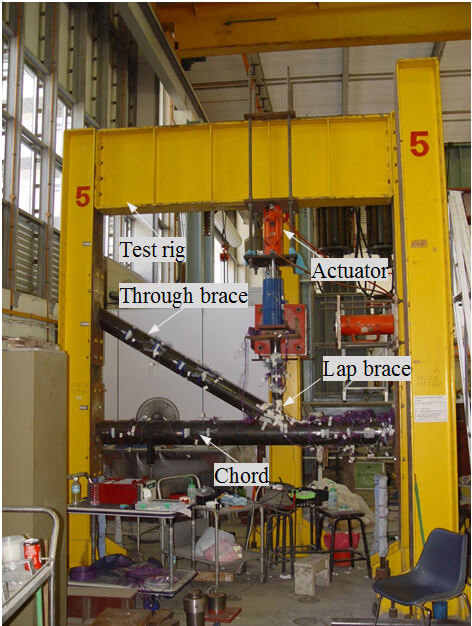
Tubular joints are generally preferred to circular hollow section joints for use in offshore structures. Tubular joints can be classified further into simple gap tubular joints and completely overlapped tubular joints. The latter is easy to fabricate and exhibit better strength properties as compared to the former. Overlapped joints are configured by welding the lap brace onto the through brace which is also welded onto the chord.
Several methods have been defined to describe failure criteria modes in tubular and circular hollow section joints. For instance, plastification of through brace wall is the primary type of failure mode in completely overlapped tubular joints. It also dissipates much energy in compression as compared to the tension phase. To the end, a lot have been uncovered about failure modes, strain and stress concentration and ultimate capacity of the completely overlapped tubular joints. However, not much investigations have been done concerning the local joint flexibility (LJF) of such joints. Knowledge of LFF for both the in-plane and out-plane bending would lead to the design of better offshore structures through increasing the deflections, reducing then buckling loads and changing the natural frequencies among other advantages.
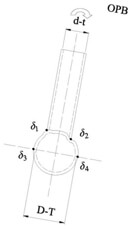
Professor Fei Gao from Huazhong University of Science and Technology, School of Civil Engineering and Mechanics and Dr. Biao Hu from the City University of Hong Kong developed parametric equations for predicting the local joint flexibility in fully overlapped tubular joints. The joints were subjected to lap brace out-of-plane bending. MARC was used for simulating the joint behavior with 8-node element. They used finite element models that were verified and calibrated using the previous studies results. This was in a bid to explore the effects of the parameters on the local joint flexibility of circular hollow section joints with complete overlap braces. The developed parametric equations were accessed using the Fatigue Guidance Review Panel (FGRP) Criteria and eventually compared to the existing T/Y-joint parametric equations. Their work is published in the research journal, Journal of Constructional Steel Research.
The authors successfully observed that the developed element model was excellent for local joint flexibility simulation of joints subjected to out-of-plane bending. LJF was found to be varying with each parameter. For instance, flexibility coefficient increased with increase in the chord radius-to-wall thickness ratio and through brace radius-to-wall thickness ratio while it decreased with increase in the angle between the chord and through brace, through brace-to-chord diameter ratio and thickness ratio. On the other hand, lap brace-to-through brace wall thickness ratio had almost negligible effects on the flexibility coefficient.
The effectiveness of the proposed parametric equations for predicting LJF was evaluated at a mean value of 1.04 and CoV P/R ratios of 4.67% of the acceptance criteria of FGRP. From the comparison to the existing T/Y-joint parametric equations, the authors concluded that it is conservative to use the existing parametric equation for predicting the LJF of completely overlapped tubular joints under out-of-plane bending as compared to the proposed parametric equations.



Reference
Gao, F., & Hu, B. (2015). Local joint flexibility of completely overlapped tubular joints under out-of-plane bending. Journal of Constructional Steel Research, 115, 121-130.
Go To Journal of Constructional Steel Research