 Advances in Engineering Advances in Engineering features breaking research judged by Advances in Engineering advisory team to be of key importance in the Engineering field. Papers are selected from over 10,000 published each week from most peer reviewed journals.

Significance
Two-dimensional (2D) materials have attracted great interest because their atomic-scale thickness gives them physical and chemical properties that can differ from those of bulk materials. Graphene is a well-known example, consisting of a single layer of carbon atoms. Many other 2D materials are obtained from layered crystals, where individual atomic sheets are held together by relatively weak van der Waals forces. These weak interactions allow the layers to be separated through a process known as exfoliation.
However, 2D materials can also be obtained from non-layered crystals in which atoms are connected through stronger chemical bonds. These are known as non-van der Waals (non-vdW) 2D materials. Their surfaces often contain atoms with unsatisfied chemical bonds, giving them properties that may be useful in catalysis, electronics, and magnetic applications.
Identifying suitable non-vdW materials is challenging because their parent crystals lack the naturally separated layers found in conventional 2D materials. Exfoliation requires breaking chemical bonds within a three-dimensional network while preserving enough connections to form a stable atomic sheet. The difficulty is determining which bonds can be broken most easily and whether the remaining structure can exist independently.
Computational methods have helped identify many layered materials suitable for exfoliation, but they are less effective for non-layered crystals. Methods based on atomic distances or gaps between layers cannot adequately describe the different strengths of chemical bonds in a three-dimensional crystal. More detailed calculations can provide this information, although evaluating every possible cleavage surface across thousands of materials requires considerable computational resources. A useful prediction method must therefore account for two competing factors: the energy needed to separate a sheet from its parent crystal and the energy required to break that sheet into smaller fragments. A material is more likely to produce an intact 2D structure when separating the sheet is energetically favorable compared with breaking it apart.
In a recent research paper published in Nature Communications, graduate student Tom Barnowsky, Professor Carsten Timm, and Dr. Rico Friedrich from Technische Universität Dresden in Germany developed the universal eXfoliation and Cleavage Potential (XCP), combined with two complementary algorithms for predicting cleavage surfaces and exfoliable 2D structures from bulk crystals. Their framework identified 44,030 potentially cleavable surfaces and structures, including 2,531 promising composition-conserving non-vdW 2D candidates evaluated using detailed calculations. It provides a computational tool for discovering 2D materials beyond conventional layered crystals.
The researchers developed a model called the universal eXfoliation and Cleavage Potential (XCP), which estimates the strength of interactions between atoms using their chemical identities and separation distances. The model combines two mathematical descriptions of atomic interactions: the Morse potential, which captures important features of covalent and metallic bonding, and the Yukawa potential, which accounts for screened ionic interactions.
Its parameters were fitted using density functional theory (DFT) calculations from the AFLOW-ICSD materials database. This allowed XCP to estimate bond energies across a broad range of chemical compositions without performing expensive electronic-structure calculations for every possible cleavage surface. Two complementary algorithms were then developed to identify possible 2D structures. The first, called BONDDEL, progressively removes the weakest bonds within a crystal until connected atomic sheets remain. This method can identify structures with irregular or corrugated surfaces that cannot be described by a simple flat cut. When applied to iron titanium oxide (FeTiO₃), it recovered the structure of ilmenene, a non-vdW 2D material that has already been produced experimentally.
The second algorithm, HKLSEARCH, examines different crystallographic planes and estimates the energy required to separate the crystal along each one. Planes with lower bond-energy densities are considered more favorable for cleavage. In silicon, for example, the method correctly identified the {111} planes as preferred cleavage surfaces. It also reproduced the expected equilibrium crystal shape, supporting the ability of the model to distinguish between different surface energies.
To compare materials with different bonding strengths, the team introduced an exfoliability ratio. This quantity compares the energy required to break a 2D sheet into smaller fragments with the energy needed to separate it from the bulk crystal. A higher ratio indicates that the sheet is more strongly bonded internally than it is to the surrounding crystal, making intact exfoliation more favorable. They also validated against previously reported non-vdW materials showed that the framework correctly identified the exfoliation planes in 23 of 29 experimentally established cases, corresponding to a success rate of about 80%.
The researchers then applied the framework to a large collection of experimentally observed bulk crystal structures. Screening 24,566 non-layered crystals identified 44,030 potentially cleavable surfaces and 2D structures. After selecting candidates that retained the chemical composition of their parent material and applying a conservative exfoliability threshold, they obtained 2,531 promising non-vdW 2D candidates for further investigation.
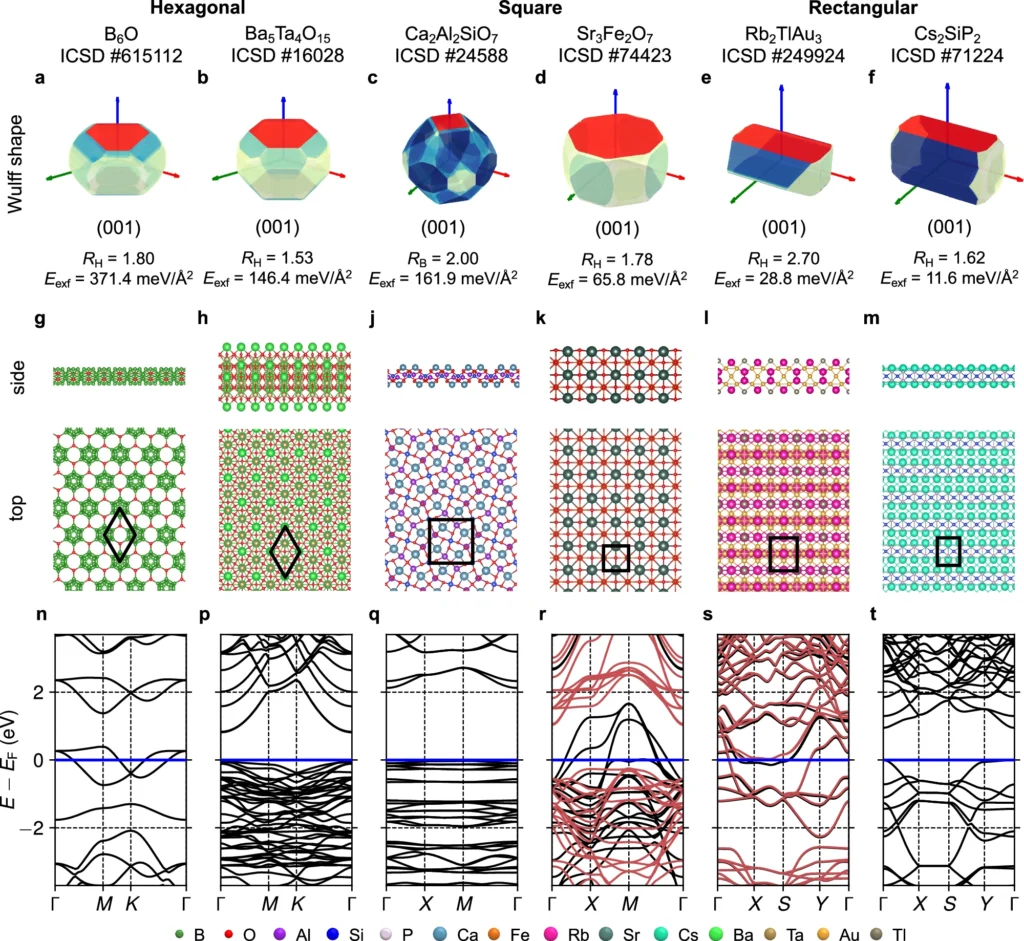
The team performed DFT calculations to evaluate the energies and relaxed atomic structures of these candidates. About 85.9% had calculated exfoliation energies below 140 meV/Ų, the reference value for hematene, an experimentally produced non-vdW 2D material. This comparison indicated that many of the predicted sheets could be accessible through exfoliation.
An important feature was the structural rearrangement that occurred after separation from the bulk crystal. Unlike conventional layered materials, which often retain much of their original atomic arrangement, non-vdW sheets can undergo considerable changes in thickness and surface area. Breaking bonds allows the remaining atoms to move into more favorable positions, sometimes substantially reducing the energy of the isolated sheet.
The authors’ calculations also examined whether the predicted structures could remain stable. Using a thermodynamic stability criterion, 49% of the monolayers were classified as stable, increasing to 70% when considering bilayer structures. Vibrational calculations indicated that 64.4% of the candidates were dynamically stable, meaning they showed no substantial lattice instabilities under the computational criterion used.
The identified materials covered all five possible 2D Bravais lattice types, including rectangular, square, hexagonal, oblique, and centered rectangular structures. Their electronic properties were also diverse. Boron suboxide (B₆O), for example, was predicted to change from a semiconductor in its bulk form to a metal when isolated as a 2D sheet. Other compounds, including Ba₅Ta₄O₁₅ and Ca₂Al₂SiO₇, showed transitions from indirect to direct electronic band gaps.
Comparison with existing 2D materials databases revealed very little overlap. This indicated that the screening framework had identified a largely unexplored collection of candidate materials beyond those commonly considered in conventional 2D materials research.
The new study of Barnowsky, Timm, and Friedrich demonstrated a new way to predict which parts of a non-layered crystal may form stable 2D sheets without relying on the presence of weakly bonded layers. By considering the relative strengths of chemical bonds, the framework extends computational exfoliation screening to materials previously difficult to assess systematically.
The exfoliability ratio provides a useful distinction between a crystal that can be cleaved and one that may release an intact atomic sheet. A low-energy cleavage surface alone does not guarantee that the resulting structure will remain connected. Comparing the energies of separation and fragmentation provides a more meaningful basis for identifying potential 2D materials across different chemical bonding environments. The study also establishes why structural relaxation matters when evaluating non-vdW sheets. Breaking strong chemical bonds changes the atomic environment, allowing substantial rearrangements that can lower the energy of the isolated material. Accounting for these changes is therefore essential for assessing both exfoliation energetics and the properties of the resulting structures.
The predicted diversity of crystal structures and electronic behavior broadens the range of materials available for investigating low-dimensional physics. In particular, changes in electronic band structure after exfoliation indicate that reducing a material to atomic-scale thickness can produce properties that are absent in its bulk form. Beyond identifying individual candidates, the framework provides a computationally efficient way to prioritize materials for more detailed investigation. It connects bulk crystal structures, bond strengths, preferred cleavage surfaces, and the stability of isolated sheets within a single screening strategy.


Reference
Barnowsky, T., Timm, C. & Friedrich, R. High-Throughput Prediction of Exfoliable Non-van der Waals Materials from a Universal Potential. Nat Commun 17, 8977 (2026). https://doi.org/10.1038/s41467-026-76806-8