Journal Reference
International Journal of Energy Research, Volume 39, Issue 7, pages 941–953, 2015.
Juliana M. Juárez, Marcos B. Gómez , Oscar A. Anunziata*
Centro de Investigación en Nanociencia y Nanotecnologia (NANOTEC), Facultad Regional Córdoba, Universidad Tecnológica Nacional, Córdoba, Argentina
Abstract
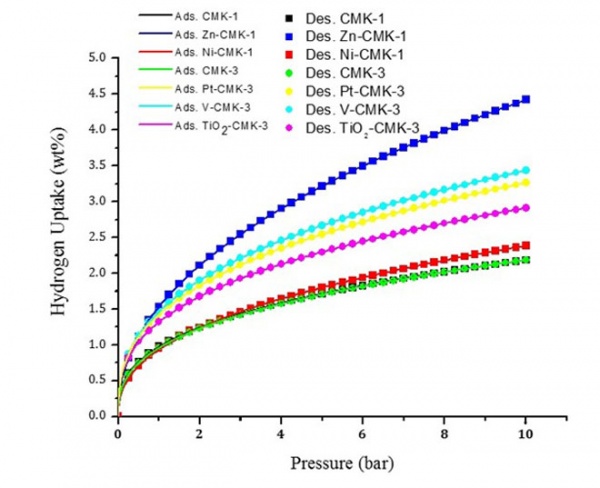
The aim of this work is to prepare CMK-1 modified with Zn and Ni in order to improve its capacity in hydrogen storage. The approach that we have followed includes synthesis of nanostructures with the experimental study of its adsorption capacity and storage properties. We have shown that CMK-1 ordered porous carbon modified with metals is a promising material for hydrogen storage. The incorporation of metals was performed by wetness impregnation. The samples were characterized by X-ray diffraction, Fourier transform infrared spectroscopy, scanning electron microscope, transmission electron microscopy, X-ray photoelectron spectroscopy, and Brunauer–Emmett–Teller methods. The CMK-1 modified with Zn showed the highest H2 uptake at 77 K and at low and high pressure (1.5 and 4.4 wt.% at 1 and 10 bar, respectively). The introduction of Ni into CMK-1 does not increase hydrogen storage capacity at low pressure. However, at a higher pressure (10 bars), Ni-CMK-1 displays improved results in hydrogen uptake compared with those of CMK-1 pristine, 2.4 and 2.1 wt.%, respectively. Copyright © 2015 John Wiley & Sons, Ltd.
Copyright © 2015 John Wiley & Sons, Ltd.
Go To International Journal of Energy Research


About the author
Dra. Juliana M. Juárez was born in Córdoba, Argentina, in 1980. She had received the B.E. and Ph.D. degrees in Chemical Engineering from Universidad Tecnológica Nacional, Facultad Regional Córdoba, Argentina, in 2005 and 2015, respectively.
In the research career, he became doctoral fellow, postdoctoral fellow, assistant researcher of the Consejo Nacional de Investigaciones Científicas y Técnicas (CONICET), Argentina as a member of Centro de Investigación en Nanociencia y Nanotecnología (NANOTEC), Facultad Regional Córdoba, Universidad Tecnológica Nacional – FRC. His current research interests include hydrogen storage on nanoporous materials, conducting polymers and drug controlled release systems.

About the author
Dr. Marcos Bruno Gómez Costa was born in Córdoba, Argentina, in 1977. He received the B.E. and Ph.D. degrees in chemical engineering from Universidad Tecnológica Nacional, Córdoba, Argentina, in 2002 and 2007, respectively.
Since 2000, he has been with the Department of chemical engineering, National Technological University Córdoba, where he was an Assistant, Teaching Assistant and became an Adjunct Professor in 2008. In the research career, he became doctoral fellow, postdoctoral fellow, assistant researcher and now an adjunct researcher of the Consejo Nacional de Investigaciones Científicas y Técnicas (CONICET), Argentina. Dr. Gómez Costa is a member of Centro de Investigación en Nanociencia y Nanotecnología (NANOTEC), Facultad Regional Córdoba, Universidad Tecnológica Nacional – FRC. His current research interests include hydrogen storage on nanoporous materials, conducting polymers and drug controlled release systems.

About the author
Oscar A. Anunziata.
He has a Doctorate in Chemistry from National University of Cordoba (1987). He is a Main Researcher of the National Scientific and Technical Research Council – Argentina. He is the postgraduate’s Director and Professor of Doctoral Career in Engineering (System, Materials, Chemistry and Electronic) of Technological University of Cordoba, Argentine. Referee of more than 30 International Journals. Is a specialist in Catalysis and Materials Science and Technology and Reaction Kinetics. He is Chief of the Nanoscience and Nanotechnology Center (NANOTEC) of Technological University of Cordoba, Argentine. He has specialized in inorganic synthesis of zeolites, and nanomaterials and development of new materials, and to correlate activity and properties effect. The research activities aim at the understanding of different process on a meso- and microscopic porous materials at nanometric levels, and at using this knowledge for materials design and preparation and for process development. His responsibilities include new tailored product developed by new synthesis procedures and post synthesis treatment, catalytic materials, hosts materials, H2 up-take, drug delivery nanomaterials, semiconductors and chemical sensors, characterization and testing the system with probe molecules. It has more than 100 scientific publications, 10 book chapters, and has authored more than 350 national and international conferences and proceedings.
 Advances in Engineering Advances in Engineering features breaking research judged by Advances in Engineering advisory team to be of key importance in the Engineering field. Papers are selected from over 10,000 published each week from most peer reviewed journals.