 Advances in Engineering Advances in Engineering features breaking research judged by Advances in Engineering advisory team to be of key importance in the Engineering field. Papers are selected from over 10,000 published each week from most peer reviewed journals.

Significance
Human locomotion is a remarkably complex and finely tuned biomechanical process, in which the ankle joint plays a disproportionately influential role. Although relatively small, this joint facilitates critical transitions throughout the gait cycle—stabilizing the leg during initial contact, supporting body weight during stance, and enabling push-off and toe clearance during swing. Its contributions are both mechanical and energetic, with dynamic changes in dorsiflexion and plantarflexion angles helping to coordinate multi-joint movement and manage ground reaction forces. Despite this centrality, surprisingly little is known about how subtle or isolated limitations in ankle range of motion (RoM) influence overall gait in individuals without pathology. In clinical and rehabilitation settings, ankle mobility is often restricted—intentionally or otherwise—through devices like orthoses, prosthetics, or post-surgical immobilization. For example, treatments such as ankle arthrodesis effectively fuse the joint, eliminating movement to reduce pain or instability. Similarly, assistive exoskeletons and braces limit motion as a trade-off for added torque support or protection from injury. Yet in most of these contexts, the reduction in ankle RoM is entangled with other confounding variables: weight of the device, presence of motorized assistance, concurrent neuromuscular deficits, or the asymmetrical effects of trauma and surgical intervention. This makes it extraordinarily difficult to isolate the specific biomechanical consequences of RoM restriction from the larger clinical picture. The core challenge, then, lies in understanding how the human body adapts—or chooses not to adapt—when ankle mobility is mechanically constrained in an otherwise healthy system. Can people maintain coordinated, symmetric gait when only 10–15 degrees of motion are available at the ankle? Will they unconsciously adjust step length, joint timing, or muscle activation to avoid bumping into mechanical end-stops? Or is the human neuromuscular system so robust that walking patterns remain largely unchanged despite such constraints?
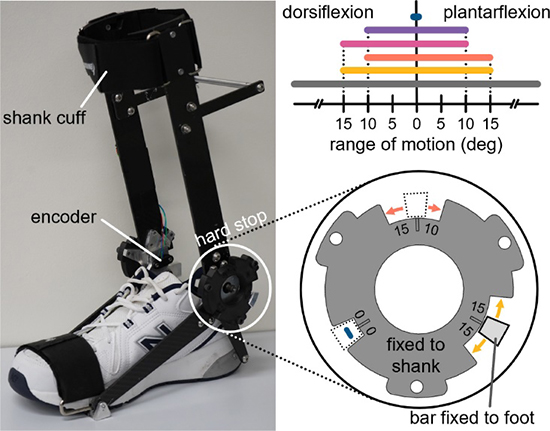
New research paper published in Journal of Biomechanics and conducted by PhdD student Michael Rose, Will Flanagan, Brandon Peterson, Paige Steffler, Brandon Tran, Lisa Su, Professor Rachel Gehlhar Humann, and Professor Tyler Clites from the University of California, Los Angeles, researchers removed the noise and complexity from prior investigations by creating a simplified, low-mass exoskeleton that could selectively limit ankle motion without adding propulsion or affecting joints upstream. By focusing on young, able-bodied participants, they intentionally avoided the confounds of weakness, compensation, or neurological impairment. Their goal was to uncover what truly happens when ankle mobility is restricted in isolation—whether the body passively tolerates the limits, adapts through subtle gait adjustments, or begins to offload effort to other joints entirely.
The team innovation focused on minimizing weight, avoiding any propulsion assistance, and ensuring that only the sagittal range of motion was affected. This setup allowed them to focus entirely on the ankle’s mechanical limits and observe how otherwise healthy, young adults adapted when these limits were imposed during treadmill walking. Each participant, walking with the exoskeleton on their right leg, completed trials under various conditions that ranged from full freedom of movement to total fusion (±0°), as well as intermediate constraints like ±15°, ±10°, and asymmetrical ranges such as +15°/−10°. What emerged from these trials was somewhat unexpected. Participants, even when facing significant movement restrictions, did not meaningfully alter their gait to avoid the mechanical stops. Despite frequent contact with these hard limits—especially at the most restricted settings—their overall movement patterns remained surprisingly stable. The gait did not fall apart, nor did participants show the kind of compensatory strategies often seen in clinical populations. This was particularly evident in the joint kinematics: while local asymmetries at the ankle did increase with more severe limitations, there were no substantial global differences across the gait cycle, except in the simulated fusion case. Even then, the asymmetry was largely localized, without major repercussions in hip or knee movement. From a muscle activation standpoint, the data told a more nuanced story. Electromyography recordings revealed that the soleus—a key plantarflexor involved in push-off—was notably less active when ankle range was tightly constrained. Interestingly, the reduction in soleus engagement correlated strongly with the duration of contact at the dorsiflexion limit, suggesting that participants were not resisting the stop but instead allowing the ankle to rest passively against it. This had mechanical consequences too: the ankle performed less positive work in these conditions, though this drop wasn’t matched by a compensatory increase at other joints unless motion was nearly eliminated altogether.
In conclusion, the new study by Professor Tyler Clites and colleagues is important to both clinical and engineering spheres because it challenges a long-standing assumption—that limiting ankle range of motion inevitably disrupts natural walking mechanics. By focusing on healthy individuals and isolating mechanical constraint from other confounding factors, the researchers offer clear, empirical evidence that the body is more tolerant of ankle restriction than previously thought. Even with reductions down to ±10°, gait symmetry and joint coordination were largely preserved. This reveals a remarkable flexibility in the neuromuscular system, which seems capable of accommodating mechanical boundaries without resorting to broad compensations or maladaptive patterns—unless motion is completely eliminated. One of the most important takeaways is that not all ankle movement is equally essential. The findings suggest that retaining just a modest amount of dorsiflexion may be sufficient for most steady-state, level-ground walking. This nuance matters in clinical decision-making. Surgeons and rehabilitation specialists often must weigh the trade-offs between mobility, stability, and pain reduction. For patients considering procedures like ankle arthrodesis, or for those who require bracing due to neuromuscular conditions, these results indicate that partial restriction could still permit near-normal gait function—possibly without demanding major compensatory effort elsewhere in the leg. From an engineering standpoint, the implications are equally compelling. Designers of passive or semi-active exoskeletons, orthotic devices, or even prosthetic ankles might not need to replicate the full 70° of physiological RoM. Instead, they could prioritize other features—like lightweight construction, durability, or targeted torque support—while still maintaining enough mobility to preserve functional gait. This insight opens the door to simpler, more accessible assistive devices that avoid the mechanical complexity of full-range actuators, especially in applications where level-ground ambulation is the primary goal.


Reference
Michael J. Rose, Will Flanagan, Brandon T. Peterson, Paige K. Steffler, Brandon T. Tran, Lisa Su, Rachel Gehlhar Humann, Tyler R. Clites, The Impact of ankle range of motion on lower-limb gait biomechanics, Journal of Biomechanics, Volume 189, 2025, 112811,