Advances in Engineering Advances in Engineering features breaking research judged by Advances in Engineering advisory team to be of key importance in the Engineering field. Papers are selected from over 10,000 published each week from most peer reviewed journals.

Significance Statement
Thin-walled tube is one of the most commonly used energy absorber. It can dissipate impact energy through different deformation modes via axial or lateral conditions. In case of a perfect tube, oscillation of crushing force and erratic buckling mode is natural. In axial impact event, critical buckling force is much higher than the average one while it has a decreasing trend due to strain rate effect. Buckling mode is seen to be sensitive to diameter-thickness ratio.
Theoretical analyses made to mean crushing force as initial imperfections such as local dents, holes, grooves, ribs and pre-buckle on tube are commonly used to regulate collapse process has shown good agreement with experimental results.
Dr. Yanpeng Wei and colleagues at the Institute of Mechanics – Chinese Academy of Sciences studied the progressive behavior of a gradient grooved tube GGT designed for high temperature gas cooled reaction HTR with its influence on several non-dimensional controllable geometric parameters studied by systematic numerical simulations and experiments. The study appeared in International Journal of Mechanical Sciences
For theoretical analysis, the crushing process is proactively regulated by a series of grooves presetting along the stainless steel tube. A theoretical crushing model for gradient grooved tube under axial loading is used to predict the quadratic upward trend of its crushing force.
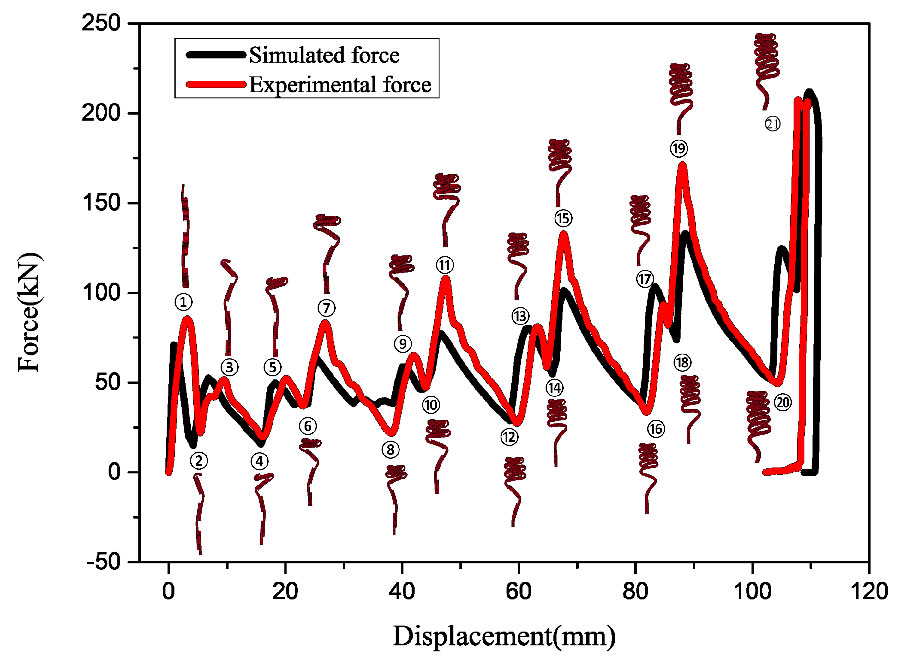
Results showed that all plastic hinges are strictly limited to the preset grooves to form five complete concertina folds in accordance with experimental results. Eccentric factor mf is about 0.6 which is consistent with experimental results. There was also good agreement between 2D DIC and numerical results of displacement-time and velocity-time curves in initial and post-buckling stage. Force-displacement curves for both pressure sensor and numerical model showed good consistency. A complete validation was also achieved by the numerical model as it predicted buckling modes, crushing displacement, velocity and crushing force well.
For regulation of buckling modes, non-dimensional width is equal to π/2 based on Alexander’s model adopted. Numerical evaluation also suggested π/2 as a reasonable value for the non-dimensional width of gradient grooves in all cases. The numerical results of local buckling behavior of grooves at different groove depth showed that groove regions bends smoothly to form a perfect plastic hinge at initial groove depth of value less than or equal to 0.6. A value of 0.6 was hereby set as the initial groove depth in all gradient grooved tube configurations while controllable non-dimensional half wavelength was determined as 0.7-1.2 for this type of gradient grooved tube.
The force-displacement curve of gradient grooved tube at the same experimental results showed an upward trend with slight oscillations integrally which enhances buckling stability impacted by the slender control rod.
The force-displacement curves for theoretical results could also predict the trend even though exact values are lower than the experimental and numerical results which may be due to strain hardening and strain rate hardening consideration. The upward trend influencing by non-dimensional half wavelength of theoretical curves fits well with the numerical section force-displacement curves which provides further evidence for controllability of the gradient grooved tube.
Theoretical analysis of sectionalized force-displacement curves between three terms of quadratic crushing force and half wavelength showed that the quadratic term is mainly derived from plastic bending in local gradient grooves which can also be suppressed with bigger half wavelength.
A primary term is mainly derived from stretching and compressing of the grooves showing insensitivity to the half wavelength while the constant term of crushing force is mainly derived from stretching and compressing of rings between the grooves having a positive correlation with half wavelength.
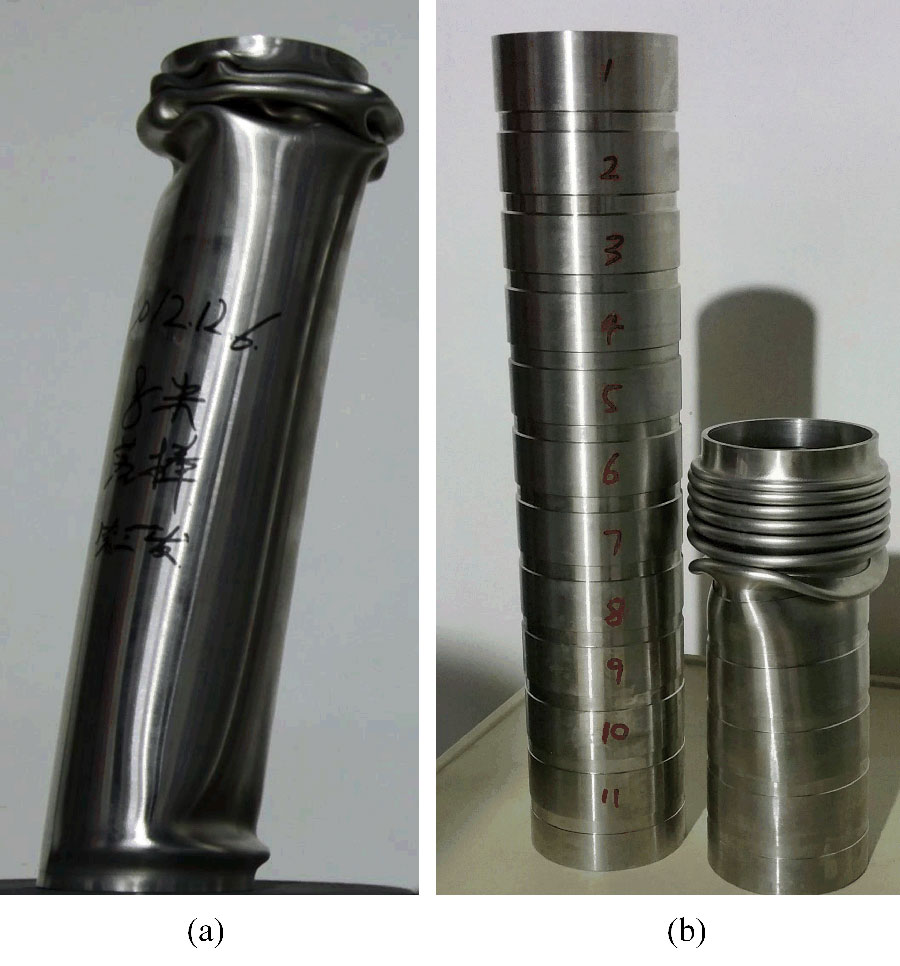
Freefall impact experiments showed that the gradient grooved tube exhibited better stability with standard concertina folds and consistent buckling sequences with no lateral offset when compared with perfect tube in high temperature gas cooled reaction applications from slender control rods.
The findings of this study have proven that gradient grooved tube can be used as a good energy absorber which protects the graphite in high temperature gas cooled reaction from the slender control rod.
Journal Reference
Yanpeng Wei1, Zhe Yang1, He Yan2, Yacong Guo1, Xianqian Wu1, Chenguang Huang1. Proactive Regulation of Axial Crushing Behavior of Thin-Walled Circular Tube by Gradient Grooves. International Journal of Mechanical Sciences, Volumes 108–109, 2016, Pages 49–60.
[expand title=”Show Affiliations”]- Key Laboratory for Mechanics in Fluid Solid Coupling Systems, Institute of Mechanics, Chinese Academy of Sciences, Beijing 100190, China.
- Institute of Nuclear and New Energy Technology of Tsinghua University, Collaborative Innovation Center for Advanced Nuclear Energy Technology, Beijing 100084, China.
Go To International Journal of Mechanical Sciences